The term “ponytail facelift” appears increasingly in online searches and cosmetic surgery discussions, but it does not describe one universally standardised operation. Different surgeons may use the term for procedures involving different incision patterns, tissue planes and areas of the face, so the operative details are more important than the name itself.
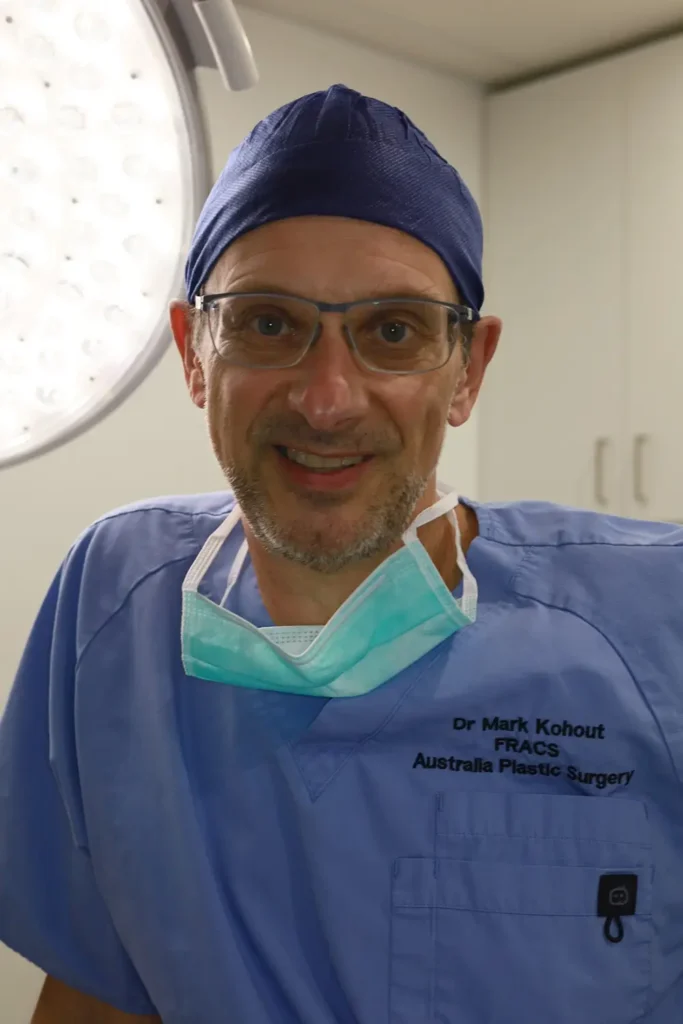
Dr Mark Kohout is a Specialist Plastic Surgeon practising in Sydney with more than 25 years of clinical experience. His current facial surgery information includes ponytail lift and other facelift options, and consultation is used to determine which approach may be appropriate for an individual patient’s anatomy, medical history and priorities.
What Does the Term Ponytail Facelift Usually Mean?
A ponytail facelift generally refers to a facial lifting approach using incisions positioned largely within or close to the temporal hair-bearing scalp. The procedure may address selected tissues of the temple, outer brow, cheek and mid-face, although the exact technique varies between surgeons.
The name comes from the upward effect that can occur around the temples and cheeks when hair is pulled into a high ponytail. Published surgical techniques using this terminology include endoscopic deep-plane approaches, but the label itself should not be assumed to describe an identical operation in every practice.
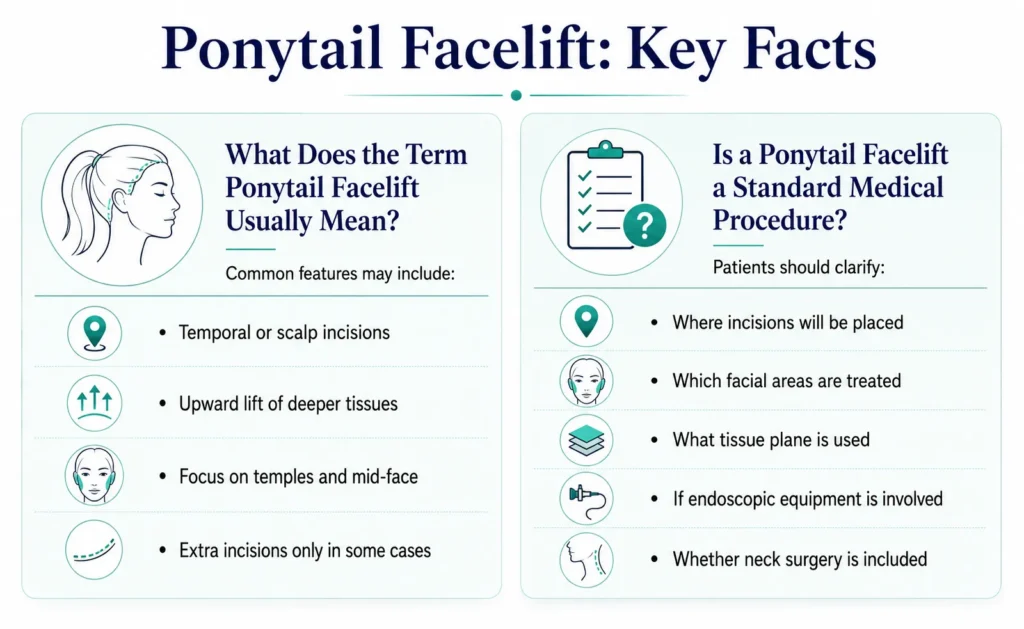
Common characteristics may include:
- Temporal or scalp-based incisions
- Upward repositioning of deeper facial tissues
- Attention to the temple and mid-face
- Limited additional incisions in selected cases
Is a Ponytail Facelift a Standard Medical Procedure?
Ponytail facelift is not a single standardised medical procedure with one universally accepted operative definition. The same phrase may refer to different combinations of endoscopic, deep-plane, SMAS-based or limited-incision techniques.
One published technique specifically called the “Ponytail Lift” was described in a retrospective series of 600 procedures performed by a single surgeon over 22 years. That publication provides evidence for one defined surgical method, but it should not be assumed that every surgeon using the term performs the same operation.
Patients should clarify:
- Where the incisions will be placed
- Which facial areas will be treated
- Which tissue plane will be used
- Whether endoscopic equipment is involved
- Whether neck surgery is included
Does Dr Mark Kohout Offer a Ponytail Lift in Sydney?
Dr Mark Kohout’s current facial surgery pricing information specifically lists a ponytail lift among the procedures available through his practice. The precise technique proposed for an individual patient still requires consultation and should not be inferred from the procedure name alone.
His broader facelift information describes surgery that addresses deeper facial support structures as well as skin, with operative planning based on the facial and neck changes being assessed. Patients considering a ponytail-style approach can therefore discuss what Dr Kohout means by the term in their particular case.
A consultation can clarify:
- The intended surgical approach
- Areas expected to be addressed
- Incision placement
- Whether another facelift technique is more appropriate
Which Facial Structures Can Be Involved?
Facelift surgery can involve the skin as well as deeper supporting structures such as the superficial musculoaponeurotic system, commonly called the SMAS. Some temporal and mid-face techniques also involve releasing or repositioning tissues attached by facial retaining ligaments.
The SMAS is a fibromuscular layer connected with the muscles of facial expression and deeper support structures. Published temporal and ponytail-style techniques differ in exactly how this layer and adjoining tissues are approached, so patients should ask which anatomical layers are being treated rather than relying on a branded name.
Structures that may be considered include:
- Temporal soft tissues
- SMAS
- Retaining ligaments
- Cheek tissues
- Skin and subcutaneous fat
Which Areas of the Face Can a Ponytail-Style Approach Address?
Ponytail-style procedures commonly focus on the temples, lateral brow and mid-face rather than concentrating primarily on the neck. Some techniques also address portions of the lower face, depending on the operation being performed.
The extent should be matched to the areas being assessed. A person whose main concerns relate to pronounced neck laxity or lower-face tissue descent may require an approach providing more direct access to those regions.
Areas discussed may include:
- Temples
- Outer brow
- Upper cheek
- Mid-face
- Selected lower-face tissues
Where Are Ponytail Facelift Incisions Usually Placed?
Incisions are commonly positioned within or close to the temporal hair-bearing scalp, although additional incisions may be required depending on the surgical plan. Every incision creates a permanent scar whose final visibility varies between patients.
Published temporal endoscopic techniques describe access through the scalp rather than a conventional long preauricular incision, while other ponytail-style procedures may incorporate additional scalp or ear-region access. Hair density, hairline position, skin characteristics and previous surgery all influence incision planning.
Planning may consider:
- Hairline height and shape
- Hair density
- Previous facial scars
- Required surgical access
- Tendency to form prominent scars
How Does a Ponytail Facelift Differ From a Conventional Facelift?
A ponytail-style procedure generally uses a different access pattern and may place greater emphasis on the temporal and mid-face regions. A conventional facelift commonly provides broader access to the lower face and may be combined with direct treatment of the neck.
Dr Mark Kohout’s facelift information describes rhytidectomy as surgery addressing age-related changes involving the mid-face, lower face and neck. The appropriate operation therefore depends on where tissue changes are located rather than on selecting the procedure with the shortest or most appealing name.
Important differences may involve:
- Incision length and position
- Areas treated
- Tissue planes accessed
- Amount of skin adjustment
- Whether neck surgery is required
How Does a Ponytail Facelift Compare With a Deep-Plane Facelift?
The terms are not interchangeable because “deep plane” describes a surgical tissue plane, while “ponytail facelift” is a procedure label. Some published ponytail techniques use a deep-plane approach, but other operations carrying the ponytail name may use different methods.
The 2024 published series by Kao and Duscher describes an endoscopic deep-plane technique under the Ponytail Lift terminology. That evidence relates to the authors’ defined operation and should not automatically be applied to every surgeon using a similar name.
Patients should ask:
- Is the procedure endoscopic?
- Is a deep-plane dissection performed?
- Is the SMAS treated differently?
- Which retaining ligaments are released?
Who Might Be Assessed for a Ponytail Facelift?
Suitability depends on facial anatomy, tissue position, general health and the areas a patient wants assessed. The procedure name alone cannot determine whether it is an appropriate surgical option.
Dr Mark Kohout’s current facelift information emphasises individual facial assessment when selecting an operative approach. A different facelift, brow procedure, eyelid operation or no surgery may be discussed when another approach better matches the anatomy.
Assessment may consider:
- Temporal and brow position
- Mid-face tissue position
- Jawline and neck changes
- Skin and soft-tissue characteristics
- Previous facial surgery
When Might Another Facelift Approach Be More Appropriate?
Another facelift technique may be considered when the principal changes involve the lower face, jawline or neck rather than predominantly the temple and mid-face. Broader access may be required when several facial and neck regions need to be addressed together.
No named operation is appropriate for every pattern of facial change. Examination of the entire face and neck helps determine whether a ponytail-style procedure provides suitable access or whether another operative plan should be considered.
Another approach may be discussed for:
- More extensive lower-face changes
- Neck skin laxity
- Platysma bands
- Previous facelift surgery
- Several facial regions requiring treatment
What Happens During a Ponytail Facelift?
The operation generally involves planned scalp or temporal incisions followed by surgical access to deeper tissues that are repositioned and secured. The exact sequence depends on the surgeon’s chosen technique and any additional procedures being performed.
Published ponytail and temporal endoscopic methods include tissue-plane dissection, ligament release and internal fixation, but these details should not be attributed automatically to Dr Mark Kohout’s operation without an individual surgical plan. His current website confirms availability of a ponytail lift but does not publicly define every technical step.
A surgical plan may specify:
- Incision locations
- Tissue planes approached
- Direction of tissue repositioning
- Fixation method
- Additional facial procedures
What Is Recovery Like After a Ponytail Facelift?
Recovery commonly involves swelling, bruising, tightness and temporary changes in sensation around the operated areas. The duration and severity vary according to surgical extent and individual healing.
Dr Mark Kohout’s facial surgery recovery information advises patients to follow individual wound, activity and postoperative instructions rather than relying on one universal recovery schedule. Healing continues after the most visible swelling has reduced.
Early recovery may involve:
- Facial or temporal swelling
- Bruising
- Scalp tightness
- Altered sensation
- Temporary activity restrictions
How Do Ponytail Facelift Scars Change?
Facelift scars are permanent but commonly change in colour, firmness and texture as they mature. Hairline scars can remain noticeable in certain lighting or hairstyles even after substantial healing has occurred.
Scar behaviour depends partly on genetics, incision tension, wound healing, hair density and ultraviolet exposure. Patients should understand the likely incision locations before surgery so scar placement can form part of their decision.
Scar care may involve:
- Wound care during early healing
- Sun protection after the skin closes
- Silicone products when advised
- Review of persistent redness or thickening
What Risks Should Be Considered?
Ponytail facelift surgery carries the general risks of surgery as well as risks specific to operating around facial nerves, scalp tissues and the hairline. Complications can be temporary or persistent and may occasionally require further treatment.
Published endoscopic and facelift literature describes complications including altered sensation, temporary nerve dysfunction, infection, scarring and revision surgery. A surgeon’s own consent discussion should explain the risks relevant to the proposed operation rather than relying on the results of one published series.
Potential risks can include:
- Bleeding or haematoma
- Infection or delayed wound healing
- Altered sensation
- Facial nerve weakness
- Hair loss or hairline change
Can Other Procedures Be Performed at the Same Time?
Additional facial procedures may sometimes be performed during the same operation when clinically appropriate. Combining procedures increases the operative plan and may alter risks, anaesthetic requirements and recovery.
Possible combinations depend on the areas being assessed and should not be assumed to be necessary. Dr Mark Kohout’s current facial surgery information includes facelift, neck, brow and eyelid procedures that can be discussed individually during consultation.
Discussion may include:
- Eyelid surgery
- Brow surgery
- Neck surgery
- Fat grafting
- Other facial procedures where appropriate
What Happens During a Consultation With Dr Mark Kohout?
Consultation involves assessment of facial anatomy, medical history, previous procedures and the areas the patient wants to discuss. It also provides an opportunity to determine what a ponytail lift would specifically mean in that patient’s surgical plan.
Dr Kohout’s current website advises face-to-face consultation when facelift surgery is being considered. This is particularly important with loosely used labels such as ponytail facelift because incision patterns and anatomical techniques cannot be determined from the name alone.
Consultation may cover:
- Medical and surgical history
- Examination of the face and neck
- Likely incision placement
- Risks and limitations
- Recovery requirements
Ponytail Facelift FAQs
Can a ponytail facelift change where my hairline sits or how I wear my hair?
Yes, hairline incisions can slightly adjust the position of the temporal hairline, and scars may be more visible with certain hairstyles, especially if hair is fine or very light. During consultation, the surgeon will discuss how you usually wear your hair and plan incisions with that in mind as much as possible.
Is a ponytail facelift only suitable for women who actually wear ponytails?
No, the term comes from the direction of lift rather than a requirement to wear a ponytail, and the technique can be considered for men and women. Suitability depends on facial anatomy, skin quality and pattern of ageing, not on hairstyle.
Will people immediately know I have had a ponytail facelift if I see them soon after surgery?
In the early recovery period there will usually be swelling, bruising and changes that can be visible, so most patients plan some time away from social or work activities. Over the following weeks, as healing progresses, changes tend to be less obvious, but visibility varies from person to person.
Does a ponytail facelift affect how my glasses or sunglasses sit on my face?
Most of the work is focused on the temple and mid face tissues rather than the nose or ears, so glasses generally sit in the same place once healing has progressed. In the early phase, some patients prefer lighter frames or limited wear while swelling and tenderness settle.
Can I colour or chemically treat my hair after a ponytail facelift?
Hair colouring and chemical treatments usually need to be postponed until incisions have healed and the scalp is less sensitive, as advised by the surgeon. Once the initial healing period has passed, many patients return to their usual hair routines, taking care to avoid direct irritation over the scar lines at first.
Is it possible to combine a ponytail facelift with fat transfer to the face?
In some cases, surgeons may discuss combining a ponytail-style facelift with fat transfer to areas where volume has reduced, such as the cheeks or temples. Whether this is appropriate depends on individual anatomy, goals and overall safety considerations, and is decided during detailed consultation and planning.
Does a ponytail facelift change my ability to move my forehead or eyebrows?
Temporary changes in movement or sensation can occur after any facelift, particularly when working near the brow and temple region. In many patients, movement normalises as healing progresses, but there is a small risk of longer-lasting change, which should be discussed before surgery.
Could I still need another facelift later if I have a ponytail facelift now?
Yes, the ageing process continues after any facelift, and some patients may consider additional procedures in the future if new concerns develop or existing ones progress. Others may feel that one operation provides enough change for their needs; this varies from person to person.
Is a ponytail facelift ever used as a revision procedure after a previous facelift?
In selected cases, a surgeon may consider a ponytail-style approach to address specific areas that remain or have changed after an earlier facelift, but revision surgery is usually more complex. The risks, benefits and scar patterns are discussed carefully, as previous surgery can affect tissue behaviour and planning.
Can I travel by plane soon after a ponytail facelift?
Short flights may be possible after the early recovery period if the surgeon is comfortable with healing progress, but longer trips or travel immediately after surgery are usually discouraged. It is important to be close enough to the treating team for follow-up and prompt review if concerns arise in the early phase.
Medical References

- Haffner T. The temporal endoscopic midface lift: centrofacial rejuvenation without facial scars. – Plastic and Aesthetic Research – https://www.oaepublish.com/articles/2347-9264.2016.63
- Kao CC, Duscher D. The Ponytail Lift: 22 Years of Experience in 600 Cases of Endoscopic Deep Plane Facial Rejuvenation. – Aesthetic Surgery Journal – https://academic.oup.com/asj/article/44/7/671/7502919
- Shtraks JP, Fundakowski C, Yu D, et al. Investigation of the Longevity of the Endoscopic Midface Lift. – JAMA Facial Plastic Surgery – https://pmc.ncbi.nlm.nih.gov/articles/PMC6802057/
Take our Plastic Surgery Quiz to find out if you’d be a good candidate and if you are ready for cosmetic surgery.
What Should Sydney Patients Consider Before Surgery?
Sydney patients should consider surgeon qualifications, accredited surgical facilities, postoperative support and the practical implications of scar exposure to ultraviolet radiation. Choosing an operation should be based on clinical assessment rather than social-media terminology.
Dr Mark Kohout is listed on his current website as a Specialist Plastic Surgeon with more than 25 years of clinical experience. Patients can also independently check practitioner registration and seek another appropriately qualified opinion before making a decision.
Practical considerations include:
- Practitioner registration and qualifications
- Where surgery will be performed
- Arrangements for postoperative review
- Scar and sun protection
- Access to care if concerns arise
What Are the Next Steps for Someone Considering a Ponytail Facelift?
The next step is an individual consultation to determine whether a ponytail lift or another facial surgery approach fits the anatomy and areas being assessed. The consultation should establish exactly what procedure is proposed rather than relying on the ponytail terminology alone.
Dr Mark Kohout’s current Sydney facial surgery information includes ponytail lift and broader facelift options. Patients should use the consultation and required cooling-off period to review the proposed incisions, risks, recovery, alternatives and expected limitations before deciding whether to proceed.
Further Reading
- Read more about Facelift Surgery Sydney Procedure
- Read more about Different Techniques for SMAS Facelift
- Read more about Recovery After Facelift Surgery
- Read Dr Mark Kohout’s Blog on Managing Swelling and Bruising after Facelift
- Read Dr Mark Kohout’s Blog on Cost of a Facelift in Sydney
Related Blog Posts
Managing Swelling and Bruising after Facelift
Dr Mark Kohout is a Specialist Plastic Surgeon based in Sydney, with specialist registration in Surgery – Plastic Surgery, more than 25 years of experience in cosmetic and reconstructive procedures,…
Recovery After Facelift Surgery In Sydney
Facelift surgery, or rhytidectomy, is a procedure that addresses visible changes in the mid to lower face and the neck that develop gradually over time. For individuals considering this procedure,…
Different Techniques for SMAS Facelift
SMAS in Facelift Surgery: Insights from Dr Mark Kohout A facelift is a widely performed procedure aimed at addressing the face and neck areas. In this blog, Sydney Plastic Surgeon Dr Mark Kohout will…
Experienced Plastic Surgeon
Dr. Mark Kohout
A qualified plastic surgeon who operates with care and integrity, based in central Sydney with over 25 years of experience in the cosmetic field. His extensive training and experience assures patients they are in well trained surgical hands. Dr. Kohout is a dedicated, friendly professional who is committed to providing the high quality care, support and results, alongside his compassionate team.
Dr Mark Kohout (MED0001133000)
Specialist Plastic Surgeon
Specialist registration in Surgery – Plastic Surgery