
Dr Mark Kohout

Return To Exercise After Fat Transfer To Breasts

doctor working
Home » Blog » Return To Exercise After Fat Transfer To Breasts
Return To Exercise After Fat Transfer To Breasts by Dr Mark Kohout

Table of Contents

Return To Exercise After Fat Transfer To Breasts by Dr Mark Kohout

Fat transfer to breasts, also known as autologous fat grafting, involves the use of your own fat – most often taken from the abdomen, thighs, or hips – to adjust breast volume and reshape breast contour. This process provides a soft, natural feel because it uses living tissue from your own body.


Dr Mark Kohout, Specialist Plastic Surgeon in Sydney, offers personalised surgical care and detailed post-operative guidance to help patients navigate each stage of recovery. A carefully structured return to exercise is an important aspect of this process, supporting optimal healing, the survival of transferred fat cells, and comfort during the recovery period.

Download Dr Mark Kohout’s Breast Augmentation Surgery Guide

Understanding Fat Transfer To Breasts​

During fat transfer surgery, liposuction is performed to remove fat from selected donor sites. The harvested fat is then purified to remove any fluids, oils, and non-viable cells, leaving only healthy, intact fat cells ready for placement into the breasts. These cells are carefully injected in small amounts and at multiple levels to ensure they receive an adequate blood supply. Since fat cells are delicate and require time to integrate into the surrounding breast tissue, it is vital to limit movement, avoid pressure, and protect the area in the early weeks. This integration period is when the long-term results are most influenced.

Return To Exercise After Fat Transfer To Breasts by Dr Mark Kohout

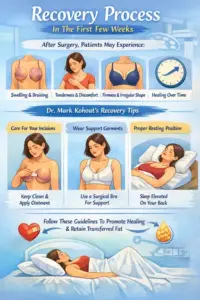
Recovery Process In The First Few Weeks​

Immediately following surgery, patients often experience swelling, bruising, and tenderness in both the donor areas and the breasts. Temporary firmness or irregularities in breast shape may also occur as swelling changes over time. During this stage, Dr Mark Kohout provides clear guidance on how to care for incisions, use support garments effectively, and position yourself when resting or sleeping to reduce pressure on the breasts.

By following these recommendations, patients can promote healing and support the retention of transferred fat.

Typical Timeline For Returning To Exercise​

In the first week, movement should be limited to slow walking around the home to maintain circulation and reduce the risk of blood clots. Lifting, pushing, pulling, or engaging in activities that activate the upper body should be avoided to prevent disrupting the graft. In the second and third weeks, light lower-body exercises such as gentle stretching or slow cycling may be introduced if approved by the surgeon, but anything that involves bouncing or movement of the chest should still be avoided.


Weeks four and five allow for a gradual reintroduction of light upper-body activities, starting with very low resistance to avoid strain on healing tissues. Only in the sixth week and beyond, after assessment at a follow-up appointment, should patients consider returning to their usual exercise routines, with an emphasis on gradually increasing intensity.

Donor Site Considerations​

The recovery of donor areas following liposuction is an important factor in the overall exercise timeline. Wearing a compression garment as directed helps control swelling and supports skin retraction. It is also advisable to avoid targeted exercise that heavily involves these areas in the early recovery stage. As healing progresses and swelling decreases, patients may gradually increase the intensity of lower-body or core workouts under guidance.

Exercises To Approach With Caution​

Certain exercises require particular care due to their potential to impact the healing breasts or donor sites. High-impact cardio, such as running or skipping, can create unnecessary movement in the breast tissue, which may interfere with fat graft survival. Similarly, upper-body strength training that heavily engages the chest muscles, including bench presses, push-ups, and dips, can place direct pressure on the grafts. Contact sports should be avoided until full healing is achieved to reduce the risk of trauma to the breasts.

Supporting Recovery Through Nutrition And Hydration​

Nutrition plays a key role in tissue healing and recovery. Consuming an adequate amount of protein supports the repair of surgical tissues, while vitamins A and C contribute to collagen production and overall skin health. Zinc is essential for wound healing, and healthy fats provide the energy needed for recovery. Staying well-hydrated helps maintain circulation and may also aid in reducing swelling, which can contribute to overall comfort during the healing phase.

Listening To Your Body​

Every patient’s recovery experience is unique, so paying close attention to how your body responds to exercise is essential. If you notice any increase in swelling, discomfort, redness, or changes in breast texture after activity, it is advisable to rest and consult your surgeon. Regular follow-up appointments with Dr Mark Kohout provide an opportunity to assess healing, review activity levels, and adjust recommendations accordingly.

Local Considerations For Sydney Patients​

Patients in Sydney should be mindful of the local climate, particularly during warmer months. Exercising outdoors in high temperatures can increase swelling and discomfort during the early stages of recovery. Indoor, air-conditioned environments or shaded walking paths may be preferable for gentle movement. Sydney’s many parks and coastal pathways can be enjoyed later in recovery when your surgeon confirms it is safe to increase your activity.

Long-Term Fitness After Fat Transfer To Breasts​

Once healing is complete, patients can resume a varied exercise program that includes cardiovascular activities, strength training, and flexibility exercises. Maintaining a stable body weight is beneficial for preserving the results of fat transfer, as significant weight fluctuations can influence breast volume. Incorporating exercise as part of a balanced lifestyle supports both general health and the longevity of surgical results.

FAQs About Returning To Exercise After Fat Transfer To Breasts​

What happens if I return to vigorous exercise too soon after surgery?

Engaging in strenuous activity before the fat cells have integrated may reduce the survival of the graft, increase swelling, and delay healing.

Can gentle yoga be resumed earlier than other activities?

Certain gentle yoga poses may be possible earlier in recovery, but any movements that stretch or compress the chest should be avoided until cleared by your surgeon.

How does weather in Sydney impact my recovery exercise routine?

Hot and humid conditions can increase swelling and discomfort. Indoor activity in a climate-controlled setting is often more comfortable during early recovery.

Will wearing a sports bra affect the fat graft?

A supportive, non-compressive bra is usually recommended to protect the graft. Avoid overly tight garments that may place pressure on the breasts in the first weeks.

Is swimming safe during recovery?

Swimming should be avoided until incisions are fully healed and your surgeon confirms it is safe, as pools and open water may carry a risk of infection.

Are there long-term exercise restrictions after recovery is complete?

In most cases, there are no permanent restrictions once healing is complete, though maintaining a stable weight is encouraged to preserve results.

How do I know if an exercise is causing harm to my results?

If you experience increased swelling, pain, or changes in breast texture during or after an activity, it is best to stop and seek your surgeon’s advice.

Medical References

Moving Forward Safely​

Returning to exercise after fat transfer to breasts requires patience, a gradual approach, and ongoing communication with your surgeon. Under the guidance of Dr Mark Kohout, patients can reintroduce activity in a way that supports healing and comfort while protecting the investment they have made in their procedure.


For tailored advice and recovery planning, arrange a consultation at Dr Mark Kohout’s Sydney clinic to discuss your individual needs and goals.

Further Reading


Related Blog Posts

Correcting The Waterfall Deformity With Breast Revision Surgery

Correcting The Waterfall Deformity With Breast…

Breast augmentation has been performed for many decades, and it continues to be one of the most requested forms of cosmetic surgery worldwide. For most patients, the results remain satisfactory…
Recovery After Breast Augmentation: Guidelines for Healing after Implants

Recovery After Breast Augmentation: Guidelines for…

Recovery after breast augmentation is a critical phase that can significantly affect the overall success of the procedure. A well-managed recovery process can support healing, reduce the risk of complications,…

Exercise Timeline after Breast Augmentation

Exercise Timeline after Breast Augmentation

A Guide to Resuming Exercise after Breast Augmentation If you’re considering breast augmentation (augmentation mammoplasty), understanding the exercise timeline after the procedure is important to encourage an uneventful smooth recovery. Sydney…

Experienced Plastic Surgeon

Dr. Mark Kohout

A qualified plastic surgeon who operates with care and integrity, based in central Sydney with over 20 years of experience in the cosmetic field. His extensive training and experience assures patients they are in highly trained surgical hands. Dr. Kohout is a dedicated, friendly professional who is committed to providing the high quality care, support and results, alongside his compassionate team.

Dr Mark Kohout (MED0001133000)
Specialist Plastic Surgeon
Specialist registration in Surgery – Plastic Surgery

This website contains imagery which is only suitable for audiences 18+. All surgery contains risks, read more here.

X

Get Your Breast Augmentation Guide

Get Your Facial Aesthetic

Get Your Breast Implant Removal

Get Your Female Genital Surgery Guide

Get Your Excess Skin Guide

Get Your Gynaecomastia Guide

Get Your Liposuction Guide

Get Your Abdominoplasty Guide

Get Your Cost of Surgery Guide

Get Your Breast Implant Replace Guide

Get Your Breast Reduction Guide

Make an Enquiry