



Many people considering thigh lift surgery are active at work, at home or through regular walking, gym training and recreational sport. A common concern is how the procedure may affect movement and when different types of exercise may be reintroduced.
Dr Mark Kohout is a Specialist Plastic Surgeon practising in Sydney with more than 25 years of clinical experience. He provides individual postoperative guidance based on the thigh lift technique, wound healing, swelling, general health and the physical demands of each patient’s usual activities.
How Does Thigh Lift Surgery Affect Movement?
Thigh lift surgery removes excess skin and adjusts soft tissues in an area involved in walking, sitting and standing. Movement must be modified during recovery because the incisions and deeper tissues are exposed to tension with many everyday activities.
The operation may involve an incision in the groin crease, a longer vertical incision along the inner thigh or an incision focused on the outer thigh and hip. Liposuction may also be included in selected procedures, which can add swelling and tenderness to the early recovery period.
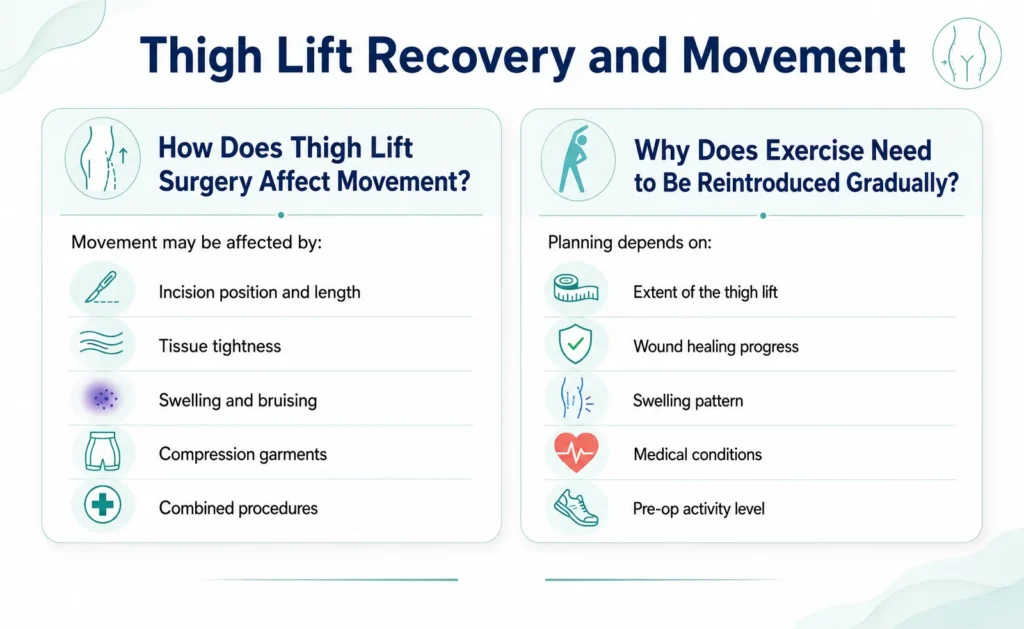
Movement may be affected by:
- The position and length of the incisions
- Tightness across the operated tissues
- Swelling and bruising
- Compression garments
- Procedures performed at the same time
Why Does Exercise Need to Be Reintroduced Gradually?
Exercise needs to return in stages because the skin may appear closed before the deeper tissues have regained sufficient strength. Heavy loading, impact or wide movements introduced too early may place unnecessary tension on the wounds.
Movement remains important because prolonged inactivity can contribute to stiffness, loss of conditioning and blood-clot risk. The aim is therefore to balance regular mobility with protection of the operated tissues.
Planning depends on:
- The extent of the thigh lift
- How the wounds are healing
- The pattern of swelling
- Medical conditions affecting recovery
- Preoperative activity levels
What Movement Is Usually Encouraged During the First Two Weeks?
The first two weeks generally focus on short walks, wound care, rest and essential daily movement rather than formal exercise. Walking is usually performed in brief, regular periods within the limits provided by the surgical team.
Patients may initially walk only around the home and may require another person or a stable support nearby. Stairs, prolonged standing and unnecessary trips outside the home may need to be limited while balance, comfort and mobility improve.
Early movement may include:
- Short indoor walks
- Ankle and foot movement while resting
- Moving carefully between bed and a chair
- Brief standing for personal care
Why Is Walking Important After Thigh Lift Surgery?
Short walks help maintain circulation and joint movement during the early thigh lift recovery period. They also reduce the amount of time spent continuously lying or sitting.
Walking should remain controlled and should not be treated as a fitness target during early healing. Distance, speed and terrain can be adjusted later according to wound condition and symptoms.
Walking may contribute to:
- Leg circulation
- Hip, knee and ankle mobility
- Lung function after anaesthesia
- Gradual return to everyday movement
- Reduced stiffness from prolonged rest
Can Low-Impact Cardio Begin During Weeks Three to Six?
Some patients may begin limited low-impact cardiovascular activity during this period after examination and medical clearance. The starting duration and resistance are kept modest so the response of the thighs can be monitored.
A recumbent bicycle or level treadmill may be considered when the incisions are closed, movement is comfortable and the activity does not rub or stretch the operated area. Approval depends on the specific procedure rather than the calendar alone.
Possible early options include:
- Level treadmill walking
- Short sessions on a recumbent bike
- Repeated circuits on a flat path
- Light upper-body conditioning while seated
Can Upper-Body Exercise Resume Before Leg Training?
Supported upper-body exercise may sometimes return before lower-body strength work because it places less direct load on the thighs. It must still avoid strong bracing, heavy lifting or positions that create tension through the operated area.
Seated exercises may be more practical than standing movements during early recovery. Patients who have also undergone abdominal surgery usually need separate restrictions on lifting and trunk exercises.
Early upper-body options may include:
- Supported arm exercises
- Light resistance-band movements
- Shoulder mobility work
- Postural exercises
When Can Strength Training Begin After a Thigh Lift?
Lower-body strength training may begin after the wounds and deeper tissues have progressed sufficiently on examination. It is generally reintroduced with low resistance, controlled movement and longer recovery between sessions.
Many patients begin with movements that resemble everyday tasks rather than heavy gym exercises. Progression is based on symptoms and clinical review rather than returning immediately to previous loads.
Initial exercises may include:
- Sit-to-stand repetitions
- Low step-ups
- Partial squats to a chair
- Light machine-based exercises
- Controlled calf raises
When Can Running or High-Impact Exercise Resume?
Running and high-impact exercise are usually introduced later than walking or cycling because repeated impact increases movement and load through the thighs. Some patients may need several months before these activities are considered.
The timing depends on scar stability, swelling, strength and the extent of surgery. Patients with long vertical incisions or combined body procedures may require a longer progression before jogging, jumping or court sports.
Higher-impact activities include:
- Jogging
- Running
- Jumping exercises
- Court sports
- High-intensity interval training
When Can Swimming or Pool Exercise Begin?
Water-based exercise should not begin until every incision is fully closed and the surgical team confirms that immersion is appropriate. Entering a pool with an open or incompletely healed wound can increase infection risk.
Once approved, pool walking or controlled swimming may provide cardiovascular exercise without repeated ground impact. Wide kicks, forceful breaststroke movements and extended pool sessions may still need to be delayed.
Water-based options may include:
- Pool walking
- Low-intensity water exercise
- Short swimming sessions
- Gradual return to stronger kicking
Can Core Exercise Affect the Thighs?
Core exercises can create tension through the pelvis, hips and upper thighs even when the legs appear relatively still. Strong abdominal bracing may therefore need to be delayed, particularly after combined abdominal or body surgery.
Early core activity may focus on breathing, posture and low-level activation rather than loaded flexion or prolonged holds. Planks, heavy carries and demanding rotational work should return only after individual review.
Core progression may include:
- Diaphragmatic breathing
- Postural activation
- Supported pelvic control
- Later return to loaded trunk exercises
How Can You Tell If Exercise Is Progressing Too Quickly?
A persistent increase in swelling, pain or pulling after exercise may indicate that the current level is too demanding. Symptoms that remain noticeably worse the following day should be discussed with the treating team.
A small increase in awareness after a new activity can occur, but repeated worsening is a reason to reduce intensity or duration. Progression should not depend on pushing through wound pain.
Possible signs of excessive activity include:
- Swelling that does not settle overnight
- Increasing tightness along the scars
- New bruising
- Ongoing pain after exercise
- Reduced comfort with normal walking
Can Compression Garments Be Worn During Exercise?
Compression garments may be prescribed to manage swelling and support the operated area during recovery. Whether they should be worn during walking or later exercise depends on the garment, procedure and instructions provided.
The garment should not fold tightly into the groin or rub against an incision. Additional tight leggings may increase heat, friction or pressure and should be discussed if they cause discomfort.
Garment concerns may include:
- Rubbing along incision lines
- Rolling or bunching
- Excessive tightness
- Skin irritation
- Heat during activity
How Can Work Affect the Return to Exercise?
Work contributes to the total physical load placed on the body and should be considered alongside planned exercise. A full workday involving walking, stairs or lifting may leave limited capacity for additional training.
Office-based and physical occupations have different recovery demands. Patients should discuss duties, commute length, uniforms and access to rest before selecting a return-to-work date.
Work-related factors include:
- Time spent standing
- Lifting requirements
- Stair use
- Driving or commuting
- Ability to modify duties
How Does Sydney Weather Affect Recovery Activity?
Heat and humidity may contribute to swelling, skin irritation and discomfort beneath compression garments. Walking during cooler periods or in temperature-controlled locations may be more manageable.
Patients should follow medical advice about hydration, particularly when they have heart, kidney or other health conditions. Sun protection is also relevant once the scars are exposed and sufficiently healed.
Sydney planning may involve:
- Early-morning walks
- Shaded, level routes
- Indoor walking spaces
- Breathable outer clothing
- Sun protection for healed scars
What Role Can a Physiotherapist or Exercise Physiologist Play?
A physiotherapist or accredited exercise physiologist may help develop a graded program after the surgeon confirms that structured rehabilitation is appropriate. Their role can include exercise selection, technique review and adaptation for work or sport.
Clear communication between the allied health practitioner and surgical team is important. Restrictions relating to scar tension, range of motion or loading should be incorporated into the program.
They may assist with:
- Walking progression
- Strength-program design
- Balance and movement technique
- Return to work or sport
- Management of existing joint conditions
What Happens During Follow-Up with Dr Mark Kohout?
Postoperative appointments allow Dr Mark Kohout to examine the wounds, scars and swelling before advising on activity progression. Recommendations may be increased, maintained or reduced according to the findings.
Patients should describe what they are doing rather than simply saying they have returned to exercise. The type of activity, duration, resistance and response the following day all provide useful clinical information.
Follow-up discussions may cover:
- Daily walking
- Work and commuting
- Gym or home exercises
- Swelling after activity
- Upcoming travel or sporting plans
Thigh Lift Surgery and Exercise FAQs
Can I train one leg more if it feels weaker after a thigh lift?
Both legs should usually progress at a similar pace to avoid uneven strain. Any noticeable difference should be discussed with the surgeon or physiotherapist.Can I use a massage gun or foam roller after surgery?
Avoid using them directly over healing scars or recently operated tissue. Gentle massage may be introduced later with professional guidance.Can I use a standing desk during recovery?
Short periods of standing may be suitable once early healing has progressed. Alternating between sitting and standing can help limit swelling and fatigue.What if I accidentally take a large step or jog briefly?
One sudden movement may only cause temporary discomfort, but watch for sharp pain, bleeding or changes at the incision. Contact the treating team if these occur.Can I wear tight gym leggings over compression garments?
Very tight clothing can increase friction and pressure around healing incisions. Looser, breathable layers are often more comfortable.Can I plan a hiking holiday a few months after surgery?
Possibly, but it depends on healing, fitness and the difficulty of the hike. Discuss major walking or travel plans with the surgeon beforehand.When can I return to hot yoga or infrared saunas?
Heat and deep stretching can increase swelling and scar sensitivity. These activities should be delayed until the surgeon confirms they are suitable.Is fitness tracker data useful during recovery?
Yes. Step counts and activity trends can help guide gradual progress, but they should not be treated as performance targets.Can I do gentle balance exercises after a thigh lift?
Balance work may be introduced later if it does not strain the thighs or increase fall risk. Support from a wall or bench may be helpful.Why do my scars still feel tight during exercise months later?
Scar tightness or pulling can persist during certain movements. If it remains uncomfortable or limits activity, speak with the surgeon or physiotherapist.Medical References
- Albanese R, Blessent CGF, Tomaselli F, De Santis G, Pinto V, Pinelli M, et al. A comprehensive review of medial thighplasty: The role of liposuction in reducing complications and optimizing patient outcomes. – Journal of Clinical Medicine – https://www.mdpi.com/2077-0383/14/7/2426
- Labardi L, Gentile P, Gigliotti S, Marianetti M, Colicchia GM, Pascali M, et al. Medial thighplasty: Horizontal and vertical procedures after massive weight loss. – Journal of Cutaneous and Aesthetic Surgery – https://jcasonline.com/medial-thighplasty-horizontal-and-vertical-procedures-after-massive-weight-loss/
- Sisti A, Cuomo R, Zerini I, Tassinari J, Brandi C, Grimaldi L, et al. Complications associated with medial thigh lift: A comprehensive literature review. – Journal of Cutaneous and Aesthetic Surgery – https://jcasonline.com/complications-associated-with-medial-thigh-lift-a-comprehensive-literature-review/
Take our Plastic Surgery Quiz to find out if you’d be a good candidate and if you are ready for cosmetic surgery.
How Should You Prepare for Recovery Before Surgery?
Recovery planning should account for home support, transport, work leave and temporary exercise restrictions. Preparing these arrangements before surgery can reduce pressure to resume demanding activities prematurely.
Patients should discuss the home layout, stairs, dependants, work duties and regular sporting commitments during consultation. Major trips or events should also be mentioned when selecting an operative date.
Planning may include:
- Arranging help at home
- Preparing meals and supplies
- Organising transport
- Discussing modified work duties
- Pausing gym or class memberships
What Should You Consider Before Choosing Thigh Lift Surgery?
The decision should include consideration of scars, recovery demands, possible complications and the effect on everyday movement. Patients should understand that returning to previous exercise levels may take longer after extensive or combined procedures.
Thighplasty literature identifies wound separation, seroma, infection, scar migration and contour concerns among reported complications. The risk profile varies according to technique, patient health and the extent of surgery.
Questions to consider include:
- Can I arrange enough recovery time?
- Who can assist me at home?
- Am I prepared to pause high-impact exercise?
- Do I understand the wound-related risks?
- Is my weight and health reasonably stable?
What Are the Next Steps for Those Planning Exercise After a Thigh Lift?
People considering thigh lift surgery can arrange a consultation to discuss how recovery may interact with their work, exercise and family responsibilities. Individual assessment is required before any personal activity timeline can be provided.
Dr Mark Kohout provides thigh lift consultations and postoperative care in Sydney. The appointment gives patients an opportunity to discuss incision patterns, scars, complications and a staged return to walking, cardiovascular activity and strength training.
Further Reading
- Read more about Body Lift Sydney
- Read Dr Mark Kohout’s Blog on Managing Thigh Lift Scars: A Guide
- Read Dr Mark Kohout’s Blog on Will Medicare Cover A Thigh Lift After Weight Loss?
- Read Dr Mark Kohout’s Blog on Recovery After Excess Skin Removal Surgery
- Read Dr Mark Kohout’s Blog on Weight Considerations for Plastic Surgery Patients
- Read more about Recovery After Plastic Surgery
Related Blog Posts
What Is Empty Buttock Syndrome? Causes,…
Volume changes in the buttocks are sometimes described as “Empty Buttock Syndrome,” a non-medical term used to explain a noticeable reduction in shape or projection following certain procedures or significant…

Gluteal Augmentation With Implants in Sydney:…
Interest in fuller, more projected buttock shapes has grown steadily, encouraged in part by social media and online imagery. Many people in Sydney arrive at a consultation with screenshots, mixed…

FAQs About Bodylift Surgery
Dr Mark Kohout, Plastic Surgeon in Sydney, brings over 25 years of experience in aesthetic and reconstructive surgery. His practice is known for its patient-focused approach and thorough consultation process.…
Experienced Plastic Surgeon
Dr. Mark Kohout
A qualified plastic surgeon who operates with care and integrity, based in central Sydney with over 25 years of experience in the cosmetic field. His extensive training and experience assures patients they are in well trained surgical hands. Dr. Kohout is a dedicated, friendly professional who is committed to providing the high quality care, support and results, alongside his compassionate team.
Dr Mark Kohout (MED0001133000)
Specialist Plastic Surgeon
Specialist registration in Surgery – Plastic Surgery