
Interest in fuller, more projected buttock shapes has grown steadily, encouraged in part by social media and online imagery. Many people in Sydney arrive at a consultation with screenshots, mixed messages from friends and influencers, and a sense that it is difficult to separate trends from balanced medical information.
Â
Gluteal augmentation with implants is one of the procedures that people often want to understand more clearly. Instead of using fat transfer, this operation uses specially designed implants that may increase buttock volume and projection. It is a structured surgical procedure with specific benefits, limitations and potential complications.
Â
This article reflects the way Dr Mark Kohout, Plastic Surgeon in Sydney, speaks with patients who are considering gluteal implant surgery. The focus is on practical detail, realistic expectations and open discussion of risk, so that individuals can decide whether further consultation with a suitably qualified practitioner might be appropriate for them.
Â
The information provided is general in nature. It does not replace personalised medical advice that takes into account an individual’s health, anatomy and circumstances.
Fat Transfer to the Buttocks and Why Some Patients Explore Alternatives
Many patients first hear about buttock surgery in the context of fat transfer to the buttocks. In that procedure, fat is removed from other parts of the body using liposuction, processed, then injected into the buttock tissues to increase fullness and adjust shape.
Â
On the surface, this can seem attractive. It uses fat from regions where there is more volume and transfers it to an area where additional fullness is desired. However, internationally there has been significant concern about the safety of fat transfer to the buttocks, particularly when fat is injected into or near the deeper gluteal muscles and large veins. In those situations, fat can enter the circulation and reach the lungs, which can be life threatening.
Â
Surgical societies around the world have responded with guidance on:
- Injection depth
- Cannula type
- Volumes used
- The importance of training and facility standards
Â
Some surgeons have adjusted how they perform this procedure. Others have decided not to offer it, as they consider the specific risk profile not appropriate for their practice.
Â
In Australia, these issues sit within a broader cosmetic surgery regulatory framework. The Medical Board of Australia and AHPRA place strong emphasis on patient safety, realistic information and clear explanation of risks and recovery. Within this setting, many patients in Sydney ask whether there are alternative surgical options, and whether gluteal implants might be considered as one of those options.
What Gluteal Augmentation With Implants Involves
Gluteal augmentation with implants is a surgical procedure that uses solid silicone implants designed specifically for the buttock region. These implants are firmer than most breast implants and are intended to tolerate the ongoing pressure and movement associated with sitting, walking and daily activities.
Â
In a typical operation:
- An incision is made within or close to the natural crease between the buttocks
- A pocket is created within the tissues in a planned position
- The implant is placed into this pocket
- The position and overall contour are checked and adjusted if required
- The tissues are closed in several layers and a dressing is applied
Â
Surgery is performed in an accredited hospital or day surgery facility, with anaesthesia provided by a specialist anaesthetist. In Sydney, Dr Mark Kohout undertakes gluteal implant procedures in such settings, in line with current expectations for cosmetic surgery.
Â
Implants can be placed in different planes relative to the gluteal muscles. In some cases they sit under the strong fibrous tissue that covers the muscles. In other cases, they may be positioned within the muscle itself, with muscle tissue both in front of and behind the implant. The decision about implant plane is based on tissue thickness, quality, existing shape and the type of change being considered. During consultation, Dr Kohout explains which approach he recommends and how it relates to each patient’s anatomy.
Potential Changes and Realistic Limitations

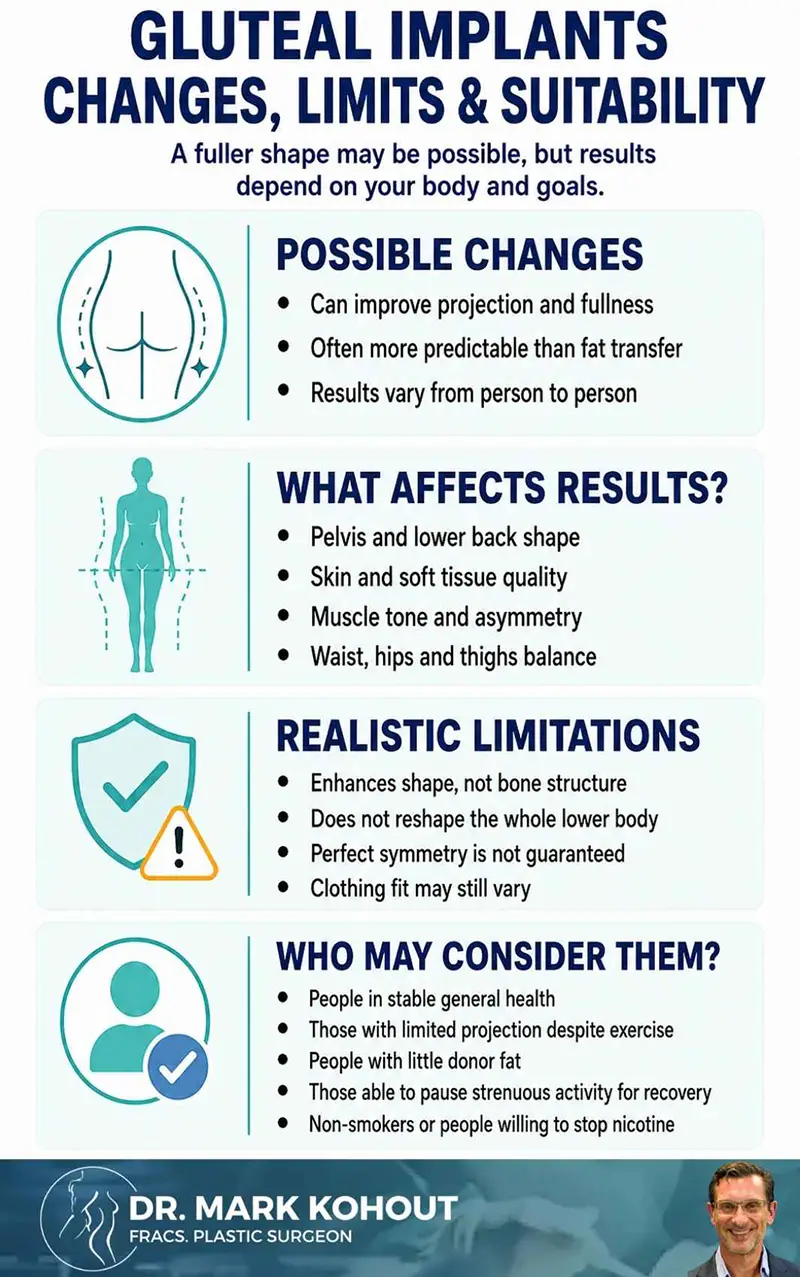
Patients who ask about gluteal implants usually hope to see a more projected and fuller buttock contour. Because the size and shape of the implant are chosen before surgery, the planned volume change is more predictable than with fat transfer, where a variable proportion of the fat survives.
Even with implants, the final appearance is shaped by several factors:
- The width and structure of the pelvis
- The natural curve of the lower back
- The thickness and elasticity of skin and soft tissue
- Muscle tone and posture
- Any existing asymmetry between the two sides
Two people with the same implant size may show very different outcomes. For this reason, Dr Mark Kohout assesses the whole lower torso rather than focusing solely on the buttocks. He looks at the relationship between the waist, hips and thighs, and explains that implants can alter projection but cannot change underlying bone structure or create a body outline that does not match a person's frame.
There are clear limitations. Gluteal implants are not a method for reshaping the entire lower body. They cannot guarantee how clothing will sit, and they cannot control how other people might perceive the result. Part of Dr Kohout's role as a Plastic Surgeon in Sydney is to outline these limitations clearly so that patients can decide whether the likely changes align with their expectations.
Who Might Consider Gluteal Implants
Suitability for gluteal augmentation with implants depends on general health, anatomy and personal goals. A consultation allows these factors to be reviewed together.
Â
From a health perspective, individuals may be considered for this operation if they:
- Have medical conditions that are reasonably stable and appropriately managed
- Do not have untreated illnesses that significantly increase surgical risk
- Are able to pause heavy physical work and strenuous exercise during recovery
Â
Nicotine use is an important topic. Smoking and vaping can reduce blood flow to the skin and soft tissue and are associated with higher rates of wound healing problems. Patients are usually asked to stop nicotine use before surgery and remain nicotine free during the early recovery period.
Â
Anatomical factors are equally important. Gluteal implants may be discussed with people who:
- Have limited natural buttock projection despite exercise
- Do not have enough donor fat for liposuction-based procedures
- Have noticeable asymmetry between the two sides and would like this reduced, while understanding that full symmetry is rarely possible
Â
During clinical examination, Dr Mark Kohout considers buttock size and shape, pelvic width, hip and thigh contour, the curve of the lower back and the quality of the skin. He also reviews any prior scars or operations that could influence implant placement or healing. This detailed assessment supports a tailored discussion about whether implants are likely to produce a noticeable change in shape, whether a fat-based approach might be more appropriate, or whether no surgical procedure is advisable.
Â
Motivation is another important factor. Cosmetic surgery is elective and should not be undertaken in response to short term pressures, trends or the hope that altering one part of the body will resolve broader life difficulties. When expectations or motivations sit outside what surgery can reasonably provide, Dr Kohout discusses this openly and may recommend against proceeding.
Consultation and Planning in Sydney
For patients in Sydney and surrounding areas, the process usually begins with a consultation at Dr Kohout’s practice. This visit is structured to support informed decision-making rather than to persuade anyone to have an operation.
Â
During the consultation, Dr Kohout:
- Reviews medical history, including previous operations, medications and allergies
- Invites the patient to describe what concerns them about their buttock shape
- Examines the buttocks and surrounding areas, with attention to proportion, tissue quality and asymmetry
Â
Clinical photographs may be taken and stored securely as part of the medical record. These assist with planning implant size and position and provide a reference when results are reviewed in follow up.
Â
Planning discussions typically cover:
- Whether gluteal augmentation is appropriate to consider at all
- The relative roles of implants, fat transfer or staged procedures
- The range of implant sizes that the tissues are likely to accommodate
- The proposed implant plane and incision location
- The hospital or day surgery facility where the procedure would take place
- The type of anaesthesia and an outline of the recovery period
Â
Dr Kohout also explains potential complications in detail and describes how they would be managed if they occurred. Patients are encouraged to ask questions, take notes and reflect on the information after the appointment. A second consultation is available for those who wish to revisit particular points or explore alternatives further.
Â
Current Australian guidance supports a cooling off period before cosmetic surgery. Consistent with this, Dr Kohout encourages patients to take adequate time to think about their options and discuss them with trusted people, rather than making rapid decisions.
The Operation and Early Recovery
On the day of surgery, patients are admitted to an accredited hospital or day surgery facility in Sydney. A specialist anaesthetist provides anaesthesia and monitors the patient throughout. Before entering the operating theatre, Dr Kohout reviews the plan, checks that questions have been addressed and marks the operative areas while the patient is standing, to reflect how tissues sit under gravity.
Â
In the operating theatre, the skin is cleaned with antiseptic solution and covered with sterile drapes. An incision is made in or near the crease between the buttocks. Through this incision, a pocket is carefully created in the chosen tissue plane. The implant is placed into the pocket, and its position is assessed visually and by feel. Adjustments are made as needed so that the contour appears as balanced as possible within the limits of the patient’s anatomy.
Â
Once both implants are positioned, the tissues are closed in multiple layers, often with dissolving sutures. A dressing is applied and, in many cases, a supportive garment is fitted. This garment is used to support the area while early healing takes place.
Â
In the initial hours after surgery, patients are monitored in the recovery area and then, if appropriate, on the ward. Discomfort, tightness and a feeling of pressure in the buttocks are common. Nursing staff assist with early movement, which supports circulation and helps reduce the risk of blood clots. Some patients return home on the same day, while others stay overnight, depending on their progress, general health and whether additional procedures were performed.
Â
At discharge, patients receive clear written instructions that typically include:
- How to care for dressings and incisions
- How long to wear the supportive garment
- When and how to take prescribed medications
- Which positions place less pressure on the implants
- When driving, work and exercise may be gradually resumed
- Symptoms that should prompt urgent contact with the practice or emergency care
Â
Follow up appointments are arranged so that Dr Kohout can monitor healing, remove any non-dissolving sutures if used and address questions as they arise.
Risks and Possible Complications
Balanced discussion of risk is a key component of AHPRA-compliant cosmetic surgery information. All operations carry the possibility of complications, even when carefully planned and performed in experienced hands.
Â
General surgical and anaesthetic risks include:
- Bleeding, which may occasionally require a return to theatre
- Infection, which might require antibiotics or further intervention
- Delayed or impaired wound healing
- Scarring that may be raised or more visible than hoped
- Changes in skin sensation in the operative area
- Blood clots in the legs or lungs
- Reactions to anaesthetic medications
Â
Gluteal implants introduce additional specific considerations. These include the possibility of:
- Infection around the implant, which in some cases may require removal of the device
- Fluid collections (seromas) that might need to be drained
- A tight or uncomfortable capsule forming around the implant (capsular contracture)
- Movement or rotation of the implant, leading to shape change or asymmetry
- Ongoing discomfort, particularly when sitting for long periods
- Persistent altered sensation in the buttock area
Â
Implants are not regarded as permanent lifetime devices. Over time, changes in the body, capsule formation, personal preferences or other medical issues may lead to discussion about revision or removal. Regular follow up with a Plastic Surgeon familiar with gluteal implants is an important part of longer term care.
Â
During consultation, Dr Mark Kohout explains these risks in plain language and encourages patients to weigh them against potential benefits and the practical impact of recovery on work, family life and other responsibilities.
Comparing Implants With Fat Transfer Procedures
Many patients ask whether implant-based surgery or fat transfer procedures are “better“. In reality, the more useful question is which option, if any, is better aligned with a particular person’s anatomy, health and preferences.
Â
Fat transfer to the buttocks can be considered for individuals who have adequate donor fat and who prefer not to have an implanted device. It may adjust contour at both the donor and recipient sites. However:
- A variable proportion of the transferred fat does not survive
- Final volume is less predictable
- Donor sites have their own scars, risks and recovery
- There is a specific concern about fat entering the circulation if injections are made too deeply
Â
Implants offer a defined volume, selected in advance, and do not require liposuction donor sites. Their risk profile is different and centres on the body’s response to the device and the potential for implant-related complications.
Â
In his Sydney practice, Dr Mark Kohout does not apply a one-size-fits-all approach. For some patients, implant-based augmentation may be reasonable to consider. For others, a fat-based procedure may be more appropriate, and for some, the most suitable recommendation is that no buttock surgery should be undertaken. This individualised planning supports decisions that are better matched to each person’s situation.
Gluteal Augmentation With Implants FAQs
Can gluteal implants be felt when sitting on hard surfaces, like a wooden chair or stadium seat?
Some people notice a different sensation when sitting on firm surfaces after gluteal implants, especially in the early months. Over time, most patients adapt to this change, but Dr Kohout discusses seat comfort and practical strategies for daily activities during consultation.Is it possible to have gluteal implants if someone already lifts heavy weights or does high-intensity training?
Many patients who consider this procedure are active, including those who lift weights. Return to heavy training needs to be gradual, and certain movements may feel different, so Dr Kohout provides individualised guidance about realistic timelines and exercise modifications.What happens to gluteal implants if body weight changes significantly later in life?
Implants themselves do not gain or lose weight, but the tissues around them can change with overall weight gain or loss. This can alter the way the buttocks look and feel, and in some cases patients may revisit their options with Dr Kohout if they are considering revision.Can someone lie on their back or side comfortably after gluteal augmentation with implants?
In the early phase, lying positions may feel restricted or uncomfortable, and patients are given instructions on how to position themselves. Over time, most people find a comfortable way to sleep on their back or side, but this can vary between individuals.Do gluteal implants affect how clothing such as jeans or tailored trousers fit around the hips and seat?
Clothing often fits differently after gluteal implants because the profile of the buttock changes. During consultation, patients are encouraged to think about clothing choices and to plan for a period of trying different cuts and styles as their body settles after surgery.Can gluteal implants interfere with future medical imaging, such as MRI or CT scans?
Gluteal implants are usually visible on imaging, but they do not generally prevent scans from being done. Patients should always let radiology staff know about any implants so that images can be interpreted accurately.Is it possible to feel the edges of a gluteal implant through the skin?
In some individuals, particularly those with thinner tissues, the outline of the implant may be more noticeable to touch. During planning, Dr Kohout considers soft tissue thickness and implant size to help reduce the likelihood of prominent edges, but this cannot be eliminated entirely.What happens if a patient later decides they no longer want gluteal implants?
Implants can be removed in a further operation, with or without additional procedures to adjust the remaining tissue. The buttock shape after removal depends on factors such as skin elasticity, scar tissue and weight changes since the original surgery.Can gluteal implants be combined with other procedures, such as liposuction to nearby areas, in the same operation?
In some cases, gluteal implants are combined with liposuction to the flanks or thighs to adjust overall contour. Whether this is appropriate depends on the patient’s health, anatomy and operating time, and is considered carefully by Dr Kohout during planning.Is there an age range where gluteal augmentation with implants is more or less suitable?
There is no fixed age limit, but suitability depends on health status, tissue quality and realistic expectations rather than age alone. Younger and older adults are assessed individually, and in some cases age-related medical conditions may influence whether surgery is recommended.Medical References
- Mofid MM, Gonzalez R, de la Peña JA, Mendieta CG, Senderoff DM, Jorjani S. Buttock Augmentation with Silicone Implants: A Multicenter Survey Review of 2226 Patients. Plast Reconstr Surg. 2013. https://www.drmofid.com/files/2016/03/silicone_butt_aug.pdf
- Elsaftawy A, Bonczar T, Stolarski M, Gabryszuk K. Submuscular Buttock Augmentation With Silicone Implants in 80 Female Patients. Aesthetic Surg J. 2024;44(3):302–310. https://academic.oup.com/asj/article/44/3/302/7238649
- Del Vecchio D, Kenkel JM; Multi-Society Task Force for Safety in Gluteal Fat Grafting. Practice Advisory on Gluteal Fat Grafting. Aesthetic Surg J. 2022;42(9):1019–1029. https://academic.oup.com/asj/article/42/9/1019/6566385
Preparing for a Consultation
Patients often feel more comfortable and informed during their appointment when they have prepared beforehand. Before seeing Dr Kohout, many find it helpful to:
- List current medications, including supplements and non-prescription products
- Note previous operations, significant illnesses and hospital admissions
- Reflect on how long they have been considering buttock surgery and what has prompted that interest
- Write down specific questions about risks, recovery, alternatives and long-term considerations
Â
Some people bring photographs that illustrate the general type of contour or projection they find appealing. Dr Kohout uses these images as a starting point for discussion about what may or may not be achievable within the limits of a person’s frame and tissues, rather than as results to replicate.
Â
It is appropriate to ask about a surgeon’s training, how frequently they perform gluteal implant surgery, where the procedures are carried out and what support is available if complications occur. Many patients involve their general practitioner, who can provide additional medical background and support the decision-making process.
Choosing a Plastic Surgeon and Facility in Sydney
In Australia, not every doctor offering cosmetic procedures has completed specialist surgical training. Patients can check the AHPRA register to confirm whether a practitioner is recognised as a specialist in Plastic and Reconstructive Surgery.
Â
Dr Mark Kohout is a Plastic Surgeon based in Sydney with specialist training and many years of clinical experience in Plastic and Reconstructive Surgery. He performs gluteal augmentation procedures in accredited hospitals and day surgery facilities, working with specialist anaesthetists and trained perioperative staff.
Â
The cost of gluteal implant surgery is influenced by hospital fees, anaesthetist fees, surgeon fees, implant costs and the type of aftercare required. For most people, this type of buttock surgery is considered cosmetic and does not attract Medicare rebates, although individual circumstances and private health insurance policies vary. A detailed written quote is provided so that financial considerations can be taken into account alongside medical information.
Next Steps With Dr Mark Kohout in Sydney
Gluteal augmentation with implants is a significant decision. It may change buttock projection and contour for selected patients, but it also carries important risks, involves a recovery period and has long-term considerations related to the presence of an implant. It is not suitable for everyone, and choosing not to proceed is always a valid outcome.
Â
For individuals in Sydney and surrounding regions who are seriously considering buttock surgery, a consultation with Dr Mark Kohout provides an opportunity to explore options in detail. In that setting, he assesses general health and anatomy, discusses implant-based and fat-based approaches where relevant, explains potential complications and advises whether surgery of any kind is appropriate.
Â
Patients can contact his Sydney practice by phone or via the enquiry form on his website to request an appointment. Whatever decision is made, the guiding principle is that it is informed, carefully considered and aligned with the patient’s overall health and circumstances.
Further Reading​
- Read more about Abdominoplasty / Tummy Tuck Sydney
- Read more about Liposuction Sydney
- Read more about Body Procedures
- Read Dr Kohout’s Blog on Recovery After Liposuction: What to Expect and How to Maximise Healing
- Read Dr Kohout’s Blog on Weight Considerations for Plastic Surgery Patients
- Read Dr Kohout’s Blog on Returning To Exercise After Plastic Surgery
Related Blog Posts
FAQs of Abdominoplasty after Weight Loss…
Abdominoplasty after significant weight loss can help individuals address the excess skin and increase the visibility of muscle tone that often results from substantial weight reduction. In Australia, many people…

Skin Tightening After Weight Loss Medications
Losing a significant amount of weight is an accomplishment that can bring real changes in mobility, energy, and overall health. Many people in Sydney are now achieving weight reduction through…
Managing Swelling and Bruising after Tummy…
Abdominoplasty is a surgical procedure performed to address excess abdominal skin and support abdominal wall contouring. As with any surgery, a period of healing follows – and for most patients,…
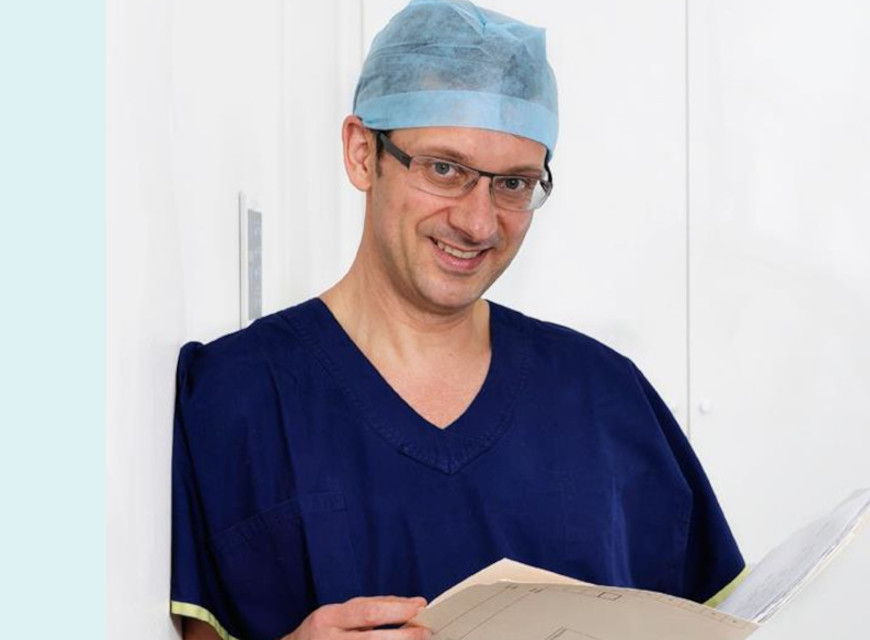
Experienced Plastic Surgeon
Dr. Mark Kohout
A qualified plastic surgeon who operates with care and integrity, based in central Sydney with over 20 years of experience in the cosmetic field. His extensive training and experience assures patients they are in highly trained surgical hands. Dr. Kohout is a dedicated, friendly professional who is committed to providing the high quality care, support and results, alongside his compassionate team.
Dr Mark Kohout (MED0001133000)
Specialist Plastic Surgeon
Specialist registration in Surgery – Plastic Surgery