
Upper Blepharoplasty vs Brow Lift in Sydney

With Dr. Mark Kohout

Upper Blepharoplasty vs Brow Lift in Sydney by Dr Mark Kohout

People considering surgery around the upper eyelids or brow often ask whether upper blepharoplasty or a brow lift is more appropriate. These procedures can address different anatomical concerns, although the areas are closely related. In some patients, heaviness above the eyes is mainly caused by excess upper eyelid skin. In others, the brow position contributes to the appearance of heaviness or skin folding around the upper eyelids.

Understanding the difference between upper blepharoplasty vs brow lift surgery can help patients ask informed questions during consultation. However, the most suitable option cannot be determined from appearance alone or from online information. Assessment by a qualified medical practitioner is required.

This page provides general educational information for patients in Sydney considering upper eyelid or brow surgery. It does not replace personalised medical advice.

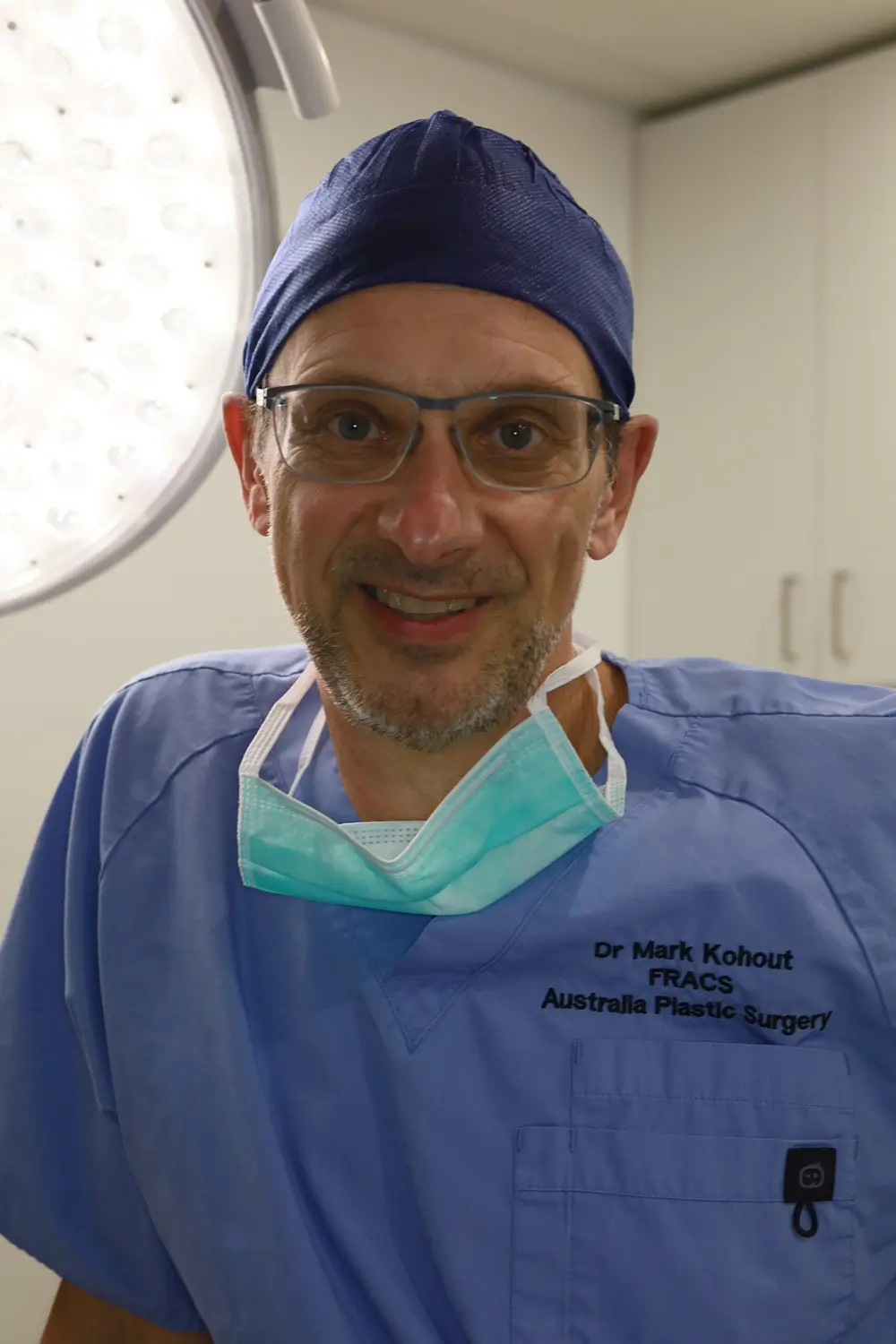
Dr Mark Kohout MBBS, FRACS Plast is a Specialist Plastic Surgeon consulting at Australia Plastic Surgery, Suite 2, 37 Bay St, Glebe, Sydney NSW 2037.

What Is Upper Blepharoplasty?

Upper blepharoplasty is a surgical procedure that addresses excess skin, and in some cases tissue, of the upper eyelids. It may be considered when upper eyelid skin folds over the eyelid crease, causes a heavy sensation, affects makeup application, or contributes to functional concerns such as obstruction of the upper field of vision.

During upper blepharoplasty, an incision is usually placed within or near the natural upper eyelid crease. The surgical plan may involve removal of excess skin and, in selected cases, adjustment of underlying tissue. The amount of tissue addressed depends on the patient’s eyelid anatomy, skin quality, brow position, eye shape, medical history and surgical goals.

Upper blepharoplasty does not primarily change the position of the brow. This is an important distinction. If the brow itself sits low, removing eyelid skin alone may not address the underlying brow position. In some patients, brow position needs to be considered before deciding whether upper eyelid surgery is suitable.

What Is a Brow Lift?

A brow lift is a surgical procedure that addresses the position and support of the brow. It may be discussed when brow descent contributes to heaviness around the upper eyelids, skin folding, or changes in the upper facial area.

A brow lift does not primarily remove upper eyelid skin in the same way as upper blepharoplasty. Instead, it focuses on the brow and forehead tissues. Different brow lift techniques may be used depending on patient anatomy, hairline position, forehead height, skin quality, brow asymmetry, surgical history and the surgeon’s assessment.

Some patients seek advice about brow lift surgery because they feel the upper eyelid area looks heavy, but assessment may show that the brow position is the main contributing factor. Other patients may have both excess upper eyelid skin and brow descent, meaning both areas need to be discussed carefully.

A brow lift is not suitable for every patient with upper eyelid heaviness. Suitability depends on examination and discussion of risks, alternatives and recovery.

Why the Eyelids and Brow Need to Be Assessed Together

The upper eyelids and brow are anatomically connected. Brow position can influence how much skin appears to sit on or near the upper eyelid. When the brow sits lower, it may push skin downward, making the upper eyelids appear heavier.

Some patients compensate for brow descent by raising the forehead muscles. This can create forehead lines or a feeling of tension. If the forehead muscles relax during assessment, the true brow position may become more apparent.

For this reason, upper eyelid concerns should not be assessed in isolation. A consultation may include examination of the eyelid crease, brow position, forehead movement, skin quality, eyelid function, visual field concerns, dry eye symptoms and general facial anatomy.

In some cases, upper blepharoplasty may be appropriate. In other cases, a brow lift may be discussed. Some patients may be advised that combined or staged procedures could be considered. Others may be advised that surgery is not appropriate or that further assessment is required.

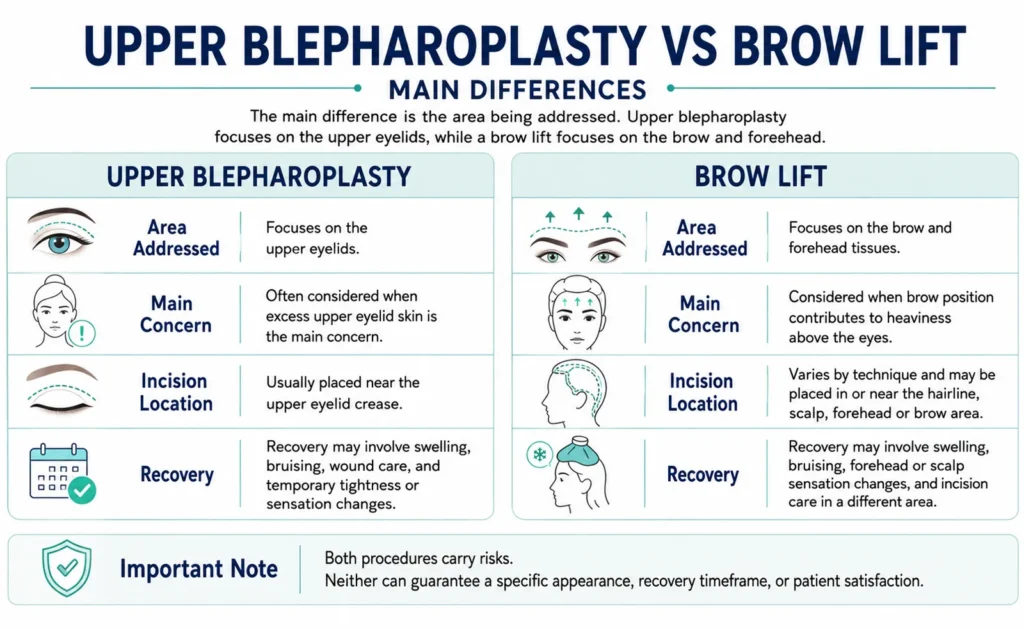
Upper Blepharoplasty vs Brow Lift: Main Differences

The key difference between upper blepharoplasty and brow lift surgery is the area being addressed.

Upper blepharoplasty focuses on the upper eyelids. It may remove excess upper eyelid skin and adjust tissue where appropriate. It is generally considered when the main concern is upper eyelid skin redundancy.

A brow lift focuses on the brow and forehead tissues. It may be considered when brow position contributes to heaviness around the upper eyelid area.

The incision location also differs. Upper blepharoplasty commonly uses an incision near the upper eyelid crease. Brow lift incisions vary depending on the technique and may be placed in or near the hairline, scalp, forehead region or brow area, depending on the surgical approach.

Recovery considerations also differ. Upper blepharoplasty recovery usually involves eyelid swelling, bruising, wound care and temporary changes in eyelid sensation or tightness. Brow lift recovery may involve swelling, bruising, scalp or forehead sensation changes, and incision care in a different area.

Both procedures carry risks. Neither procedure can guarantee a particular appearance, recovery timeframe or patient satisfaction.

Upper Blepharoplasty vs Brow Lift by Dr Mark Kohout

When Upper Blepharoplasty May Be Considered

Upper blepharoplasty may be discussed when excess upper eyelid skin is the main concern. Some patients describe upper eyelid skin resting close to the lash line, difficulty applying eye makeup, heaviness of the upper eyelids, or visual field concerns.

Functional concerns may require additional assessment. In selected cases, visual field testing or referral information may be relevant if a patient reports obstruction of vision. Medicare or private health insurance considerations depend on specific criteria and documentation, and eligibility cannot be assumed without assessment.

Upper blepharoplasty may not be the most suitable option if the main issue is brow descent rather than eyelid skin excess. Removing eyelid skin without considering brow position may not address the cause of the heaviness. It may also affect eyelid closure or the relationship between the eyelid and brow if too much skin is removed.

Assessment is required to determine whether upper blepharoplasty is appropriate.

When a Brow Lift May Be Considered

A brow lift may be discussed when brow position contributes to upper eyelid heaviness or skin folding. Some patients may notice that lifting the brow manually changes the upper eyelid area. This does not confirm that surgery is suitable, but it may indicate that brow position should be assessed.

Brow position can differ between sides. Some patients have brow asymmetry, forehead muscle overactivity, or a brow position that contributes to visual field symptoms. These factors may influence surgical planning.

A brow lift may not be appropriate if the concern is mainly excess upper eyelid skin and the brow position is suitable. In that situation, upper blepharoplasty may be discussed instead. Some patients may have both eyelid skin excess and brow descent, requiring a more detailed discussion.

The decision depends on anatomy, symptoms, medical history, eye health, skin quality, hairline position, risks, recovery and patient priorities.

Can Upper Blepharoplasty and Brow Lift Be Performed Together?

In selected patients, upper blepharoplasty and brow lift surgery may be discussed together. This may be relevant when both excess upper eyelid skin and brow descent contribute to the patient’s concerns.

Combined surgery may increase operating time, recovery requirements and risks. It is not suitable for every patient. In some cases, staging the procedures may be recommended. Staging means performing procedures at different times rather than during the same operation.

The decision to combine or stage surgery depends on the patient’s anatomy, medical history, surgical goals, eye health, recovery capacity and risk profile. Patients should understand what each procedure is intended to address, as well as what it cannot address.

No combined procedure can guarantee a particular surgical result. A personalised surgical plan can only be discussed after consultation and examination.

Functional Concerns and Visual Field Symptoms

Some patients seek advice about upper eyelid or brow surgery because the upper field of vision feels obstructed. This may occur when upper eyelid skin, brow position, or both contribute to tissue sitting over the upper eye area.

Functional assessment may include discussion of symptoms such as difficulty seeing upward, heaviness later in the day, forehead muscle strain, or needing to raise the brows to see more clearly. In some cases, formal visual field testing may be requested.

Functional concerns do not automatically mean that surgery is medically indicated or eligible for Medicare or private health insurance support. Criteria may apply, and documentation is usually required.

Patients should discuss their symptoms clearly during consultation so the eyelid and brow relationship can be assessed.

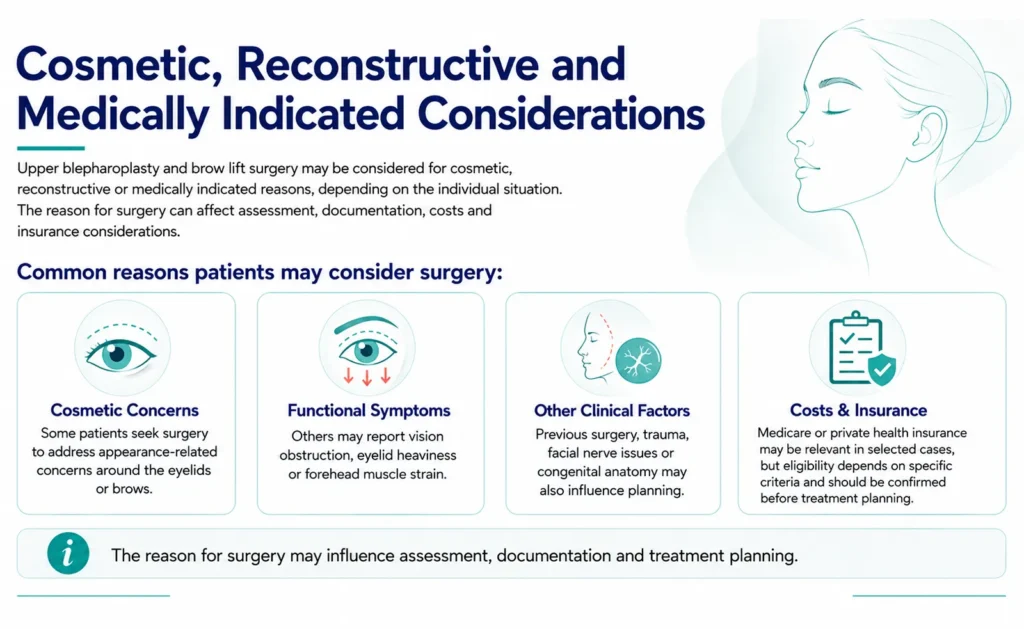
Cosmetic, Reconstructive and Medically Indicated Considerations

Upper blepharoplasty and brow lift surgery may be considered for cosmetic, reconstructive or medically indicated reasons, depending on the individual circumstances.

Some patients seek surgery because of appearance-related concerns. Others may report functional symptoms such as obstruction of vision, eyelid heaviness or forehead muscle strain. Some patients may have issues related to previous surgery, trauma, facial nerve concerns or congenital anatomy.

The reason for surgery may influence assessment, documentation, costs and insurance considerations. Medicare or private health insurance support may be relevant in selected cases, but eligibility depends on specific criteria and should be confirmed before treatment planning.

Dr Kohout can discuss whether further assessment, testing or referral documentation may be required.

Cosmetic Reconstructive and Medically Indicated Considerations by Dr Mark Kohout

Recovery After Upper Blepharoplasty vs Brow Lift

Recovery after plastic surgery varies between patients and depends on the procedure performed, surgical technique, anaesthetic requirements, medical history, wound healing and post-operative care.

After upper blepharoplasty, patients may experience swelling, bruising, tightness, watery eyes, dryness, temporary sensitivity or changes in eyelid sensation. Some patients may need ointment, eye drops or specific wound care instructions.

After brow lift surgery, patients may experience swelling, bruising, scalp or forehead tightness, altered sensation, or incision-related symptoms. The location and extent of these symptoms depend on the technique used.

Activity restrictions may differ between procedures. Patients may be advised to avoid strenuous activity, heavy lifting, bending, swimming or contact activities for a period based on their surgical plan and review. Driving should not resume while affected by anaesthesia, sedating medication, pain, restricted vision or impaired movement.

No recovery timeline can be guaranteed. Dr Kohout provides instructions based on the procedure, patient health factors and progress at follow-up appointments.

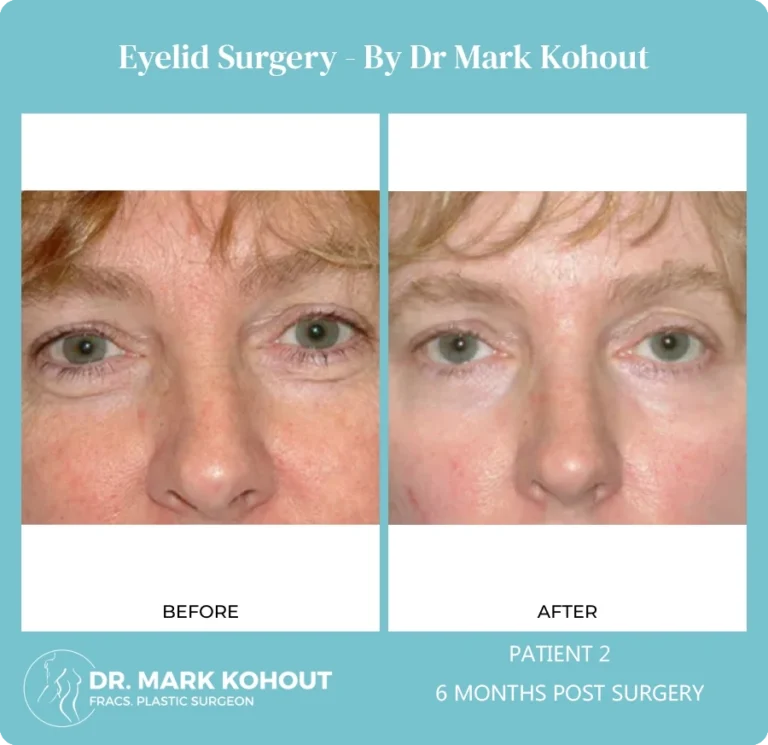
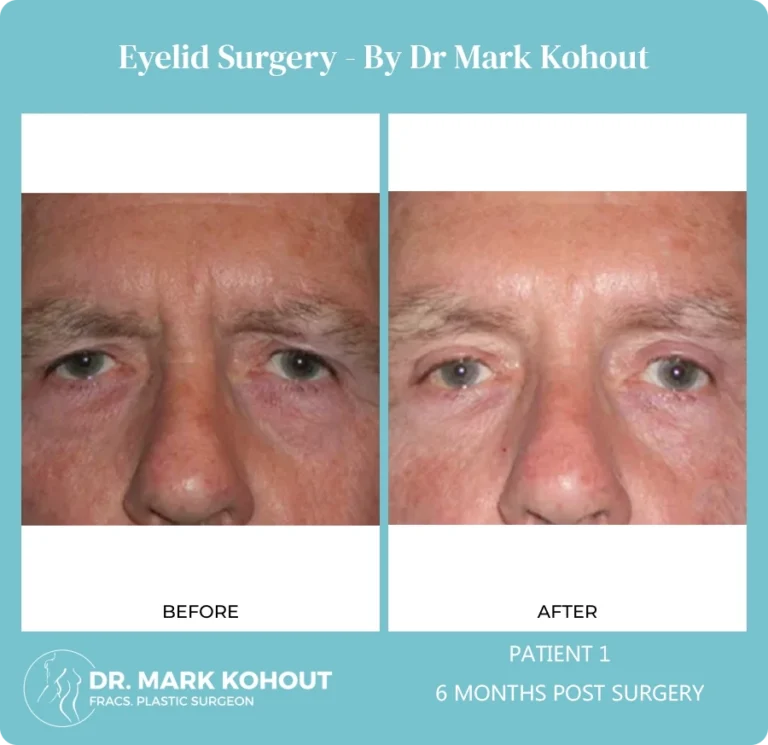
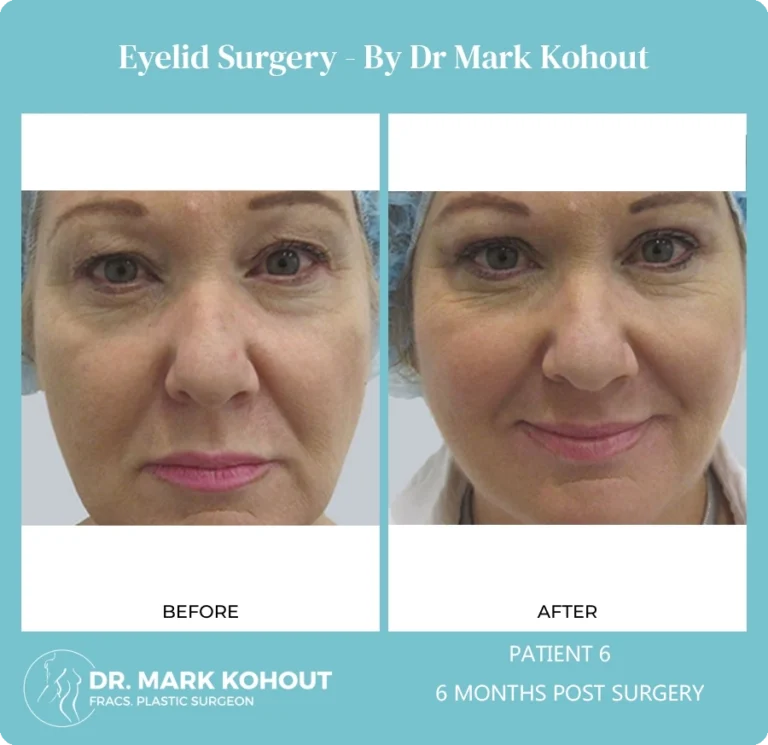
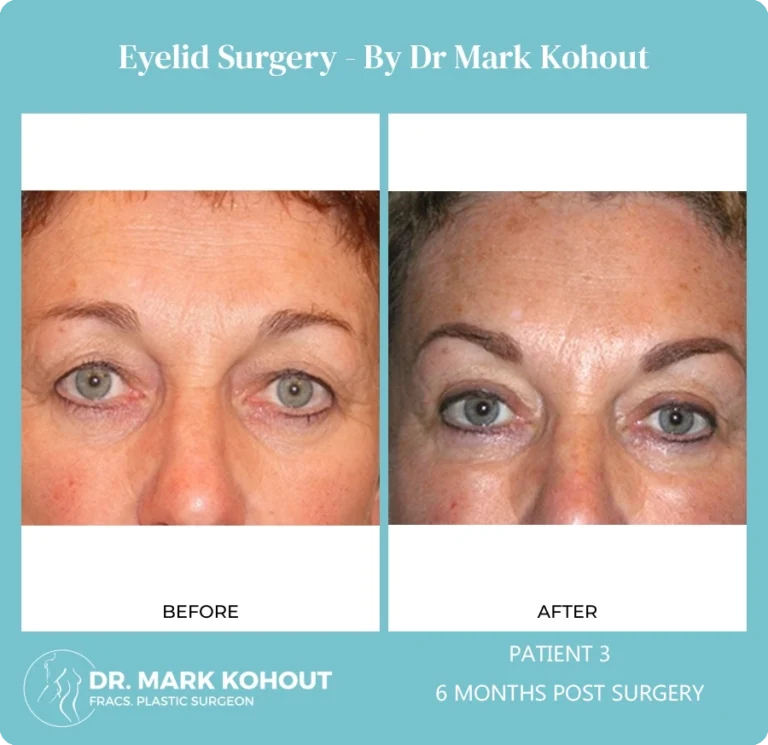
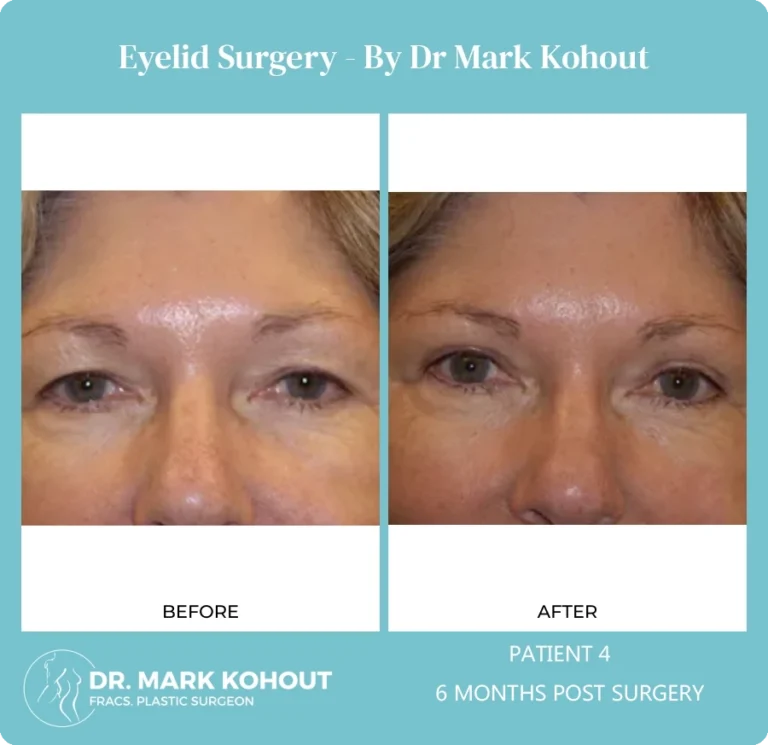
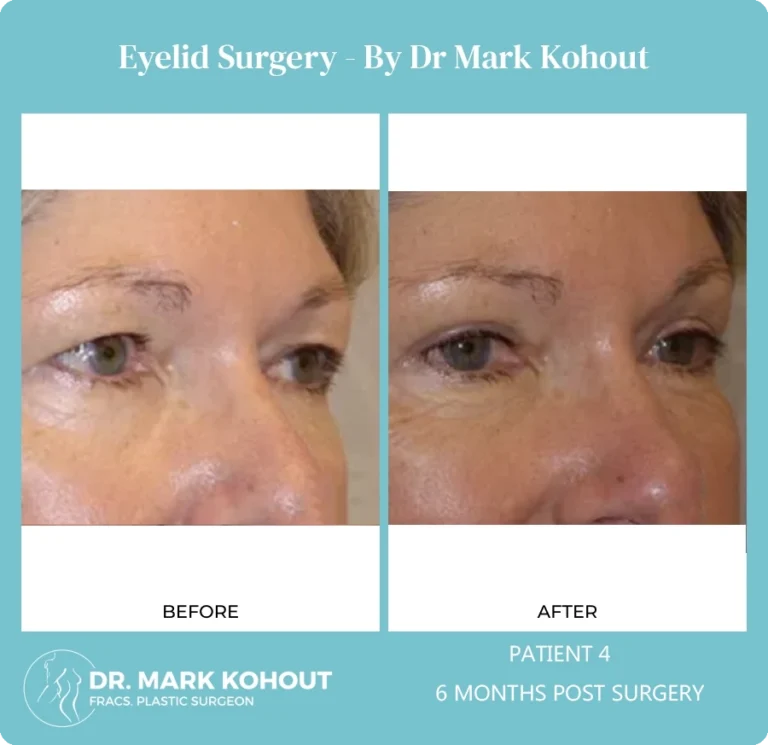
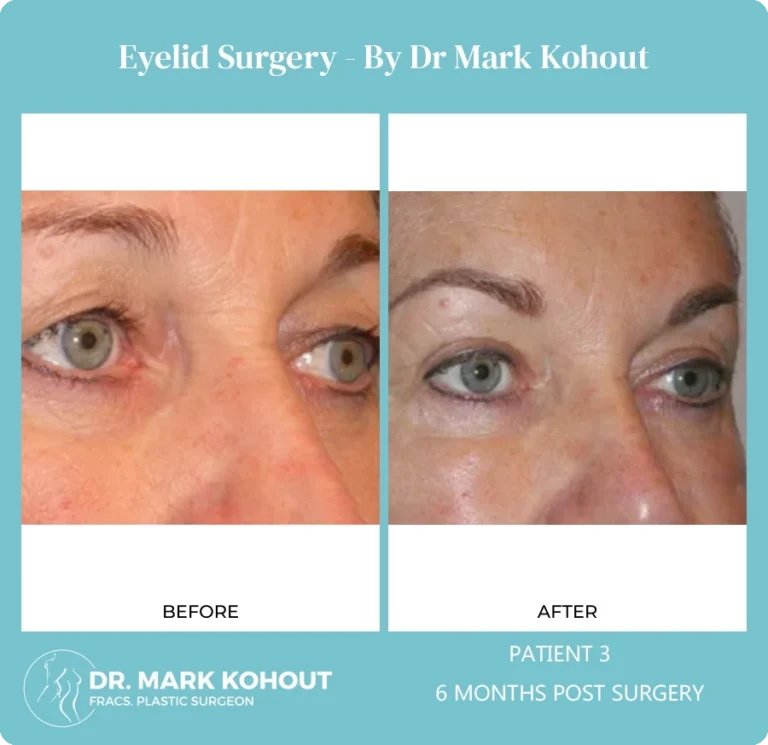
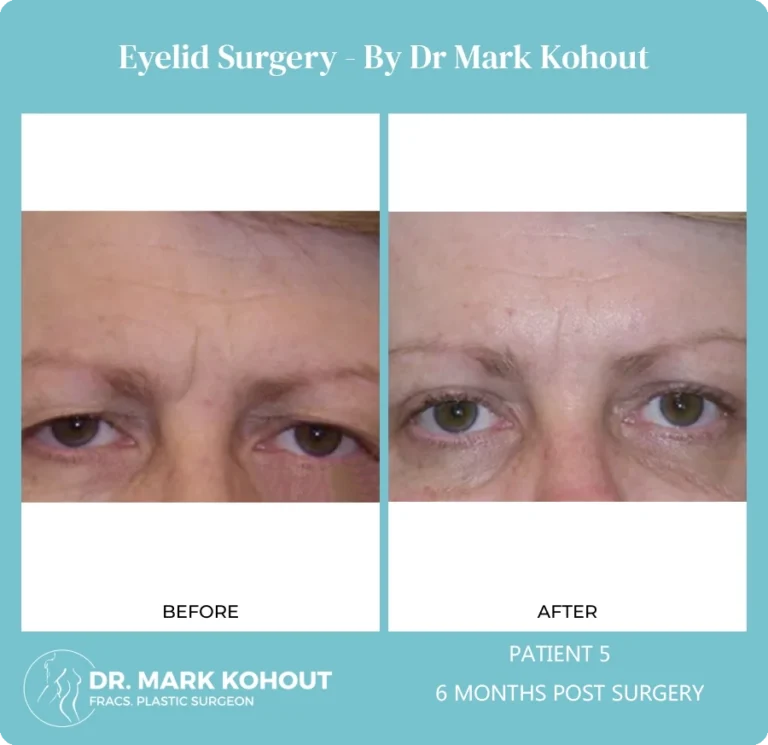
Before and After Photos of Blepharoplasty Surgery

View examples of blepharoplasty surgery performed by Dr Mark Kohout. Individual outcomes vary.

Disclaimer

Individual results vary due to personal health factors and genetics, and all surgical procedures carry inherent risks that should be discussed with a qualified health professional.

Risks and Complications to Consider

All surgery carries risks. Upper blepharoplasty and brow lift surgery have different risk profiles, although some risks overlap.

Possible risks of upper blepharoplasty may include bleeding, infection, delayed wound healing, scarring, asymmetry, dry eyes, watery eyes, irritation, changes in eyelid sensation, difficulty closing the eyes, blurred vision, changes in eyelid position, and need for further treatment.

Possible risks of brow lift surgery may include bleeding, infection, delayed wound healing, scarring, asymmetry, altered forehead or scalp sensation, hairline changes, hair loss around incision sites, brow position concerns, nerve-related changes, and need for further treatment.

Anaesthetic risks may also apply. Smoking, vaping, certain medications, dry eye conditions, thyroid eye disease, previous eye surgery, and other medical conditions may affect risk and planning.

Patients should seek urgent medical advice if they experience symptoms such as sudden vision changes, severe pain, increasing swelling, bleeding, fever, wound discharge, chest pain, shortness of breath or other symptoms of concern.

Scarring and Incision Placement

Incision placement differs between upper blepharoplasty and brow lift surgery.

Upper blepharoplasty incisions are commonly placed in or near the upper eyelid crease. The incision position depends on eyelid anatomy, skin excess and surgical planning.

Brow lift incisions vary more widely. Depending on the technique, incisions may be located in the scalp, near the hairline, within forehead lines, or near the brow. Hairline position, forehead height, brow asymmetry and skin quality may influence technique selection.

Scar appearance varies between patients. Factors such as genetics, skin quality, wound healing, sun exposure, smoking or vaping, infection and tension on the wound may affect scars. Scars change over time, but no scar appearance can be guaranteed.

Dr Kohout provides wound care and scar management advice where appropriate.

Comparing Upper Blepharoplasty and Brow Lift

Factor Upper Blepharoplasty Brow Lift
Main area addressed Upper eyelid skin and tissue Brow and forehead tissues
May be considered when Upper eyelid skin excess is the main concern Brow position contributes to heaviness
Incision area Usually upper eyelid crease region Varies by technique; may involve scalp, hairline, forehead or brow area
Does it change brow position? Not primarily Yes, depending on surgical plan
Does it remove upper eyelid skin? Yes, where appropriate Not primarily
Recovery considerations Eyelid swelling, bruising, wound care, temporary eye symptoms Forehead or scalp swelling, bruising, altered sensation, incision care
Assessment required Yes Yes

This table is general only. Individual anatomy can change the discussion significantly.

How Dr Mark Kohout Assesses Eyelid and Brow Concerns

Dr Mark Kohout MBBS, FRACS Plast consults with patients at Australia Plastic Surgery in Glebe, Sydney.

For patients considering upper blepharoplasty or brow lift surgery, consultation may include review of medical history, eye health, medications, previous surgery, dry eye symptoms, vision concerns, brow position, eyelid skin excess, eyelid function and facial anatomy.

The assessment may also include discussion of whether the concern is mainly related to eyelid skin, brow position or a combination of both. Where functional symptoms are reported, further testing or documentation may be discussed.

Dr Kohout provides information about relevant procedure options, risks, recovery, alternatives and limitations. A surgical plan, if appropriate, is developed after assessment.

Questions to Ask During Consultation

Patients comparing upper blepharoplasty vs brow lift may wish to ask:

  • Is my concern mainly related to eyelid skin, brow position or both?
  • Would upper blepharoplasty address my concerns?
  • Would brow lift surgery be more appropriate in my case?
  • Could both procedures be considered, or should they be staged?
  • Where would the incisions be placed?
  • What risks apply to my medical history and eye health?
  • Could surgery affect dry eye symptoms?
  • What recovery instructions may apply?
  • When would follow-up appointments be required?
  • Could further treatment be needed?
  • Are there non-surgical or non-operative alternatives to consider?
  • Could visual field testing be relevant in my case?
  • Could Medicare or private health insurance criteria apply?

These questions can help patients make informed decisions based on medical advice and individual assessment.
Dr Mark Kohout

Upper Blepharoplasty vs Brow Lift: Key Points

Upper blepharoplasty and brow lift surgery address different anatomical areas. Upper blepharoplasty focuses on excess upper eyelid skin and tissue. Brow lift surgery focuses on brow position and forehead tissues.

Some patients have eyelid skin excess without significant brow descent. Others have brow descent that contributes to upper eyelid heaviness. Some patients have both.

The most suitable option depends on consultation, examination, medical history, eye health, anatomy, risks, recovery requirements and patient priorities.

No surgical result, scar appearance or recovery timeline can be guaranteed. Patients should make decisions after considering risks, alternatives, costs and post-operative care requirements.

Dr Mark Kohout

FAQs About Upper Blepharoplasty vs Brow Lift

What is the difference between upper blepharoplasty and brow lift surgery?Upper blepharoplasty focuses on excess skin and tissue of the upper eyelids. Brow lift surgery focuses on the position and support of the brow and forehead tissues. The appropriate procedure depends on individual assessment.
How do I know whether I need upper blepharoplasty or a brow lift?Suitability depends on whether the concern is mainly caused by upper eyelid skin, brow position or both. A consultation is required to assess eyelid and brow anatomy.
Can upper blepharoplasty lift the brow?Upper blepharoplasty does not primarily change brow position. If brow descent is contributing to upper eyelid heaviness, brow lift surgery may need to be discussed.
Can brow lift surgery remove excess upper eyelid skin?Brow lift surgery does not primarily remove upper eyelid skin. It addresses brow position. Some patients may require discussion of both brow and upper eyelid procedures.
Can upper blepharoplasty and brow lift be performed together?In selected patients, both procedures may be discussed together. Combined surgery may increase operating time, recovery requirements and risks. Staged surgery may be recommended in some cases.
Is upper eyelid heaviness always caused by excess eyelid skin?No. Upper eyelid heaviness may be related to excess eyelid skin, brow position, eyelid function, eye health or a combination of factors. Assessment is required.
How long is recovery after upper blepharoplasty or brow lift surgery?Recovery varies between patients. It depends on the procedure performed, surgical technique, anaesthetic requirements, medical history and healing progress. Dr Kohout provides individual post-operative instructions after surgery.
Will I have visible scars after upper blepharoplasty or brow lift surgery?All surgical incisions create scars. Incision placement and scar appearance vary depending on the procedure and patient factors. No scar appearance can be guaranteed.
Are there risks with upper blepharoplasty and brow lift surgery?Yes. Risks may include bleeding, infection, delayed wound healing, scarring, asymmetry, changes in sensation, eye irritation, dry eye symptoms, brow position concerns and need for further treatment. Anaesthetic risks may also apply.
Where can I discuss upper blepharoplasty vs brow lift in Sydney?Patients can schedule a consultation with Dr Mark Kohout MBBS, FRACS Plast at Australia Plastic Surgery in Glebe, Sydney, to discuss eyelid and brow concerns, suitability, risks and recovery considerations.

Welcome to the Practice of
Dr. Mark Kohout

With over 25 years of experience and Harvard training, Dr. Mark Kohout offers experienced plastic and reconstructive surgery at his Sydney and Orange clinics. His patient-first approach focuses on delivering safe, natural results tailored to your unique goals.

Schedule a Consultation with Dr Mark Kohout

Patients considering upper blepharoplasty or brow lift surgery in Sydney can schedule a consultation with Dr Mark Kohout at Australia Plastic Surgery in Glebe.

Consultation allows assessment of eyelid and brow anatomy, discussion of procedure options, and review of risks, recovery, alternatives and expected post-operative care.

Dr Mark Kohout MBBS, FRACS Plast
 Specialist Plastic Surgeon
 Australia Plastic Surgery
 Suite 2, 37 Bay St
 Glebe, Sydney NSW 2037

Take our Plastic Surgery Quiz to find out if you’d be a good candidate and if you are ready for cosmetic surgery.​

Further Reading

Book your Consultation

Take the first step toward your goals by filling out the brief form below. This information helps us understand your specific needs so we can make the most of our time together during your session. Once you submit your details, a member of our team will review your request and reach out shortly to confirm your appointment.

Patient Photo Assessment

Sending photos for a patient photo assessment can help you and your plastic surgeon prepare for your consultation. By reviewing clear, accurate photos, Dr Kohout can provide preliminary patient photo assessment like insights, assess your needs, and determine the right approach for your procedure.

Tips for Uploading Photos

ASK A FRIEND

Friend takes photo

GOOD LIGHTING

Plain wall, bright light

ALL ANGLES

Front / sides/ 45°

CLEAR & SHARP

No portrait mode

SEND ORIGINALS

No edits or compression

Dr. Mark Kohout Plastic Surgery in Sydney & Orange

Experienced Plastic Surgeon

Dr. Mark Kohout

A qualified plastic surgeon who operates with care and integrity, based in central Sydney with over 20 years of experience in the cosmetic field. His extensive training and experience assures patients they are in highly trained surgical hands. Dr. Kohout is a dedicated, friendly professional who is committed to providing the high quality care, support and results, alongside his compassionate team.

Dr Mark Kohout (MED0001133000)
Specialist Plastic Surgeon
Specialist registration in Surgery – Plastic Surgery

25

Years of Experience

Years of Delivering Exceptional Cosmetic Care.

10000+

Surgical Procedures

Procedures performed by our qualified surgeons.

15+

Available Treatments

Cosmetic treatment options tailored to your needs.

Our Trusted

Accreditations

fracs

Dr Mark Kohout is a qualified plastic surgeon based in central Sydney, with over 20 years of experience in the field of cosmetic and reconstructive surgery. He draws on extensive surgical training and clinical experience to tailor care to the individual needs and goals of each patient.

Dr Kohout is known for his thoughtful, patient-centred approach, guiding individuals through each stage of their surgical journey — from initial consultation to post-operative care. Working alongside a compassionate and professional team, he is committed to providing high standards of care in a supportive and respectful environment.

Locations

Opening Hours

Monday - Friday

8:30AM - 05:00PM

Saturday - Sunday

Closed

Disclaimer: Dr Mark Kohout (MED0001133000) a Registered Medical Practitioner, Specialist Plastic Surgeon. All surgical or invasive procedures carry risks and complications. We recommend seeking a second opinion from an appropriately qualified medical practitioner before proceeding with any surgery. Results depend on individual patient circumstances and can vary significantly. Results may also be impacted by a variety of factors including your lifestyle, weight, nutritional intake and overall health. Consult your Specialist Plastic Surgeon for details. This information is general in nature and is not intended to be medical advice nor does it constitute a doctor-patient relationship. Surgery risks and complications will be covered in detail during a consultation with your Surgeon. We recommend seeking a second opinion from an appropriately qualified medical practitioner before proceeding with surgery.

©2024  All Rights Reserved

This website contains imagery which is only suitable for audiences 18+. All surgery contains risks, read more here.

Close Welcome Bar

Get Your Buttock Lift & Implants Guide

Get Your Facial Aesthetic

Get Your Breast Implant Removal

Get Your Female Genital Surgery Guide

Get Your Excess Skin Guide

Get Your Gynaecomastia Guide

Get Your Liposuction Guide

Get Your Abdominoplasty Guide

Get Your Cost of Surgery Guide

Get Your Breast Implant Replace Guide

Get Your Breast Reduction Guide

Get Your Breast Augmentation Guide

Make an Enquiry