


Many people follow consistent lower-body exercise programs but find that the size or projection of their buttocks changes less than expected. Squats, lunges, hip thrusts and resistance exercises can strengthen the gluteal muscles, but they cannot alter every anatomical feature that contributes to buttock shape.
Dr Mark Kohout, a Specialist Plastic Surgeon in Sydney with more than 25 years of experience, consults with patients who are concerned about limited physical changes despite regular exercise. Genetics, pelvic structure, fat distribution, posture, muscle activation and age-related tissue changes can all influence this area, and understanding these factors can help clarify whether exercise guidance, physiotherapy or surgical assessment may be appropriate.
Why Can Buttock Shape Be Difficult to Change Through Exercise?
Exercise can increase gluteal strength and muscle size, but it cannot significantly change pelvic structure, skin support or genetically determined fat distribution. These anatomical factors can limit visible changes even when training is consistent.
Buttock shape is influenced by the gluteal muscles, bones, fatty tissue and the relationship between the waist, hips and thighs. Because exercise mainly affects muscle development, people following similar training programs may experience noticeably different physical changes.
- Pelvic width and angle influence overall shape
- Gluteal muscle size affects volume and projection
- Fat distribution is influenced by genetics and hormones
- Skin and connective tissue affect support
- Posture can change the side profile
Which Gluteal Muscles Affect Buttock Shape?
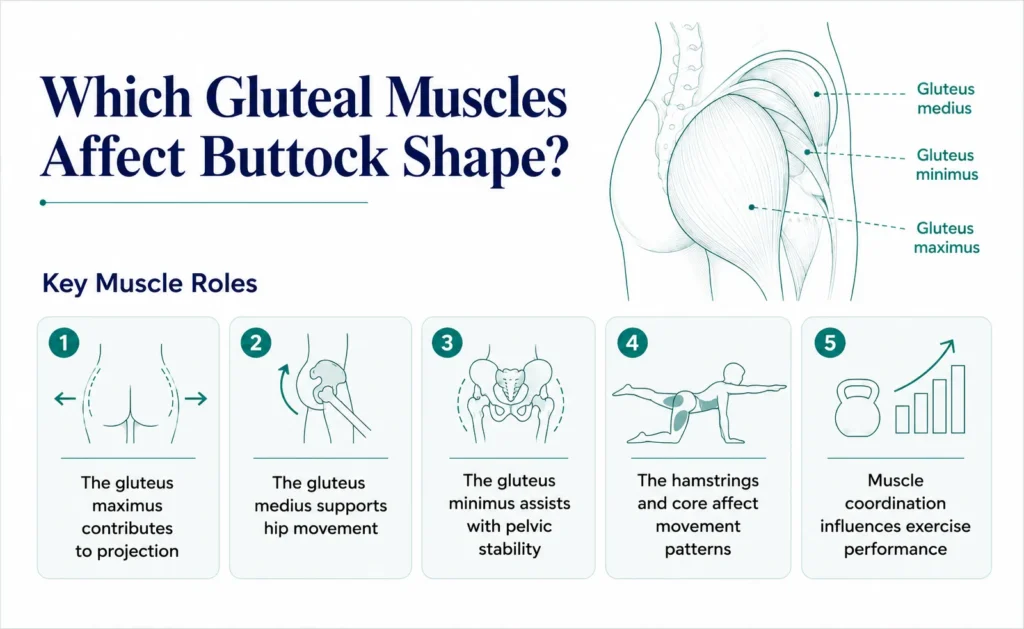
The gluteus maximus contributes most to buttock volume and outward projection. The gluteus medius and minimus assist with hip movement, pelvic stability and the upper contour of the area.
The gluteus maximus is the largest muscle in the region and may be developed through exercises such as hip thrusts, squats, step-ups and deadlifts. The visible effect of muscle development also depends on bone structure, fatty tissue and how effectively the muscles are recruited during movement.
- The gluteus maximus contributes to projection
- The gluteus medius supports hip movement
- The gluteus minimus assists with pelvic stability
- The hamstrings and core affect movement patterns
- Muscle coordination influences exercise performance
Could Genetics Be Affecting My Buttock Shape?
Genetics influence skeletal structure, muscle shape, fat distribution and the body’s response to resistance training. These inherited characteristics can affect how much projection or volume is visible.
Some people naturally carry less fatty tissue in the gluteal area or have a narrower pelvis that creates less projection from the side. Exercise can support strength and muscle development, but it cannot fully change inherited anatomical characteristics.
- Pelvic width varies between individuals
- Hip-joint angles influence the side profile
- Muscle insertion points affect visible shape
- Fat-storage patterns may be inherited
- Training responses differ between people
Can Fat Distribution Limit the Results of Glute Exercises?
Exercise cannot direct where the body stores fat or selectively increase fatty tissue in the buttocks. A person may therefore develop stronger gluteal muscles without gaining much visible volume.
Some people naturally store more fat around the abdomen or thighs and less in the gluteal region. Weight loss can also reduce buttock volume, particularly in individuals who tend to lose fatty tissue from this area early.
- Fat distribution is influenced by genetics
- Hormones can affect where fat is stored
- Targeted exercise cannot selectively add fat
- Weight loss may reduce gluteal volume
- Weight stability supports longer-term assessment
Am I Activating My Glutes Properly During Exercise?
The thighs, hamstrings or lower back may be doing more of the work during lower-body exercises. Technique, mobility, exercise selection and muscle coordination can all affect gluteal activation.
Some people rely heavily on the quadriceps or lower-back muscles during squats, lunges and deadlifts. Assessment by a physiotherapist, accredited exercise physiologist or appropriately qualified trainer may help identify whether stance, resistance, mobility or exercise selection needs adjustment.
- The thighs may dominate squatting movements
- Limited hip mobility may reduce gluteal involvement
- Pelvic control can affect muscle recruitment
- Uneven strength may alter exercise technique
- Progressive resistance supports muscle development
Can Posture Make the Buttocks Appear Flatter?
Pelvic alignment can affect the visual relationship between the lower back, waist and buttocks. Posture may therefore make the area appear more or less projected from the side.
Long periods of sitting, tight hip flexors, reduced abdominal control and habitual standing positions may influence pelvic posture. Physiotherapy or movement-based care may address functional factors, although it cannot change skeletal proportions or fat distribution.
- Pelvic tilt affects the side profile
- Tight hip flexors may alter standing posture
- Core strength contributes to pelvic control
- Extended sitting may affect hip mobility
- Postural changes vary between individuals
Why Can Buttock Volume Change with Age or Weight Loss?
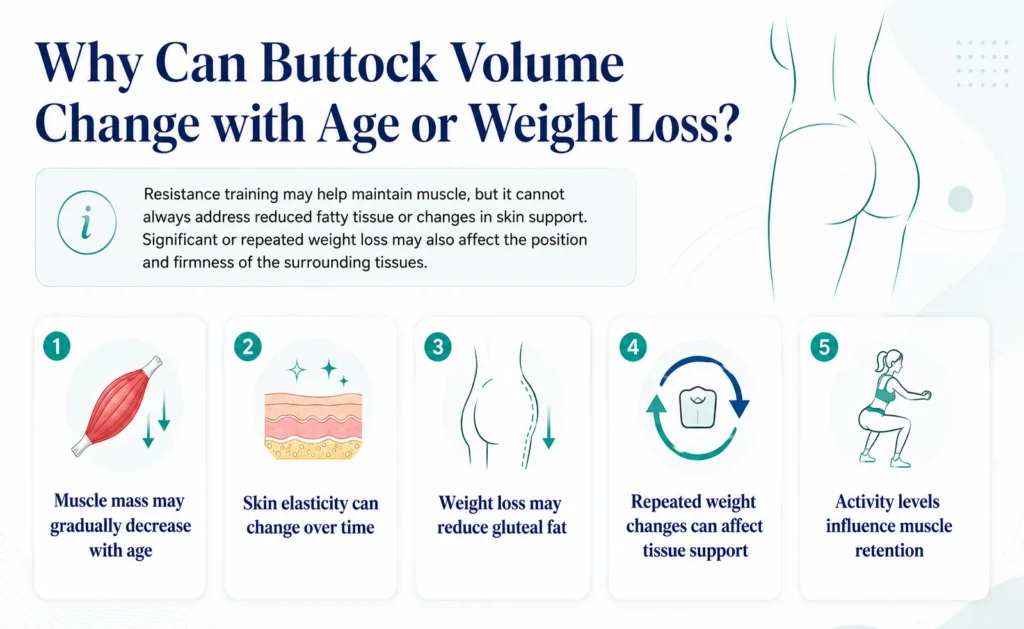
Muscle mass, fatty tissue, skin elasticity and connective-tissue support may change with ageing or significant weight variation. These changes can reduce visible volume or alter how the tissues sit over the gluteal muscles.
Resistance training may help maintain muscle, but it cannot always address reduced fatty tissue or changes in skin support. Significant or repeated weight loss may also affect the position and firmness of the surrounding tissues.
- Muscle mass may gradually decrease with age
- Skin elasticity can change over time
- Weight loss may reduce gluteal fat
- Repeated weight changes can affect tissue support
- Activity levels influence muscle retention
When Should I Seek Professional Advice About Buttock Shape?
Professional assessment may be useful when structured exercise has not produced the expected change. It can help determine whether technique, posture, weight change, anatomy or movement patterns are contributing.
The appropriate first step may be a review by an exercise professional, physiotherapist or medical practitioner. Consultation with a Specialist Plastic Surgeon may be considered when the concern involves anatomical features that exercise is unlikely to change significantly.
- Review whether the exercise program is appropriately structured
- Assess technique and muscle activation
- Consider posture and hip mobility
- Identify the effects of weight change
- Clarify what type of physical change may be possible
What Surgical Options May Be Discussed for Buttock Shape?
Surgical options may include fat transfer, gluteal implants, liposuction or buttock reshaping procedures. The appropriate option depends on anatomy, available donor fat, skin condition, health and individual goals.
Surgery is not a substitute for exercise or general health management. Every procedure involves anaesthesia, incisions, recovery requirements and potential complications, and suitability can only be determined through individual medical assessment.
- Buttock fat transfer
- Gluteal implant surgery
- Liposuction of selected surrounding areas
- Buttock reshaping where excess tissue is present
- Combined procedures for selected patients
How Does Buttock Fat Transfer Work?
Buttock fat transfer involves removing fat from suitable donor areas, processing it and injecting it into selected parts of the buttocks. Some of the transferred fat may remain long term, while another portion may be reabsorbed during healing.
This procedure may be considered when sufficient donor fat is available in areas such as the abdomen, waist or thighs. The amount that can be transferred depends on the patient’s anatomy, tissue quality and surgical assessment.
- Donor fat must be available
- Fat is collected through liposuction
- The tissue is prepared before injection
- Some transferred fat may be reabsorbed
- Direct pressure may need to be limited during recovery
When Might Gluteal Implants Be Considered?
Gluteal implants may be considered for people with limited donor fat who are seeking additional buttock volume or projection. Suitability depends on anatomy, tissue coverage, health and an understanding of the procedure’s limitations.
Gluteal implants are made from semi-solid silicone designed for use in the buttock region. Their size and placement are selected according to the patient’s body structure, activity level and available soft-tissue coverage.
- Implants may suit some patients with low body fat
- Placement depends on individual anatomy
- Incisions will result in scars
- Sitting and exercise restrictions may apply
- Further surgery may be required in the future
Buttock Liposuction Before and After Images
Can Liposuction Affect How Projected the Buttocks Look?
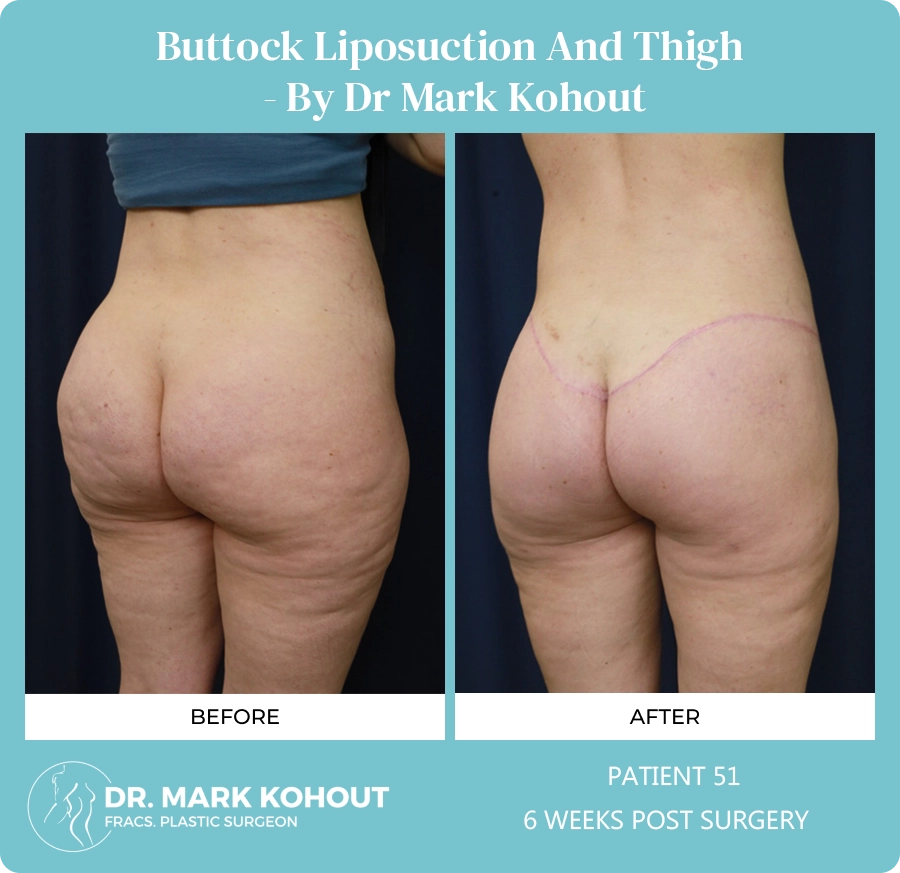
Liposuction can change the visual relationship between the waist, flanks and buttocks by removing selected fatty tissue. It does not directly add volume to the buttocks or increase gluteal muscle size.
Liposuction may be used alone or alongside another procedure when localised fat distribution affects body proportions. It is not a weight-loss treatment, and the possible result depends partly on skin elasticity, anatomy and weight stability.
- Liposuction removes selected fatty tissue
- It does not build gluteal muscle
- It does not add volume to the buttocks
- Skin may not fully contract after fat removal
- Later weight changes can affect appearance
What Happens During a Consultation with Dr Mark Kohout?
A consultation includes discussion of medical history, anatomy, goals, treatment options, limitations, risks and recovery requirements. It also provides an opportunity to determine whether surgery is suitable or whether another approach may be more appropriate.
Dr Mark Kohout assesses body composition, gluteal structure, skin quality and the amount of available donor fat. Patients can also discuss exercise history, weight changes, daily activities and the specific physical change they are considering.
- Review of medical and surgical history
- Physical assessment of the gluteal area
- Discussion of goals and anatomical limitations
- Explanation of potential risks and scars
- Development of an individual plan when appropriate
What Should I Expect During Recovery?
Recovery after surgery may include swelling, discomfort, modified sitting, adjusted sleeping positions and a staged return to work and exercise. The specific instructions depend on the procedure and the patient’s healing progress.
Fat transfer and implant surgery place different demands on the tissues, so recovery advice must be tailored to the operation performed. Follow-up appointments are important because estimated recovery timeframes cannot predict exactly how quickly an individual will heal.
- Arrange transport and assistance after surgery
- Follow wound-care and garment instructions
- Use recommended sitting or sleeping positions
- Avoid strenuous exercise until medically cleared
- Attend scheduled follow-up appointments
What Risks Should I Understand Before Buttock Surgery?
Buttock fat transfer, buttock implant surgery and liposuction carry general surgical risks as well as complications specific to each procedure. No operation can be described as free from risk.
Possible complications include bleeding, infection, blood clots, delayed wound healing, scarring, asymmetry and the need for additional surgery. Fat transfer and implants also involve separate risks that should be explained in detail during consultation.
- Infection, bleeding or fluid collection
- Delayed wound healing
- Scarring or asymmetry
- Changes in sensation
- Revision or additional surgery
Gluteal Procedures FAQs
Can I still sit normally after a fat transfer to the buttocks?
Yes, but you may be advised to avoid prolonged sitting for a short period after surgery. Special cushions or modified seating positions may be recommended during early healing.
Will the fat that’s transferred behave like normal fat over time?
In most cases, transferred fat that successfully establishes a blood supply will act like fat in other areas of the body. It may increase or decrease slightly with overall weight changes.
Is it possible to feel implants while sitting or moving?
This depends on the implant placement and individual anatomy. Some patients report mild awareness initially, which usually settles as healing progresses.
Can I combine a gluteal procedure with posture correction strategies?
Yes. In fact, some patients find that working with physiotherapists or movement specialists enhances both aesthetic and functional outcomes.
Will exercise after the procedure change my results?
Physical activity is generally encouraged after recovery, and muscle building may complement surgical outcomes. However, direct impact on transferred fat or implants is unlikely if post-operative guidance is followed.
What happens to the fat that doesn’t survive after transfer?
A portion of the transferred fat may be reabsorbed by the body, which is a normal part of the healing process. The remaining fat tends to stabilise after several months.
Can this procedure change the way clothes fit?
For some patients, adjustments in gluteal volume may alter how garments sit on the hips or waist. This is often discussed during the consultation to help manage expectations.
Is there a preferred sleeping position during recovery?
Patients are usually advised to sleep on their side or stomach for a short period after surgery. This helps reduce pressure on the area while tissues settle.
Can someone with a very lean frame still be a candidate?
Possibly, but options may be more limited. Patients with low body fat may be better suited to implant-based procedures, depending on their anatomy and goals.
Are the results meant to be obvious to others?
Not necessarily. Many individuals choose subtle changes that align with their natural shape, while others may prefer more noticeable volume. The approach is always tailored to personal preferences.
Medical References
- Valente DS, Kayser V, Kieling L, et al. Gluteal augmentation using dermal fillers: A comprehensive review of techniques and outcomes. Case Rep Rev Open Access. 2023;4(2):131. https://gnoscience.com/uploads/journals/articles/969534962176.pdf
- Omar Tillo MD, MS, EBOPRAS, FRCS(Plast), Reza Nassab MBA FRCS(Plast), Marc Pacifico MD FRCS(Plast) BAAPS Gluteal Fat Grafting Safety Review and Recommendations https://baaps.org.uk/_userfiles/pages/files/baaps_document_on_gluteal_lipofilling_safety_and_recommendations_final_1.pdf
- Daniel Del Vecchio, Jeffrey M Kenkel, Practice Advisory on Gluteal Fat Grafting, Aesthetic Surgery Journal, Volume 42, Issue 9, September 2022, Pages 1019–1029, https://academic.oup.com/asj/article/42/9/1019/6566385
How Can I Decide Whether Buttock Surgery Is Right for Me?
The decision should begin with identifying which anatomical feature is causing concern and whether exercise can realistically change it. Surgery should only be considered after individual assessment and review of the risks, limitations and recovery requirements.
Some people decide that further training, posture management or weight stability is sufficient, while others choose to discuss surgical options with Dr Mark Kohout. The decision should be based on medical advice, realistic expectations and sufficient time to consider the information provided.
- Confirm that exercise has been appropriately structured
- Consider whether your weight is stable
- Identify the specific physical change being considered
- Review the required recovery restrictions
- Consider the risks and possibility of further surgery
What Are the Next Steps for Those Considering Gluteal Adjustment?
People considering gluteal adjustment can begin by arranging a consultation to discuss their anatomy, goals and available options. An individual assessment is needed to determine whether surgery may be suitable and to explain the potential risks, limitations and recovery requirements.
Dr Mark Kohout consults with patients in Sydney who are considering buttock fat transfer, gluteal implants or other buttock reshaping procedures. The consultation provides an opportunity to review medical history, body structure and personal preferences before deciding whether to proceed with treatment.
Take our Plastic Surgery Quiz to find out if you’d be a good candidate and if you are ready for cosmetic surgery.
Further Reading
- Read Dr Kohout’s Procedure page on Body Lift Sydney
- Read Dr Kohout’s Procedure page on Buttock Implant Surgery Sydney
- Read Dr Kohout’s Blog about Preparing for Buttock Reshaping Surgery
Related Blog Posts
What Is Empty Buttock Syndrome? Causes,…
Volume changes in the buttocks are sometimes described as “Empty Buttock Syndrome,” a non-medical term used to explain a noticeable reduction in shape or projection following certain procedures or significant…

Gluteal Augmentation With Implants in Sydney:…
Interest in fuller, more projected buttock shapes has grown steadily, encouraged in part by social media and online imagery. Many people in Sydney arrive at a consultation with screenshots, mixed…
FAQs About Bodylift Surgery
Dr Mark Kohout, Plastic Surgeon in Sydney, brings over 25 years of experience in aesthetic and reconstructive surgery. His practice is known for its patient-focused approach and thorough consultation process.…
Experienced Plastic Surgeon
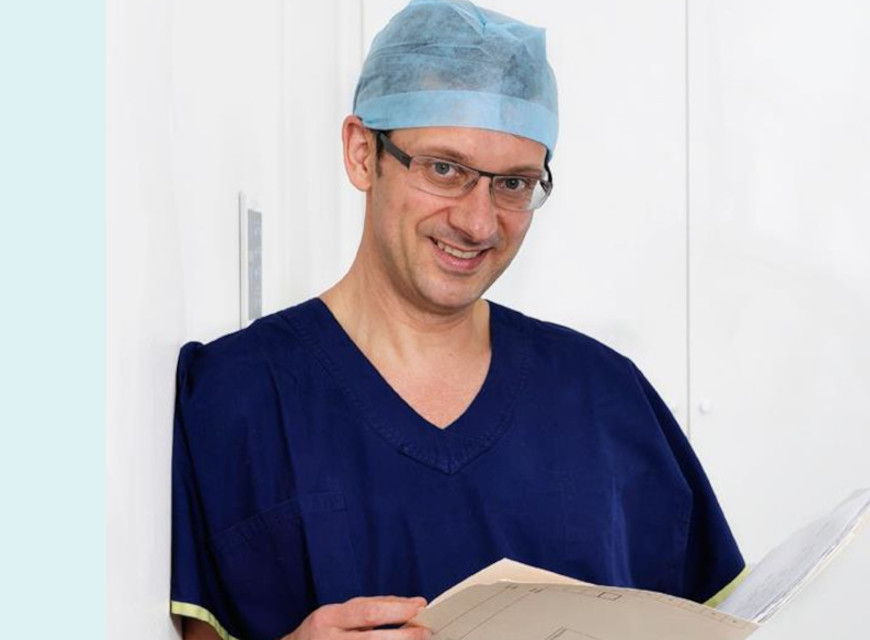
Dr. Mark Kohout
A qualified plastic surgeon who operates with care and integrity, based in central Sydney with over 20 years of experience in the cosmetic field. His extensive training and experience assures patients they are in highly trained surgical hands. Dr. Kohout is a dedicated, friendly professional who is committed to providing the high quality care, support and results, alongside his compassionate team.
Dr Mark Kohout (MED0001133000)
Specialist Plastic Surgeon
Specialist registration in Surgery – Plastic Surgery