


Dr Mark Kohout

Exploring Long-Term Options for Loss of Volume in the Buttocks

doctor working
Home » Blog » Exploring Long-Term Options for Loss of Volume in the Buttocks
Exploring Long-Term Options for Loss of Volume in the Buttocks by Dr Mark Kohout

Table of Contents

Exploring Long-Term Options for Loss of Volume in the Buttocks Banner

Changes in buttock volume can occur with ageing, weight variation, reduced muscle mass or genetically determined fat distribution. These changes may affect body proportions, the side profile or how clothing sits, although the degree and pattern vary between individuals.

Dr Mark Kohout is a Specialist Plastic Surgeon based in Sydney with more than 25 years of clinical experience. He assesses patients considering longer-term surgical options for changes in buttock volume, including fat transfer, gluteal implants and combined approaches where clinically appropriate.

Why Can the Buttocks Lose Volume Over Time?

Buttock volume may decrease because of changes in fatty tissue, muscle mass, skin support and connective tissue. Genetics, weight variation and activity levels can also influence when and where these changes become noticeable.

The buttocks are formed by the pelvis, gluteal muscles, fatty tissue and overlying skin. A change in any of these structures can alter projection, fullness or the relationship between the buttocks and surrounding areas.

Common contributing factors include:

  • Reduced subcutaneous fatty tissue
  • Changes in gluteal muscle mass
  • Significant or repeated weight variation
  • Genetically determined fat distribution
  • Changes in skin and connective-tissue support

Are There Long-Term Surgical Options for Reduced Buttock Volume?

Fat transfer and gluteal implants may provide longer-term changes in buttock volume for suitable patients. Neither method stops ageing, prevents weight-related changes or guarantees that the result will remain unchanged.

The duration of a visible change depends on the procedure, anatomy, healing, weight stability and lifestyle. Dr Mark Kohout discusses these factors during consultation so patients can consider both the potential longevity and limitations of each option.

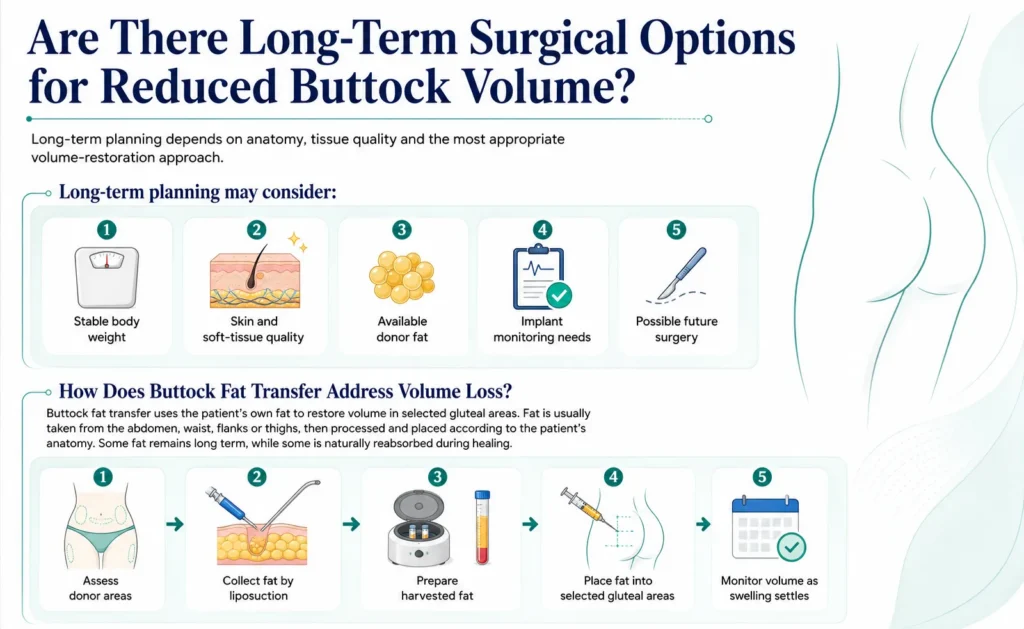
Long-term planning may consider:

  • Stability of body weight
  • Skin and soft-tissue quality
  • Available donor fat
  • Implant monitoring requirements
  • The possibility of further surgery
Are There Long Term Surgical Options for Reduced Buttock Volume by Dr Mark Kohout

How Does Buttock Fat Transfer Address Volume Loss?

Buttock fat transfer uses fatty tissue collected from another area of the patient’s body to add volume to selected gluteal regions. Some transferred fat may remain after healing, while another portion is expected to be reabsorbed.

Fat is usually collected through liposuction from areas such as the abdomen, waist, flanks or thighs. It is then prepared and placed into selected areas according to the patient’s anatomy and the capacity of the recipient tissues.

The procedure generally involves:

  • Assessing potential donor areas
  • Collecting fat through liposuction
  • Preparing the harvested tissue
  • Placing fat into selected gluteal areas
  • Monitoring volume as swelling settles

Who May Be Suitable for Buttock Fat Transfer?

Fat transfer to the buttocks may be considered when sufficient donor fat is available and the patient’s health supports surgery and healing. Suitability also depends on the amount of volume being considered and the condition of the donor and recipient tissues.

People with a very lean build may not have enough donor fat for a meaningful transfer. Smoking or nicotine use, unstable weight and certain medical conditions may also affect candidacy or increase the likelihood of healing complications.

Assessment usually includes:

  • Amount and distribution of donor fat
  • General health and medical history
  • Skin quality and tissue capacity
  • Weight stability
  • Ability to follow postoperative instructions

How Long Can Transferred Fat Remain?

Fat that establishes an adequate blood supply may remain for an extended period and behave similarly to other fatty tissue in the body. Its volume may still change with weight gain, weight loss, ageing or further changes in the surrounding tissues.

The final retained volume cannot be predicted precisely because fat survival varies between patients and treatment areas. The appearance present immediately after surgery also includes swelling and should not be treated as the settled result.

Factors that may influence retained volume include:

  • Individual healing response
  • Amount and placement of transferred fat
  • Blood supply within the recipient tissues
  • Postoperative pressure and care
  • Later changes in body weight

What Are the Limitations of Buttock Fat Transfer?

Buttock fat transfer cannot guarantee a precise increase in volume, permanent symmetry or a fixed long-term shape. The amount that can be placed is limited by donor-fat availability and the capacity of the receiving tissues.

Some patients may consider a further procedure if fat retention is lower than anticipated or if their goals change. Additional surgery involves new risks, costs and recovery requirements and should not be assumed at the initial planning stage.

Important limitations include:

  • Variable fat retention
  • Possible contour differences
  • Limited donor-fat supply
  • Changes with later weight variation
  • Potential need for further surgery

How Do Gluteal Implants Address Buttock Volume?

Gluteal implants add structural volume without relying on the patient’s fat reserves. They are selected and positioned according to pelvic dimensions, muscle structure, tissue coverage and the degree of projection being considered.

Implants used in the buttock region are semi-solid silicone devices designed for this anatomical area. They are placed through an incision near the crease between the buttocks and positioned in relation to the gluteal muscle.

Implant planning considers:

  • Buttock and pelvic dimensions
  • Available soft-tissue coverage
  • Implant size and shape
  • Incision and scar position
  • Daily activity and exercise habits

Who May Consider Gluteal Implant Surgery?

Gluteal implants may be discussed with patients who have limited donor fat but are considering additional volume or projection. General health, tissue coverage and the ability to follow recovery restrictions are central to suitability.

Implants are not appropriate for every patient, particularly when the available tissue may not adequately cover the device. An examination is required to assess muscle dimensions, skin quality and how the proposed implant may relate to surrounding structures.

A suitable candidate may have:

  • Limited fatty tissue for transfer
  • Adequate implant coverage
  • Stable general health
  • Realistic expectations
  • Capacity to follow sitting and activity restrictions

Are Gluteal Implants Permanent?

Gluteal implants are intended for long-term placement, but they should not be described as lifetime devices. Revision, adjustment or removal may be required because of complications, changes in anatomy or evolving patient preferences.

Implants do not respond to weight variation in the same way as fatty tissue. However, the skin, muscles and tissues around them can still change with ageing, weight fluctuation or physical activity.

Long-term considerations include:

  • Ongoing clinical review when advised
  • Changes in surrounding tissues
  • Implant movement or awareness
  • Infection or fluid collection
  • Possible replacement or removal

What Are the Main Limitations of Gluteal Implants?

Gluteal implants cannot guarantee exact symmetry, a specific profile or a particular degree of softness. Their visibility and how noticeable they feel depend partly on implant placement and the amount of tissue covering them.

Lean patients may have a greater chance of noticing implant edges because they have less soft-tissue coverage. The balance between adding volume and maintaining adequate coverage must be considered during planning.

Possible limitations include:

  • Palpable or visible implant edges
  • Movement, rotation or displacement
  • Firmness or implant awareness
  • Scarring
  • Need for future revision surgery

Can Fat Transfer and Implants Be Combined?

A combined approach may use an implant for structural volume and a limited amount of fat to adjust selected contour transitions. It is only an option when suitable donor fat is available and the combined procedure is medically appropriate.

Combining methods can increase the extent and complexity of surgery. Patients must consider the separate risks of liposuction, fat grafting and implant placement, along with the additional recovery requirements.

A combined plan may be used to:

  • Add central projection with an implant
  • Adjust selected outer transitions
  • Address minor contour differences
  • Use limited donor fat strategically

How Does Weight Affect Long-Term Buttock Volume?

Weight gain or loss can change the volume of natural and transferred fatty tissue around the buttocks. Significant weight variation may also affect the skin and alter how an implant relates to surrounding tissues.

Surgical planning is generally more reliable when the patient’s weight is stable and maintainable. Surgery does not prevent future changes associated with weight, ageing, pregnancy or reduced physical activity.

Weight-related considerations include:

  • Enlargement of retained fat with weight gain
  • Reduced transferred volume after weight loss
  • Changes in skin support
  • Altered proportions around an implant
  • Effects on donor areas after liposuction

Can Gluteal Muscle Training Support Long-Term Results?

Gluteal training may help maintain muscle strength and contribute to the underlying structure of the buttocks after recovery. It cannot prevent all age-related tissue changes or control how retained fat changes over time.

Patients must pause or modify exercise during early healing and return gradually after medical clearance. The timing differs according to whether the procedure involved fat transfer, implants, liposuction or a combination.

Long-term activity may support:

  • Gluteal muscle strength
  • Hip stability
  • General physical conditioning
  • Maintenance of mobility

What Happens During a Consultation with Dr Mark Kohout?

The consultation includes an assessment of buttock volume, muscle structure, skin quality, donor-fat availability and overall proportions. It also allows patients to compare the limitations, risks and recovery requirements of each surgical option.

Dr Mark Kohout reviews health conditions, medications, previous procedures, weight history, nicotine use and regular activities. He then explains whether fat transfer, implants, a combined approach or no surgery may be appropriate.

The assessment may include:

  • Medical and surgical history
  • Physical examination
  • Review of donor-fat distribution
  • Discussion of goals and limitations
  • Explanation of likely scars and recovery
Download Dr Mark Kohout’s Fees & Cost of Surgery Guide

What Should I Expect During Recovery?

Recovery may include swelling, bruising, discomfort and temporary changes to sitting, sleeping, work and exercise. The exact instructions and recovery period depend on the procedure and individual healing response.

Patients receive written guidance about wound care, garments, medications, movement and symptoms that require clinical attention. Follow-up visits allow Dr Mark Kohout and the clinical team to monitor progress and adjust advice when needed.

Recovery planning may involve:

  • Arranging transport after surgery
  • Organising help at home
  • Modifying sitting or sleeping positions
  • Taking leave from work
  • Attending postoperative reviews

How Long Should I Avoid Pressure on the Buttocks?

Direct pressure may need to be limited during the initial healing period after fat transfer or implant surgery. The required duration varies and should follow the individual instructions provided by the operating surgeon.

Fixed timeframes should not be treated as universal because the operation and healing pattern differ between patients. Desk work, driving and travel should be discussed before surgery so practical arrangements can be made.

Planning may include:

  • Modified sitting positions
  • Temporary use of recommended supports
  • Changes to sleep position
  • Adjusted work arrangements

What Risks Are Associated with Buttock Fat Transfer?

Gluteal fat transfer involves general surgical risks and procedure-specific risks, including fat embolism. Research supports careful attention to anatomy and confirmation that fat remains within the intended subcutaneous plane.

Other complications may include infection, bleeding, fat necrosis, fluid collection, contour irregularity, asymmetry and delayed healing. Ultrasound guidance may assist with visualising cannula placement, but it does not remove all risk.

Potential complications include:

  • Fat embolism
  • Infection or bleeding
  • Fat necrosis or firm areas
  • Uneven fat retention
  • Contour irregularity

What Risks Are Associated with Gluteal Implants?

Gluteal implant surgery carries risks related to anaesthesia, incisions, wound healing and the implant itself. Some complications may require medication, drainage, revision surgery or removal of the implant.

The position of the incision and ongoing pressure on the area can make wound care particularly important. Patients must follow instructions about hygiene, sitting, movement and physical activity.

Implant-related concerns may include:

  • Infection or fluid collection
  • Wound separation
  • Implant movement
  • Changes in sensation
  • Visible or widened scars

Surgical Options for Buttock Volume Changes FAQs

Can I sleep on my back after surgery?Patients are usually advised to avoid sleeping directly on their back for the initial healing period. Side or stomach sleeping positions are generally recommended until cleared by your surgeon.
Will the procedure affect how I sit or move long-term?Most individuals return to their usual movements once healing is complete. Any short-term adjustment to sitting or posture is typically temporary and part of early recovery care.
Can the fat used in transfer come back in other areas?Fat cells removed through liposuction do not return in the same area, but remaining fat cells in the body can expand with significant weight gain. The procedure does not prevent future body changes related to lifestyle or metabolism.
Is it possible to combine buttock augmentation with other procedures?Yes, some patients consider combining this with other body procedures such as liposuction or abdominal surgery. This is carefully planned to support safety and recovery.
Do implants make noise or feel unnatural?Implants used in this procedure are designed to remain stable and discreet. When positioned correctly, they typically feel integrated with the surrounding tissue.
Can I still engage in sports or strength training after surgery?Most patients return to full activity following recovery. It’s important to follow your surgeon’s timeline to avoid placing stress on healing tissues too early.
Does fat transfer change if I lose weight after surgery?Yes, significant weight loss may reduce the retained fat in the buttocks. Maintaining a consistent weight is encouraged to support long-term results.
Is there a risk of asymmetry after the procedure?Mild differences between sides are common in all areas of the body, and perfect symmetry cannot be guaranteed. Surgical planning aims to create a balanced result based on your anatomy.
Can the procedure change how clothing fits?Many patients report a difference in how certain garments sit, especially trousers and swimwear. This varies depending on the degree of change and individual body proportions.
Are there seasonal considerations for recovery?Some patients prefer scheduling this type of surgery during cooler months for comfort with compression garments and reduced sun exposure. Timing can be adjusted based on lifestyle and availability.
Medical References
  • Augmented Safety Profile of Ultrasound-Guided Gluteal Fat Transfer: Retrospective Study With 1815 Patients. Natalia Vidal-Laureano, Carlos T Huerta, Eduardo A Perez, Steven Alexander Earle. Aesthetic Surgery Journal, Volume 44, Issue 4, April 2024, Pages NP263–NP270. https://doi.org/10.1093/asj/sjad377
  • Subfascial/Intramuscular Dual-Plane Gluteal Implantation and Supplemental Fat Grafting: A Novel Technique for Buttock Augmentation. Rolando Morales, James Mentz, Taylor G Hallman, Chase Castillo. Aesthetic Surgery Journal, Volume 43, Issue 12, December 2023, Pages 1499–1507. https://doi.org/10.1093/asj/sjad198
  • Ultrasound-Guided Gluteal Fat Grafting: What is the Evidence? A Systematic Review and Meta-Analysis. Andre Milani Reis, Maria Meritxell Roca Mora, Pedro Bicudo Bregion, Lucas Kreutz-Rodrigues, Steven Camp, Basel A Sharaf. Aesthetic Surgery Journal, Volume 46, Issue 1, January 2026, Pages 57–62. https://doi.org/10.1093/asj/sjaf059

What Should I Consider Before Choosing Surgery?

The decision should be based on personal preferences, medical suitability and a clear understanding of risks and limitations. Surgery should not be undertaken with the expectation that it will stop ageing or produce an unchanging result.

Patients should compare the proposed physical change with the scars, recovery, costs and possibility of additional surgery. Taking time to reflect or seek a second qualified opinion can support informed decision-making.

Questions to consider include:

  • What specific volume change am I seeking?
  • Do I understand the main complications?
  • Am I prepared for the recovery restrictions?
  • Could I accept a variable or asymmetric result?
  • Have I considered the possibility of future surgery?

What Are the Next Steps for Those Considering Buttock Volume Surgery?

People considering longer-term options for reduced buttock volume can arrange a consultation to discuss their anatomy, health and preferences. Individual assessment is required to determine whether fat transfer, gluteal implants, a combined method or no surgery may be appropriate.

Dr Mark Kohout provides consultations in Sydney for patients considering buttock volume and reshaping procedures. The appointment provides time to compare options, ask questions and review potential complications, scars and recovery requirements.

  • Arrange an individual consultation
  • Explain the volume change being considered
  • Review donor-fat and implant suitability
  • Ask about risks and long-term care
  • Allow time to consider the proposed plan

Explore factors commonly discussed when considering buttock surgery. This quiz does not determine medical suitability.

Further Reading

Related Blog Posts

What Is Empty Buttock Syndrome? Causes, Volume Loss & Treatment Options in Sydney

What Is Empty Buttock Syndrome? Causes,…

Volume changes in the buttocks are sometimes described as “Empty Buttock Syndrome,” a non-medical term used to explain a noticeable reduction in shape or projection following certain procedures or significant…
Gluteal Augmentation With Implants in Sydney: Understanding a Surgical Option

Gluteal Augmentation With Implants in Sydney:…

Interest in fuller, more projected buttock shapes has grown steadily, encouraged in part by social media and online imagery. Many people in Sydney arrive at a consultation with screenshots, mixed…

FAQs About Bodylift Surgery

FAQs About Bodylift Surgery

Dr Mark Kohout, Plastic Surgeon in Sydney, brings over 25 years of experience in aesthetic and reconstructive surgery. His practice is known for its patient-focused approach and thorough consultation process.…
Dr. Mark Kohout

Experienced Plastic Surgeon

Dr. Mark Kohout

A qualified plastic surgeon who operates with care and integrity, based in central Sydney with over 20 years of experience in the cosmetic field. His extensive training and experience assures patients they are in highly trained surgical hands. Dr. Kohout is a dedicated, friendly professional who is committed to providing the high quality care, support and results, alongside his compassionate team.

Dr Mark Kohout (MED0001133000)
Specialist Plastic Surgeon
Specialist registration in Surgery – Plastic Surgery

This website contains imagery which is only suitable for audiences 18+. All surgery contains risks, read more here.

X

Get Your Cost of Surgery Guide

Get Your Facial Aesthetic

Get Your Breast Implant Removal

Get Your Female Genital Surgery Guide

Get Your Excess Skin Guide

Get Your Gynaecomastia Guide

Get Your Liposuction Guide

Get Your Abdominoplasty Guide

Get Your Breast Implant Replace Guide

Get Your Breast Reduction Guide

Get Your Breast Augmentation Guide

Make an Enquiry