


Some people consider buttock implant surgery to add volume or change projection in the gluteal area. The decision is personal and should be based on individual anatomy, health, preferences and a clear understanding of the operation’s limitations and risks.
Dr Mark Kohout is a Specialist Plastic Surgeon in Sydney with more than 25 years of clinical experience. He assesses muscle dimensions, tissue thickness, pelvic structure and lifestyle factors before determining whether implant surgery may be suitable and where an implant could be positioned.
Why Do Some People Consider Buttock Implant Surgery?
Buttock implant surgery may be considered by people seeking additional volume or projection in the upper and central buttocks. It may also be discussed when there is insufficient donor fat for a fat-transfer procedure.
The shape of the buttocks is influenced by the pelvis, gluteal muscles, fatty tissue and overlying skin. Surgery cannot create a universal or standard appearance, so planning focuses on the specific physical change being considered and whether it is compatible with the patient’s anatomy.
Common reasons for seeking information include:
- Limited projection when viewed from the side
- Naturally low volume in the gluteal area
- Differences between the left and right sides
- Changes associated with weight variation
- Limited fatty tissue for transfer
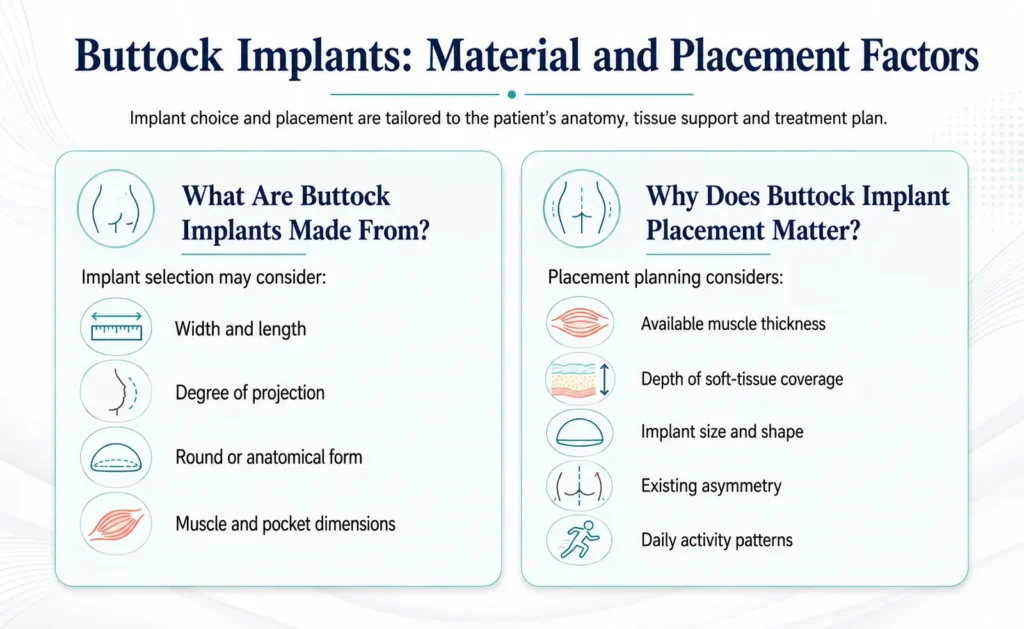
What Are Buttock Implants Made From?
Buttock implants are semi-firm silicone devices made specifically for placement in the gluteal region. They are more solid than typical breast implants and are designed to maintain their form under pressure from sitting and movement.
Implants are available in different dimensions and profiles, but selection is limited by the space available within the tissues. A larger implant is not automatically appropriate, particularly when muscle width or soft-tissue coverage is limited.
Implant selection may consider:
- Width and length
- Degree of projection
- Round or anatomical form
- Muscle and pocket dimensions
Why Does Buttock Implant Placement Matter?
The implant pocket affects tissue coverage, implant stability and how the device interacts with the gluteal muscles during movement. Placement also influences which implant dimensions can be accommodated and which complications may be more relevant.
There is no single placement plane that is appropriate for every patient. The decision should follow physical examination and take account of muscle thickness, skin and fat coverage, pelvic dimensions, previous surgery and the proposed change.
Placement planning considers:
- Available muscle thickness
- Depth of soft-tissue coverage
- Implant size and shape
- Existing asymmetry
- Daily activity patterns
What Is Intramuscular Buttock Implant Placement?
Intramuscular placement positions the implant within a pocket created in the gluteus maximus muscle. This is the placement described on Dr Mark Kohout’s current buttock implant surgery page.
The muscle provides tissue coverage around the implant and helps define the available pocket. Intramuscular placement requires careful dissection because the pocket must be deep enough for coverage while preserving appropriate muscle function and surrounding structures.
Features of intramuscular placement include:
- The implant sits within the gluteus maximus
- Muscle thickness helps cover the device
- Pocket dimensions limit implant selection
- Careful anatomical planning is required
Who May Be Assessed for Intramuscular Placement?
Intramuscular placement may be considered when the gluteus maximus has adequate dimensions and thickness to accommodate an implant. Suitability cannot be determined from body weight or photographs alone.
Dr Mark Kohout examines the muscle boundaries, buttock length, tissue thickness and position of the lower buttock fold. He also considers whether the requested projection can be accommodated without selecting an implant that is unsuitable for the available tissues.
Assessment may include:
- Gluteus maximus width and thickness
- Available soft-tissue coverage
- Buttock length and pelvic proportions
- Lower buttock fold position
- The proposed implant dimensions
What Is Subfascial Buttock Implant Placement?
Subfascial placement positions the implant above the gluteal muscle but beneath the fascia covering it. This gives the implant less muscle coverage than an intramuscular pocket.
Because the implant is positioned closer to the skin, sufficient fatty tissue and skin thickness are important. In patients with limited coverage, implant margins may be more visible or easier to feel.
Important considerations include:
- The implant sits above the muscle
- Coverage is provided mainly by fascia, fat and skin
- Tissue thickness is particularly important
- Implant visibility may be a concern
What Is Submuscular Buttock Implant Placement?
Submuscular placement positions the implant beneath the gluteus maximus muscle. It is a deeper anatomical plane and differs from creating a pocket within the muscle itself.
The plane is discussed in the broader history of gluteal implant surgery, but technique selection varies between surgeons and patients. Deeper placement does not automatically make an operation more appropriate, and the relationship to nearby anatomical structures must be considered.
Points relevant to submuscular placement include:
- The implant is positioned beneath the muscle
- The pocket is deeper than an intramuscular pocket
- Anatomical access can be more technically demanding
- It is not suitable for every body structure
What Is Dual-Plane Gluteal Implant Placement?
Dual-plane placement uses more than one tissue plane to create an implant pocket. Published research has described a combined subfascial and intramuscular technique, sometimes used with liposuction and limited fat grafting.
A 2023 retrospective study reported outcomes from 175 cases using this approach, with infection identified as the most frequently reported complication. The study was Level IV evidence, so its findings describe one clinical series rather than establishing one technique as preferable for all patients.
The study reported complications including:
- Infection
- Wound separation
- Fluid collection
- Capsular contracture
- Implant migration
Is One Implant Placement Technique Better Than the Others?
No placement technique is universally preferable for every patient. Each method has anatomical requirements, limitations and procedure-specific considerations.
The most appropriate pocket is the one that can accommodate a suitable implant while providing adequate coverage and respecting the patient’s anatomy. The decision should not be based solely on online comparisons or another patient’s procedure.
The choice depends on:
- Muscle anatomy
- Tissue coverage
- Implant dimensions
- Surgical history
- The change being considered
How Does Tissue Thickness Affect Implant Placement?
Tissue thickness affects how well the implant is covered and whether its edges may be visible or palpable. People with limited subcutaneous fat generally require particular attention to pocket depth and implant size.
An implant that is too large for the available coverage may place excessive tension on the tissues or appear more noticeable. Selecting a smaller or differently shaped implant may sometimes be more appropriate than trying to create a larger change.
Limited tissue coverage may increase concerns about:
- Visible implant borders
- Palpable edges
- Tissue tension
- Wound-healing difficulties
Where Are the Incisions Made?
Incisions are most commonly positioned in the crease between the buttocks. Through these incisions, the surgeon creates the planned pockets and inserts the implants.
Every incision results in a scar, although its final appearance varies between patients. The position of the crease may help make the scar less noticeable in some circumstances, but it also requires careful wound care because of its anatomical location.
Patients should understand that:
- Scars cannot be avoided
- Scar appearance changes during healing
- Wound care is particularly important
- Raised or widened scars may occur
What Can Buttock Implants Change?
Buttock implants are generally used to add volume and projection to the upper and central gluteal region. They do not reliably fill the lower buttock or reposition a descended lower buttock fold.
The change depends on implant dimensions, pelvic structure, muscle anatomy and existing soft tissue. An implant cannot reproduce another person’s proportions or guarantee exact symmetry.
Implants may address:
- Limited upper-buttock volume
- Reduced central projection
- Selected differences in size
- Volume when donor fat is limited
What Can Buttock Implants Not Address?
Buttock implants do not correct every concern involving the buttocks, hips or surrounding skin. Separate or alternative procedures may be required when the main concern is skin laxity, lower-buttock descent or outer-hip hollowing.
Identifying the actual anatomical concern is therefore important before selecting a procedure. Adding an implant when the primary issue involves skin position may not provide the type of change the patient is considering.
Implants may have limited effect on:
- Significant loose skin
- A descended lower buttock fold
- Broad outer-hip hollowing
- Changes caused mainly by skin laxity
- Overall weight-related body proportions
What Happens During a Consultation with Dr Mark Kohout?
The consultation includes an assessment of the buttocks while standing and may also include observation while sitting. Dr Mark Kohout reviews the patient’s anatomy, health, goals and everyday activities before discussing placement and implant options.
Medical history, medications, nicotine use, previous operations and weight changes are also reviewed. The consultation provides an opportunity to discuss what implants may change, what they cannot address and whether another option or no surgery may be more appropriate.
The appointment may include:
- Medical and surgical history
- Physical examination
- Review of muscle and tissue coverage
- Discussion of implant dimensions
- Explanation of risks and recovery
How Are Implant Size and Shape Selected?
Implant dimensions are selected according to the available pocket, pelvic proportions and tissue coverage. Patient preference is considered, but anatomy determines what can reasonably be accommodated.
Choosing an implant that exceeds the capacity of the tissues may increase tension, visibility or positioning concerns. Dr Mark Kohout discusses the likely effect of different implant profiles without promising a precise final appearance.
Selection takes account of:
- Pocket width and length
- Desired degree of projection
- Tissue thickness
- Existing asymmetry
What Happens During Buttock Implant Surgery?
Buttock implant surgery is performed under general anaesthesia in an accredited hospital. The surgeon creates a pocket in the planned tissue plane, inserts the implant and closes the incision.
The operating team positions and pads the patient to protect pressure areas during surgery. The exact operative steps vary according to anatomy, implant selection and whether any additional procedure is being performed.
The procedure involves:
- Preoperative markings
- General anaesthesia
- Creation of the implant pockets
- Placement of the implants
- Closure and dressings
What Should I Expect During Recovery?
Recovery after buttock implant surgery may involve swelling, bruising, discomfort and temporary restrictions on sitting, sleeping and physical activity. The duration and intensity of these restrictions vary according to the operation and individual healing.
Patients receive instructions about wound care, medications, movement and signs that require clinical review. Follow-up appointments allow Dr Mark Kohout and the clinical team to monitor the incision, implant position and overall recovery.
Recovery planning may include:
- Assistance at home
- Modified sitting positions
- Changes to sleeping arrangements
- Time away from work
- Gradual return to exercise
What Risks Are Associated with Buttock Implants?
Buttock implant surgery carries risks related to anaesthesia, wounds and the implant itself. Some complications may require medication, drainage, revision surgery or implant removal.
For a broader overview of the procedure, including potential complications and postoperative considerations, read Gluteal Augmentation With Implants: Risks, Recovery and FAQs.
Published studies of gluteal implant surgery have reported infection, wound separation, fluid collection, capsular contracture and implant migration. Individual risk varies according to health, anatomy, technique, implant size and postoperative care.
Potential complications include:
- Infection or bleeding
- Wound-healing problems
- Implant movement
- Fluid collection
- Further surgery
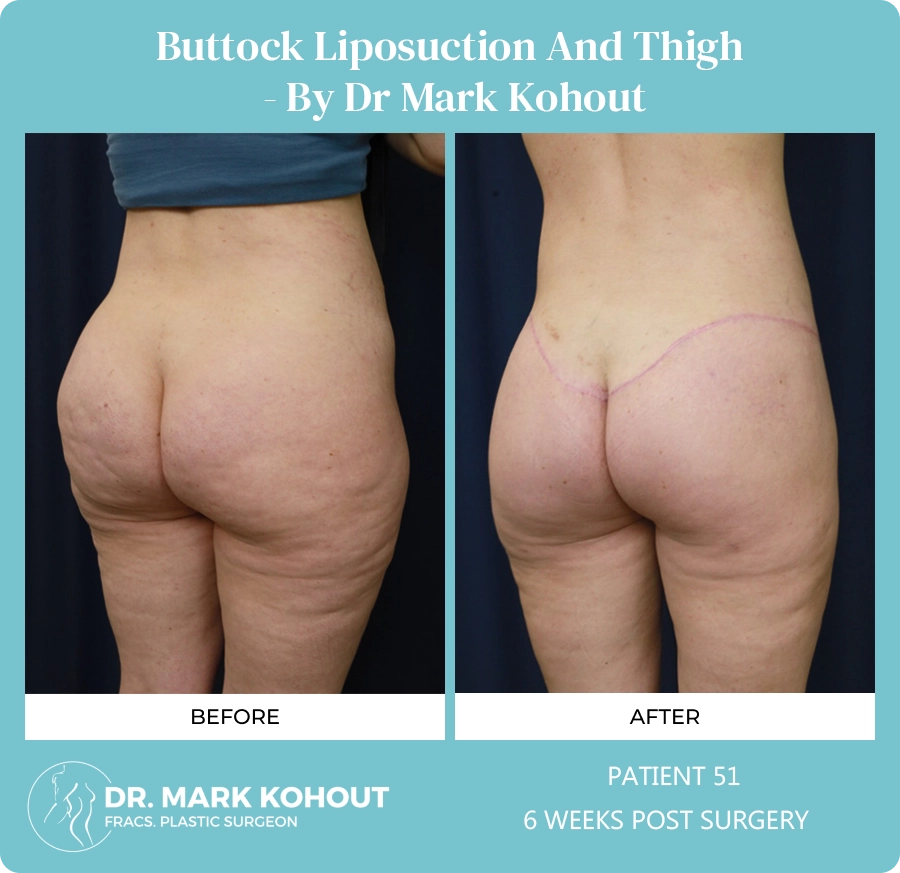
Buttock Liposuction Before and After Images
Can Buttock Implants Be Felt or Seen?
Implants may be noticeable by touch or visible under the skin, particularly when soft-tissue coverage is limited. Placement within deeper tissue and appropriate implant sizing may reduce this possibility but cannot eliminate it.
The degree of implant awareness can also change with weight loss, ageing or thinning of the surrounding tissues. Patients should understand that the implant remains a medical device rather than becoming natural body tissue.
Visibility and palpability depend on:
- Pocket depth
- Implant size
- Fat and skin thickness
- Later weight variation
Do Buttock Implants Need to Be Replaced?
Buttock implants are intended for long-term use, but they should not be described as lifetime devices. Revision, adjustment or removal may become necessary because of complications, tissue changes or altered preferences.
Regular imaging is not automatically required in the same way for every implant type or patient. New symptoms, changes in position or concerns about the implant should be assessed by an appropriately qualified medical practitioner.
Further surgery may be considered for:
- Implant movement
- Infection
- Wound complications
- Changes in surrounding tissue
- A later decision to remove or replace the implants
Buttock Implant Surgery FAQs
Can I combine buttock implants with other procedures?
Yes, in some cases, individuals choose to have additional procedures during the same operation, depending on their anatomy and overall health. This is assessed during consultation to ensure safety and suitability.Will the implants affect how I sit or move?
In the early stages of healing, patients may need to adjust how they sit or lie down. Over time, most people adapt to the presence of implants with appropriate guidance during recovery.Are buttock implants visible under the skin?
This depends on factors such as soft tissue coverage, implant size, and placement technique. Your surgeon will assess your tissue thickness to help reduce the likelihood of the implant being noticeable.Can I choose the shape or firmness of the implants?
There are different implant types available, including variations in shape and firmness. These options will be discussed with you to ensure the selection aligns with your anatomy and goals.What happens if I lose or gain weight after surgery?
Weight fluctuations can affect the surrounding tissue and may alter how the implants sit. During your consultation, the impact of weight changes will be discussed in relation to long-term expectations.How do I know if I am suitable for this procedure?
Suitability is determined by a thorough consultation that includes a medical history, physical assessment, and a discussion of your expectations. Not everyone is a candidate, and all options are reviewed carefully.Do implants need to be replaced over time?
Buttock implants are designed to be long-lasting, but like all medical devices, they may need to be assessed over time. Regular follow-ups are recommended to monitor their condition.Is one placement technique more natural-looking than another?
Each placement technique has different outcomes based on your body structure and soft tissue. The goal is to select a method that supports your preferences while respecting anatomical limits.Can I still exercise after having implants?
Most people can return to regular movement and activity after an appropriate healing period. Specific exercises may need to be modified temporarily, and this will be discussed during follow-up visits.What if I change my mind after surgery?
Any surgical decision involves planning for both short-term and long-term considerations. Implant removal or revision may be discussed if required, and options will be explained in detail.Medical References
- Gluteal Augmentation: A Historical Perspective on Aesthetic Practice. Roberto Chacur. Aesthetic Surgery Journal Open Forum, Volume 7, 2025, ojae124. https://doi.org/10.1093/asjof/ojae124
- Subfascial/Intramuscular Dual-Plane Gluteal Implantation and Supplemental Fat Grafting: A Novel Technique for Buttock Augmentation. Rolando Morales, James Mentz, Taylor G Hallman, Chase Castillo. Aesthetic Surgery Journal, Volume 43, Issue 12, December 2023, Pages 1499–1507. https://doi.org/10.1093/asj/sjad198
Why Does Specialist Plastic Surgery Training Matter?
A Specialist Plastic Surgeon has completed recognised specialist training in plastic and reconstructive surgery. This training covers surgical anatomy, operative planning, complication management and postoperative care.
Dr Mark Kohout is registered as a Specialist Plastic Surgeon and currently provides buttock implant surgery information through his Sydney practice. His website describes intramuscular pocket creation as the usual approach used in his implant procedure.
Relevant considerations when choosing a surgeon include:
- Specialist registration
- Experience with the proposed procedure
- Use of accredited facilities
- Access to postoperative care
- Clear discussion of complications
What Are the Next Steps for Those Considering Buttock Implants?
People considering buttock implants can arrange a consultation to discuss their anatomy, preferred degree of change and available options. Individual assessment is required to determine whether implant surgery and a particular placement technique may be appropriate.
Dr Mark Kohout provides consultations in Sydney for people seeking information about buttock implant surgery. The appointment allows time to review implant selection, pocket placement, scars, risks, recovery and possible alternatives before making a decision.
- Arrange an individual consultation
- Describe the specific change being considered
- Ask which placement may suit your anatomy
- Review the risks and recovery requirements
- Allow time to consider the information
This article provides general educational information and does not replace personal medical advice. All surgical and invasive procedures carry risks, and suitability requires assessment by an appropriately qualified medical practitioner.
Take our Plastic Surgery Quiz to find out if you’d be a good candidate and if you are ready for cosmetic surgery.
Further Reading
- Read Dr Mark Kohout’s Procedure Page on Body Lift Surgery
- Read Dr Mark Kohout’s Procedure Page on Thigh Lift Surgery
- Read Dr Mark Kohout’s Blog about Exploring Options for Changing Buttock Shape Without Fat Transfer
- Read Dr Mark Kohout’s Blog about Why Your Buttocks Look Flat Despite Exercise
- Read Dr Mark Kohout’s Blog about Preparing for Buttock Reshaping Surgery: A Practical Pre-Op Checklist
Related Blog Posts
What Is Empty Buttock Syndrome? Causes,…
Volume changes in the buttocks are sometimes described as “Empty Buttock Syndrome,” a non-medical term used to explain a noticeable reduction in shape or projection following certain procedures or significant…

Gluteal Augmentation With Implants in Sydney:…
Interest in fuller, more projected buttock shapes has grown steadily, encouraged in part by social media and online imagery. Many people in Sydney arrive at a consultation with screenshots, mixed…

FAQs About Bodylift Surgery
Dr Mark Kohout, Plastic Surgeon in Sydney, brings over 25 years of experience in aesthetic and reconstructive surgery. His practice is known for its patient-focused approach and thorough consultation process.…
Experienced Plastic Surgeon
Dr. Mark Kohout
A qualified plastic surgeon who operates with care and integrity, based in central Sydney with over 20 years of experience in the cosmetic field. His extensive training and experience assures patients they are in highly trained surgical hands. Dr. Kohout is a dedicated, friendly professional who is committed to providing the high quality care, support and results, alongside his compassionate team.
Dr Mark Kohout (MED0001133000)
Specialist Plastic Surgeon
Specialist registration in Surgery – Plastic Surgery