
Implant-based buttock surgery is one option for people considering a change in gluteal volume or projection. Unlike fat transfer, the procedure uses silicone implants and does not depend on the patient having enough fatty tissue available for harvesting.
Dr Mark Kohout is a Specialist Plastic Surgeon practising in Sydney with more than 25 years of clinical experience. His consultation process considers medical history, anatomy, implant suitability, potential complications and recovery requirements so that patients can make informed decisions about their care.
What Is Implant-Based Buttock Surgery?
Implant-based buttock surgery involves placing silicone implants within a surgically created pocket in the gluteal region. The operation may add volume or projection, but the degree of change depends on anatomy, implant dimensions and available tissue coverage.
The implants are manufactured specifically for use in the buttocks and are firmer than fluid-filled breast implants. They do not rely on donor fat, which means they may be discussed with patients who have limited fatty tissue or are not suitable for fat transfer.
The procedure may involve:
- Selecting an implant based on body dimensions
- Creating a pocket within the gluteal tissues
- Placing the implant through an incision near the buttock crease
- Closing the incision and applying dressings
Who May Consider Buttock Implants?
Buttock implants may be considered by people seeking additional gluteal volume who have limited donor fat or prefer not to undergo fat transfer. Suitability also depends on health, muscle structure, skin quality and the ability to follow recovery instructions.
The operation is not appropriate for everyone, and consultation does not assume that surgery will be recommended. Dr Mark Kohout assesses whether the proposed implant can be supported by the available tissues and whether the expected change is realistic.
Factors considered include:
- General health and surgical fitness
- Gluteal muscle dimensions
- Skin and soft-tissue thickness
- Weight stability
- Personal goals and expectations
How Is Safety Considered Before Buttock Implant Surgery?
Buttock implant risk management begins with patient selection, medical assessment and clear discussion of possible complications. It also involves appropriate surgical facilities, anaesthetic care, postoperative instructions and access to follow-up.
No operation can be described as free from risk. A patient’s health conditions, medicines, nicotine use, previous surgery and capacity to recover at home all need to be reviewed before a surgical plan is confirmed.
A risk-focused process includes:
- Reviewing medical and surgical history
- Identifying factors that may affect healing
- Explaining procedure-specific complications
- Planning postoperative monitoring
- Confirming informed consent
Why Does Specialist Plastic Surgery Training Matter?
A Specialist Plastic Surgeon has completed recognised postgraduate training in plastic and reconstructive surgery. This training includes surgical anatomy, patient selection, operative planning, complication management and postoperative care.
Dr Mark Kohout is a Specialist Plastic Surgeon based in Sydney and provides information about buttock implant surgery through his current practice website. Patients can verify a practitioner’s specialist registration and should ask about experience with the procedure being considered.
Relevant qualifications and care arrangements include:
- Recognised specialist registration
- Training in plastic and reconstructive surgery
- Experience with implant-based procedures
- Use of accredited surgical facilities
- Availability of postoperative review
What Happens During a Consultation with Dr Mark Kohout?
The consultation includes discussion of health, anatomy, goals, implant options, risks and recovery. It also gives patients an opportunity to determine whether implant surgery, another procedure or no surgery may be appropriate.
Dr Mark Kohout reviews previous operations, medicines, allergies, health conditions, weight changes, nicotine use and physical activities. A physical examination helps assess gluteal muscle size, tissue coverage, skin condition and the proportions surrounding the buttocks.
The appointment may cover:
- Medical and surgical history
- Examination of the gluteal region
- Implant size and placement options
- Scars and recovery restrictions
- Alternatives to implant surgery
How Are Implant Size and Shape Selected?
Implant dimensions are selected according to muscle width, pelvic proportions, tissue coverage and the amount of projection being considered. Patient preference is important, but anatomy determines what the tissues can reasonably accommodate.
Implants may vary in width, profile and shape. Selecting an implant that is too large for the available pocket may increase tissue tension, implant visibility, wound problems or displacement.
Selection may take account of:
- Width and length of the available pocket
- Existing gluteal proportions
- Soft-tissue thickness
- Desired degree of projection
- Differences between the left and right sides
Where Are Buttock Implants Placed?
Buttock implants can be positioned in different tissue planes, including within, beneath or above the gluteal muscle. The selected plane affects tissue coverage, pocket dimensions and how the implant interacts with the surrounding structures.
Dr Mark Kohout’s current procedure information describes placement within the gluteus maximus muscle as his usual approach. The appropriate technique still requires individual assessment because muscle thickness and other anatomical features vary between patients.
Recognised placement planes include:
- Intramuscular placement within the gluteus maximus
- Submuscular placement beneath the muscle
- Subfascial placement above the muscle
- Combined or dual-plane techniques described in surgical literature
What Happens During Buttock Implant Surgery?
The operation is generally performed under general anaesthesia in an accredited hospital or surgical facility. The surgeon creates the planned implant pockets, positions the devices and closes the incisions.
The incision is commonly placed near the crease between the buttocks. Exact operative steps vary according to implant selection, placement plane, anatomy and whether another procedure is being performed at the same time.
The operation usually includes:
- Preoperative markings
- Administration of general anaesthesia
- Creation of matched implant pockets
- Placement and assessment of the implants
- Closure of the wounds
What Are the Main Risks of Buttock Implant Surgery?
Buttock implant surgery carries risks involving anaesthesia, bleeding, infection, wounds, scarring and the implants themselves. Some complications may require medication, drainage, revision surgery or implant removal.
Published studies have reported complications such as infection, wound separation, fluid collections, implant displacement and capsular contracture. Complication rates vary between studies because techniques, placement planes, follow-up periods and patient groups differ.
Possible buttock implant complications include:
- Infection or bleeding
- Seroma or haematoma
- Wound separation or delayed healing
- Implant movement or rotation
- Further surgery
What Is Capsular Contracture?
The body normally forms scar tissue around an implant, known as a capsule. Capsular contracture occurs when this tissue becomes unusually firm or tight and affects comfort, implant position or shape.
The condition varies in severity and does not affect every patient. Management depends on symptoms and examination findings and may range from monitoring to additional surgery.
Capsular contracture may involve:
- Increasing firmness
- Discomfort or tightness
- A change in implant position
- Visible alteration of the gluteal contour
Can Buttock Implants Move After Surgery?
Implant displacement or rotation can occur if the device moves from its planned position. Pocket dimensions, implant selection, tissue characteristics, physical activity and healing may all influence stability.
Following postoperative instructions may reduce avoidable pressure on the healing pocket, but it cannot eliminate every possibility of movement. A persistent change in shape or implant position should be assessed by the treating surgeon.
Signs that may require review include:
- A new difference between the two sides
- A change in the location of projection
- Unusual implant movement
- Increasing discomfort during movement
What Should You Expect During Early Recovery?
Early recovery after plastic surgery may involve swelling, bruising, discomfort and temporary changes to sitting, sleeping and walking. Patients receive individual instructions because the operation and healing response differ between people.
Movement is usually encouraged within the limits set by the surgical team to support circulation. Strenuous activity, direct pressure and lower-body exercise may need to be restricted while the wounds and implant pockets heal.
Early arrangements may include:
- Assistance with household tasks
- Modified sitting and sleeping positions
- Prescribed pain management
- Time away from work
- Scheduled postoperative appointments
How Should Surgical Wounds Be Cared For?
Wound care instructions cover hygiene, dressings, garments and symptoms that should be reported. Following these instructions is important because the incision is positioned in an area exposed to pressure, movement and moisture.
Patients should not apply unapproved creams, antiseptics or dressings to the incision. The clinical team should be contacted when there is increasing redness, discharge, wound separation, fever or worsening pain.
Wound-care guidance may include:
- Keeping dressings clean and dry
- Following showering instructions
- Avoiding pressure on the incision
- Monitoring for signs of infection
- Attending scheduled wound checks
When Can You Sit Normally After Surgery?
Direct pressure on the buttocks may need to be limited during early recovery. The timing for resuming usual sitting depends on implant placement, wound healing and the instructions provided by Dr Mark Kohout.
A fixed timeframe should not be treated as applicable to every patient. Work, driving and travel arrangements should be discussed before surgery, particularly when they involve prolonged sitting.
Practical planning may involve:
- Modified sitting positions
- Shorter periods of seated activity
- Changes to desk-based work
- Delaying long-distance travel
When Can You Return to Exercise?
Physical activity is resumed gradually after the wounds and implant pockets have begun to heal. Lower-body resistance training, running and cycling may require longer restrictions than light walking.
The return to exercise depends on the type of activity, implant position, wound condition and individual recovery. Patients should obtain medical clearance before restarting movements that place pressure or strain on the gluteal muscles.
Activity planning may cover:
- Short walks during early recovery
- Driving and commuting
- Gym-based training
- Running or cycling
- Heavy lifting
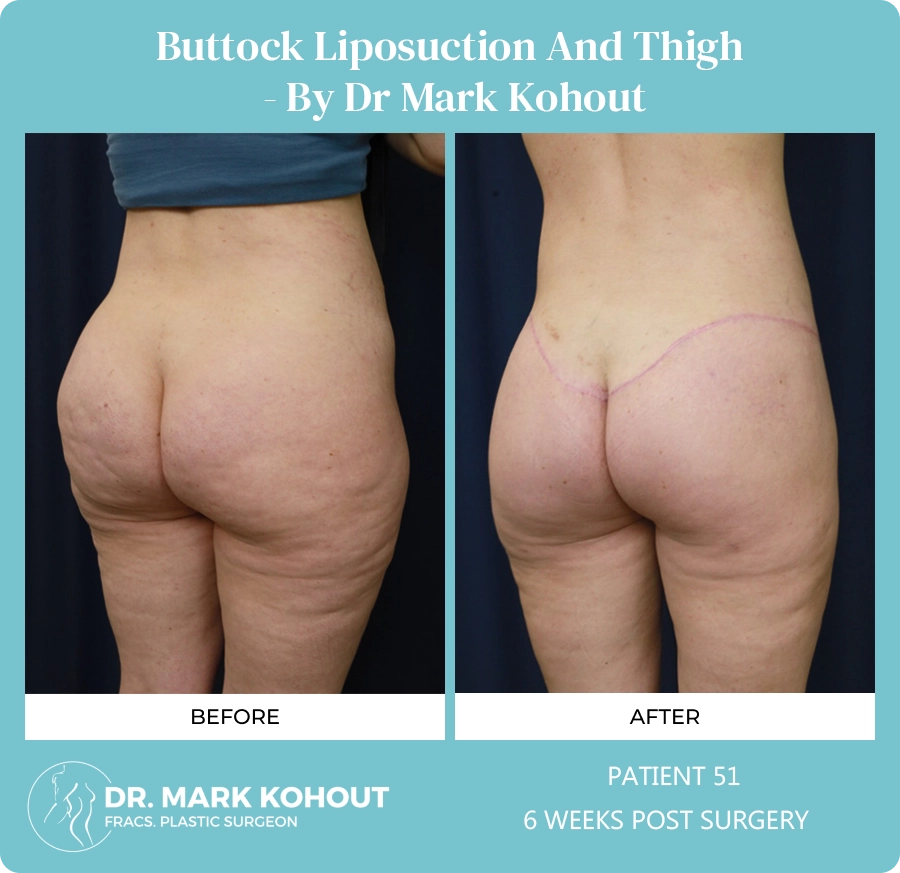
Buttock Liposuction Before and After Images
Can Buttock Implants Be Seen or Felt?
Buttock implants may be visible or palpable, particularly when soft-tissue coverage is limited. Implant size, placement depth, skin thickness and later weight changes influence how noticeable the device may be.
Appropriate selection and pocket placement may reduce visibility, but they cannot guarantee that the implant will never be felt. Patients should understand that an implant remains a medical device and does not become natural body tissue.
Implant awareness may depend on:
- Available muscle coverage
- Thickness of skin and fat
- Implant dimensions
- Pocket position
- Later weight loss
Will Buttock Implants Affect Sitting or Movement Long Term?
Most patients aim to return to ordinary sitting and movement after recovery, but individual experiences vary. Some people may remain aware of the implants during particular positions or activities.
Persistent discomfort, movement restriction or a new change in sensation should be assessed rather than assumed to be expected. Exercise programs may also need temporary modification during the recovery period.
Patients commonly ask about:
- Desk-based work
- Driving
- Running and cycling
- Lower-body resistance exercises
- Sleeping on the back
Implant-Based Buttock Surgery FAQs
Can I choose the shape of the implant, or is it always round?
There are different implant shapes available, including round and more oval (anatomical) forms. The choice is guided by your body structure, soft tissue coverage, and what will provide the most balanced result.
Is it possible to feel the implants when sitting down?
In most cases, implants are placed within or beneath the muscle to provide coverage. While some people may notice a difference in sensation early on, this typically settles as healing progresses.
Do buttock implants affect how clothing fits?
Some individuals notice changes in how garments fit around the hips and waist after surgery. It depends on the implant size and how your body responds during recovery.
Can I sleep on my back after the surgery?
Sleeping positions are adjusted for a period following surgery to support implant stability. Your surgeon will guide you on when it’s appropriate to return to regular sleeping habits.
Are the implants noticeable when touched?
Implants are placed in a way that aims to create a natural-feeling result. The extent to which they are felt can vary based on your anatomy and implant position.
Will the implants interfere with physical activities like cycling or running?
After full recovery, most people return to regular physical activity. However, your surgeon may advise modifying certain movements to protect the implant site in the long term.
Is there any sound or sensation from the implant, like movement or sloshing?
It is uncommon, but some individuals report mild awareness of the implant when shifting positions in the early recovery phase. This usually subsides once the tissue has adjusted.
Can the implants be removed later if I change my mind?
Yes, implants can be removed or replaced if desired. This would require another procedure, which your surgeon can discuss in detail during consultation.
Do the implants affect body temperature sensation or heat in that area?
There is typically no long-term change in temperature sensitivity. Some altered sensation is normal early on but usually improves over time.
Can the implants set off airport scanners or metal detectors?
Silicone implants are not metallic and do not set off security systems. You won’t need to declare them during routine travel screening.
Medical References
- Submuscular Buttock Augmentation With Silicone Implants in 80 Female Patients. Ahmed Elsaftawy, Tomasz Bonczar, Mateusz Stolarski, Kamil Gabryszuk. Aesthetic Surgery Journal, Volume 44, Issue 3, March 2024, Pages 302–310. https://doi.org/10.1093/asj/sjad253
- Gluteal Augmentation: A Historical Perspective on Aesthetic Practice. Roberto Chacur. Aesthetic Surgery Journal Open Forum, Volume 7, 2025, ojae124. https://doi.org/10.1093/asjof/ojae124
- Comparing the safety profiles of implants and autologous fat grafting in gluteal augmentation: A systematic review. Paul Oregi, Manaf Khatib, Naveen Cavale, Shakeel M. Rahman. Journal of Plastic, Reconstructive & Aesthetic Surgery, Volume 83, 2023, Pages 463–474. https://doi.org/10.1016/j.bjps.2023.04.066
What Should You Consider Before Deciding?
The decision should be based on personal goals, medical suitability and a clear understanding of risks, scars and recovery. It should not be driven by online trends, another person’s preferences or expectations of a guaranteed result.
Patients should have time to review written information, ask further questions or seek another qualified opinion. Choosing not to proceed is also a valid outcome of consultation.
Questions to consider include:
- What specific change am I considering?
- Do I understand the possible complications?
- Can I manage the recovery restrictions?
- Would I accept the possibility of revision surgery?
- Have I allowed enough time to decide?
What Are the Next Steps for Those Considering Buttock Implants?
People considering implant-based buttock surgery can arrange a consultation to discuss their anatomy, goals and available options. An individual assessment is required to determine whether implant surgery, another procedure or no operation may be appropriate.
Dr Mark Kohout provides consultations in Sydney for patients seeking information about buttock implant surgery. The appointment allows time to review implant selection, placement, scars, possible complications, recovery and long-term care before making a decision.
- Arrange an individual consultation
- Explain the specific change being considered
- Ask about implant size and placement
- Review risks and recovery requirements
- Take time to consider the information
Explore factors commonly discussed when considering buttock implant surgery. This quiz does not determine medical suitability.
Further Reading
- Read Dr Mark Kohout’s Procedure Page on Body Lift Surgery
- Read Dr Mark Kohout’s Procedure Page on Thigh Lift Surgery
- Read Dr Mark Kohout’s Blog about Preparing for Buttock Reshaping Surgery: A Practical Pre-Op Checklist
- Read Dr Mark Kohout’s Blog about Flat Buttocks Despite Exercise? Causes & Options Sydney
Related Blog Posts
What Is Empty Buttock Syndrome? Causes,…
Volume changes in the buttocks are sometimes described as “Empty Buttock Syndrome,” a non-medical term used to explain a noticeable reduction in shape or projection following certain procedures or significant…
Gluteal Augmentation With Implants in Sydney:…
Interest in fuller, more projected buttock shapes has grown steadily, encouraged in part by social media and online imagery. Many people in Sydney arrive at a consultation with screenshots, mixed…
FAQs About Bodylift Surgery
Dr Mark Kohout, Plastic Surgeon in Sydney, brings over 25 years of experience in aesthetic and reconstructive surgery. His practice is known for its patient-focused approach and thorough consultation process.…
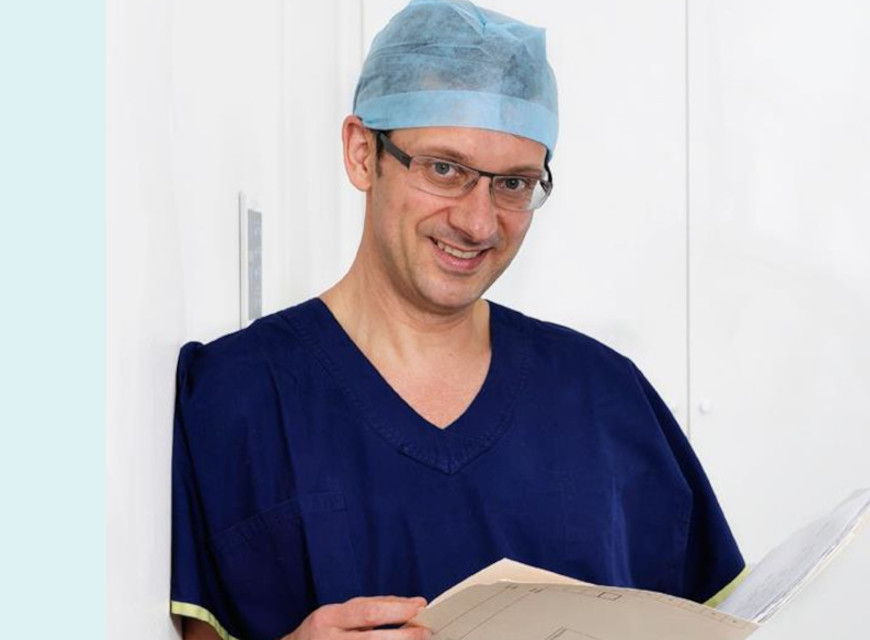
Experienced Plastic Surgeon
Dr. Mark Kohout
A qualified plastic surgeon who operates with care and integrity, based in central Sydney with over 20 years of experience in the cosmetic field. His extensive training and experience assures patients they are in highly trained surgical hands. Dr. Kohout is a dedicated, friendly professional who is committed to providing the high quality care, support and results, alongside his compassionate team.
Dr Mark Kohout (MED0001133000)
Specialist Plastic Surgeon
Specialist registration in Surgery – Plastic Surgery