



People with a lean or athletic build may have limited fatty tissue available for buttock fat transfer. Although fat can sometimes be collected from several areas, the procedure requires enough donor tissue to be removed without creating unwanted hollows or irregularities elsewhere.
Dr Mark Kohout is a Specialist Plastic Surgeon in Sydney with more than 25 years of clinical experience. He assesses body composition, skin quality, gluteal structure and personal goals to determine whether fat transfer, gluteal implants or another individually planned approach may be considered.
How Does Buttock Fat Transfer Work?
Buttock fat transfer uses fatty tissue collected from another area of the patient’s body to add volume in selected parts of the buttocks. The collected fat is processed and carefully placed, but not all transferred cells will remain after healing.
Fat is commonly collected through liposuction from areas such as the abdomen, waist, hips or thighs. The amount available for transfer depends on the distribution of fatty tissue, the condition of the donor sites and how much can be removed without adversely affecting surrounding contours.
The procedure generally involves:
- Identifying suitable donor areas
- Collecting fat through liposuction
- Preparing the harvested tissue
- Placing small amounts into selected areas
- Monitoring volume changes during healing
Why Might a Lean Person Have Limited Donor Fat?
A lean person may not have enough fatty tissue to produce the amount of buttock volume being considered. Removing too much from a small donor area could also create hollows, unevenness or an imbalanced appearance.
Body weight alone does not determine suitability because two people with similar weights may store fat in different locations. Dr Mark Kohout assesses the abdomen, waist, back, hips and thighs to establish whether sufficient donor tissue is available.
Factors that affect donor-fat availability include:
- Overall body-fat levels
- Natural fat-distribution patterns
- Previous liposuction or body surgery
- Significant weight loss
- The amount of change being considered
Can Fat Be Collected from More Than One Area?
Fat may sometimes be collected from several donor sites when no single area contains enough suitable tissue. Combining smaller amounts does not guarantee that sufficient volume will be available or that fat transfer will be appropriate.
Potential donor areas may include the abdomen, waist, hips, thighs, back or arms, depending on the individual. Each area must be assessed separately because excessive removal can affect skin quality and contour.
Planning may consider:
- How much fat is available in each area
- Whether the skin is likely to contract after liposuction
- Existing asymmetry between donor sites
- Scars or changes from previous procedures
What Happens If Too Much Fat Is Removed from a Lean Body?
Removing excessive fat from a lean donor area can result in visible hollows, contour irregularities or asymmetry. A suitable surgical plan must consider the appearance and tissue quality of both the donor and recipient areas.
The aim is not simply to obtain the largest possible amount of fat. Dr Mark Kohout considers how much tissue can reasonably be collected while maintaining proportion across the abdomen, waist, hips or thighs.
Possible concerns associated with overharvesting include:
- Localised indentations
- Uneven contours
- Greater visibility of underlying structures
- Loose or irregular skin
- Differences between the left and right sides
Does Gaining Weight Make Someone Suitable for Fat Transfer?
Deliberately gaining weight does not automatically make a person suitable for fat transfer. Newly gained weight may be distributed unpredictably and may later be lost, affecting both donor sites and transferred tissue.
Surgical planning is generally more reliable when body weight is stable and maintainable. Any proposed weight change should be discussed with an appropriate health practitioner rather than undertaken solely to qualify for a procedure.
Important considerations include:
- Whether the higher weight can be maintained
- Where additional fat is likely to be stored
- How later weight loss could affect the result
- General health and nutritional status
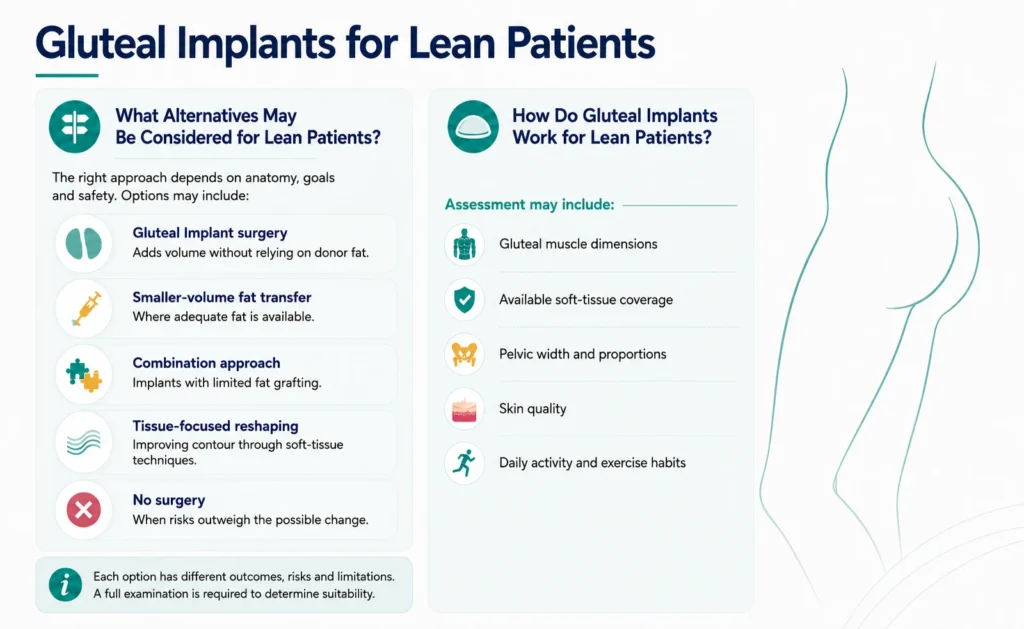
What Alternatives May Be Considered for Lean Patients?
Gluteal implants may be discussed when a patient has limited donor fat but is seeking additional buttock volume or projection. Other options may include modest fat transfer, a combined approach or tissue-focused reshaping, depending on anatomy.
These procedures produce different types of change and carry different limitations. An individual examination is required to determine whether any surgical option is appropriate.
Possible approaches include:
- Gluteal implant surgery
- A smaller-volume fat transfer where feasible
- A combination of implants and limited fat grafting
- Tissue-focused buttock reshaping
- No surgery when the risks outweigh the possible change
How Do Gluteal Implants Work for Lean Patients?
Gluteal implants add volume without depending on the patient’s fat reserves. They are placed within a surgically created pocket and selected according to anatomy, tissue coverage and the degree of projection being considered.
Implants used in the gluteal region are semi-solid silicone devices designed for this anatomical area. Lean patients require careful assessment because limited soft-tissue coverage may make implant edges or positioning more noticeable.
Assessment may include:
- Gluteal muscle dimensions
- Available soft-tissue coverage
- Pelvic width and proportions
- Skin quality
- Daily activity and exercise habits
What Are the Limitations of Gluteal Implants?
Gluteal implants cannot guarantee a particular shape, degree of symmetry or social perception of the result. They are medical devices that may be felt, move, become visible or require further surgery.
Implant surgery also involves scars, recovery restrictions and procedure-specific complications. Patients should understand that an implant may need monitoring, replacement, adjustment or removal in the future.
Potential limitations include:
- Implant awareness beneath the tissues
- Visible or palpable edges in lean patients
- Movement or displacement
- Infection or fluid collection
- Revision or removal surgery
Can Implants and a Small Fat Transfer Be Combined?
A combined approach may use an implant for central volume and a smaller amount of transferred fat to adjust selected transitions or asymmetries. This option is only possible when some suitable donor fat is available.
Combination surgery is more involved than using one method alone and may introduce risks associated with both procedures. The possible benefit must therefore be weighed against longer operating time, additional treatment areas and recovery demands.
A combined plan may be considered to:
- Add volume with an implant
- Adjust selected contour transitions
- Address minor asymmetry
- Use limited donor fat strategically
Can Liposuction Change Buttock Proportions Without Adding Much Volume?
Removing selected fatty tissue from the waist or flanks may change the visual relationship between the torso and buttocks. It does not directly increase buttock volume and may not be appropriate for someone who is already very lean.
For suitable patients, limited liposuction may alter surrounding proportions rather than enlarge the buttocks themselves. The donor areas must still contain enough tissue for removal without producing hollows or unevenness.
Liposuction planning considers:
- Existing waist and flank volume
- Skin elasticity
- The thickness of fatty tissue
- The risk of contour irregularity
- Overall body proportions
Can Exercise Change Buttock Shape in a Lean Person?
Resistance training can increase gluteal strength and may increase muscle size over time. It cannot change pelvic structure, relocate fatty tissue or provide the same structural change as an implant.
Exercises such as hip thrusts, squats, lunges and step-ups may help develop the gluteal muscles when performed with suitable technique and progression. Results depend on genetics, nutrition, training consistency and individual muscular response.
Exercise may contribute to:
- Gluteal muscle development
- Hip and pelvic stability
- General physical conditioning
Exercise cannot:
- Direct fat into the buttocks
- Change pelvic width
- Correct substantial tissue laxity
What Happens During a Consultation with Dr Mark Kohout?
The consultation includes an assessment of donor fat, gluteal anatomy, skin quality, medical history and the change being considered. It is also an opportunity to compare fat transfer, implants and other available approaches.
Dr Mark Kohout reviews previous surgery, medications, health conditions, weight history, nicotine use and regular physical activity. Photographs or measurements may also be used as part of surgical assessment and planning.
A consultation may cover:
- The amount and location of available donor fat
- The likely limits of fat transfer
- Implant suitability and tissue coverage
- Scars, risks and recovery requirements
- Alternatives to the proposed procedure
How Are Personal Goals Discussed During Consultation?
Personal goals are considered alongside anatomy and medical suitability rather than treated as a guaranteed surgical target. Photographs may help explain preferences, but another person’s result cannot be reproduced exactly.
Patients are encouraged to describe the specific change they are considering, such as additional projection, greater upper-pole volume or adjustment of asymmetry. Dr Mark Kohout can then explain which aspects may be achievable and which may be limited by anatomy.
Useful topics to discuss include:
- The area where more volume is being considered
- Whether the preferred change is modest or more noticeable
- Concerns about implants or liposuction
- Work, sitting and exercise requirements
- Acceptance of scars and possible revision surgery
What Should Lean Patients Expect During Recovery?
Recovery may involve swelling, discomfort, modified sitting or sleeping positions and temporary restrictions on work and exercise. The instructions differ depending on whether fat transfer, implants or a combined procedure is performed.
Lean patients undergoing implant surgery may require particular attention to pressure, wound healing and gradual movement. Follow-up appointments allow the clinical team to monitor healing and respond to concerns as they arise.
Recovery arrangements may include:
- Assistance at home during early healing
- Temporary changes to sitting positions
- Wound and garment care
- Time away from strenuous activity
- Scheduled postoperative reviews
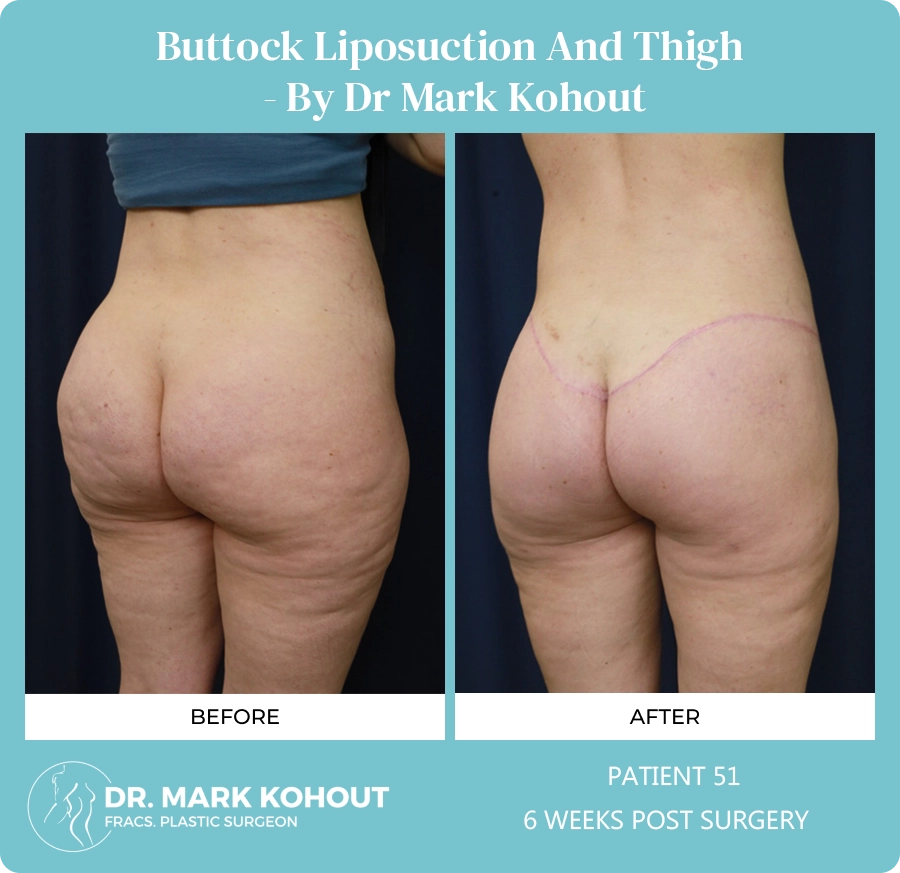
Buttock Liposuction Before and After Images
What Risks Should Be Considered Before Fat Transfer?
Buttock fat transfer carries general surgical risks and specific risks related to fat injection. These include infection, bleeding, contour irregularity, fat reabsorption, fat necrosis and fat embolism.
The final retained volume cannot be predicted precisely because some transferred fat may not establish a blood supply. Individual anatomy, injection technique, healing and later weight changes can all affect the result.
Points to understand include:
- Some transferred fat will be reabsorbed
- Asymmetry or irregularity may occur
- More than one procedure may be considered
- Serious complications are possible
- Weight changes may alter retained fat
What Risks Should Be Considered Before Implant Surgery?
Gluteal implant surgery carries risks associated with anaesthesia, incisions, wound healing and the implant itself. Complications may require medication, drainage, implant adjustment, removal or further surgery.
The location of the incision and the pressure placed on the buttock region can affect postoperative care. Patients must follow wound, sitting and activity instructions closely throughout the early healing period.
Possible complications include:
- Infection or fluid collection
- Wound separation
- Implant movement or rotation
- Changes in sensation
- Noticeable or widened scars
Buttock Enhancement with Fat Transfer FAQs
Can I use fat from just one specific area, like my arms, for the procedure?
In certain cases, fat may be taken from a single donor site, such as the arms, if there is enough volume available. However, most patients benefit from combining smaller amounts from multiple areas to support a balanced approach.
What happens to the fat that doesn’t remain in the new location?
Some of the transferred fat may be gradually reabsorbed by your body over time. This is a normal part of the healing process and is considered during surgical planning.
Can fat transfer change the way I sit or feel pressure in that area?
You may notice a temporary difference in pressure or sensation during the initial healing phase. Over time, this usually settles as the tissue integrates and swelling reduces.
Is it possible for transferred fat to increase if I gain weight later?
Transferred fat behaves like natural fat, so weight changes after surgery can affect the volume. This is discussed during your consultation to support long-term planning.
Can I request a subtle change rather than a dramatic one?
Yes. Many patients prefer modest adjustments, and the procedure can be tailored to your preferences during consultation with Dr Kohout.
Will the results feel different compared to natural tissue?
In most cases, patients describe the area as feeling similar to surrounding tissue once healing is complete. This can vary based on the amount transferred and the technique used.
Can I combine this with other procedures at the same time?
In suitable patients, fat transfer can be performed alongside other procedures. Dr Kohout will assess whether a combined approach is appropriate for you.
Is there a preferred season for scheduling this type of surgery?
Some individuals choose cooler months to assist with recovery clothing and comfort. However, surgery can be planned year-round depending on your schedule and needs.
Can someone very physically active still undergo fat transfer?
Yes, but physical activity may need to be adjusted during healing. Dr Kohout will provide guidance on when it is safe to return to exercise.
Does fat transfer work the same way for everyone?
Fat transfer outcomes can vary based on your body composition, how your tissue responds, and other individual factors. Dr Kohout will explain what you can reasonably expect in your situation.
Medical References
- Safety Considerations of Fat Grafting in Buttock Augmentation. Aesthetic Surgery Journal. https://academic.oup.com/asj/article/41/Supplement_1/S25/6277486
- Comparing the Safety Profiles of Implants and Autologous Fat Grafting. Journal of Plastic, Reconstructive & Aesthetic Surgery. https://www.sciencedirect.com/science/article/abs/pii/S1748681523002218
How Should I Prepare for Buttock Surgery?
Preparation may include medical testing, medication review, nicotine cessation and practical arrangements for the recovery period. Exact requirements depend on the selected procedure, medical history and anaesthetic plan.
Patients should provide complete information about prescription medicines, supplements, allergies, previous procedures and current health conditions. They should also plan for temporary limitations on driving, sitting, exercise and household activities.
Before surgery, patients may need to:
- Complete requested medical assessments
- Review medicines and supplements
- Arrange transport and home assistance
- Prepare an appropriate sleeping area
What Are the Next Steps If I May Be Too Lean for Fat Transfer?
People who may have limited donor fat can arrange a consultation to assess their body composition and discuss available options. The assessment may determine that fat transfer, implants, a combined approach or no surgery is appropriate.
Dr Mark Kohout consults with patients in Sydney who are considering changes to buttock volume or shape. The consultation provides time to ask questions, understand possible limitations and consider the information before deciding whether to proceed.
- Arrange an individual consultation with Dr Mark Kohout
- Discuss the specific change being considered
- Review donor-fat availability and implant suitability
- Ask about risks, scars and recovery
- Allow time to consider the recommendations
Explore factors commonly discussed when considering buttock surgery. This quiz does not determine medical suitability.
This plastic surgery quiz is intended as a general reflection tool to help you consider your goals, concerns and expectations. It does not diagnose a condition, determine whether buttock surgery is appropriate, or replace an individual consultation and clinical examination. Your answers may highlight topics to discuss further, such as donor-fat availability, implants, scars, recovery and your preferred degree of change.
Further Reading
- Read Dr Kohout’s Procedure page on Body Lift Sydney
- Read Dr Kohout’s Procedure page on Body Procedures
- Read Dr Kohout’s Procedure page on Thigh Lift Surgery Sydney
- Read Dr Kohout’s Pricing page on Body Surgery Pricing
- Read Dr Kohout’s Blog about Recovery After Liposuction: What to Expect and How to Maximise Healing
- Read Dr Kohout’s Blog about BodyTite: A Solution for Skin Laxity after Liposuction
Related Blog Posts
Exploring Options for Changing Buttock Shape…
Some people considering a change to buttock shape or projection may not have enough donor fat for fat transfer or may prefer not to undergo liposuction. In these circumstances, other…
Why Your Buttocks Look Flat Despite…
Many people follow consistent lower-body exercise programs but find that the size or projection of their buttocks changes less than expected. Squats, lunges, hip thrusts and resistance exercises can strengthen…
Gluteal Augmentation With Implants in Sydney:…
Interest in fuller, more projected buttock shapes has grown steadily, encouraged in part by social media and online imagery. Many people in Sydney arrive at a consultation with screenshots, mixed…