Choosing a breast implant size can be one of the most uncertain parts of considering breast implant surgery. Patients may arrive with a particular cup size, implant volume or photograph in mind, but those references do not show how an implant will relate to their own chest dimensions, breast tissue and lifestyle.
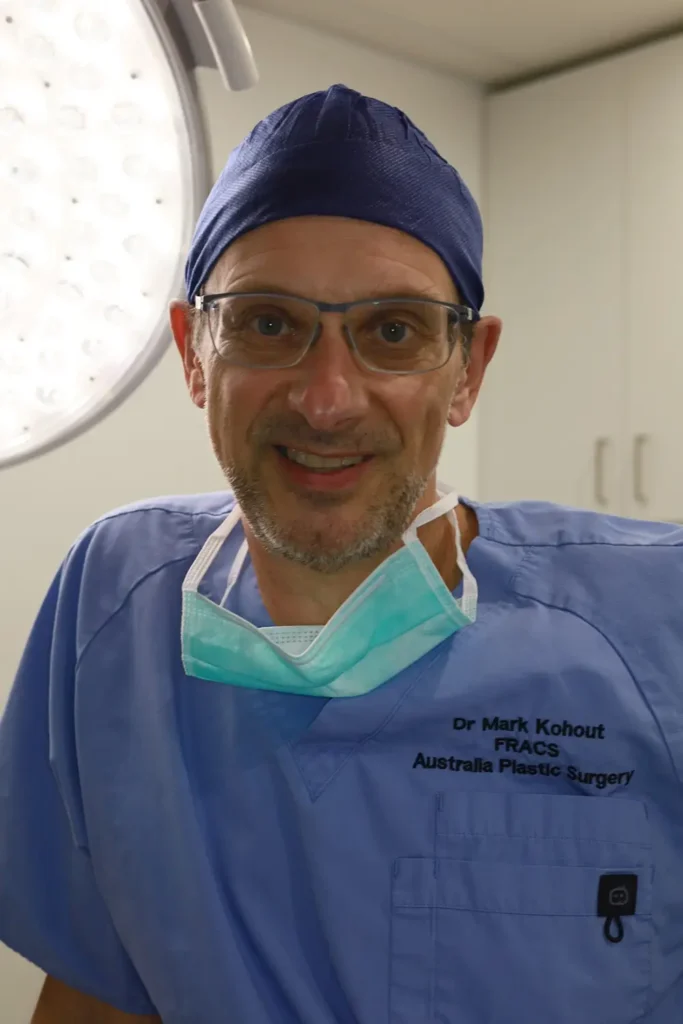
Dr Mark Kohout is a Specialist Plastic Surgeon in Sydney with more than 25 years of clinical experience. His approach to breast implant planning considers implant volume, width, projection, tissue coverage, existing breast shape and personal preferences rather than relying on one number alone.
What Does Breast Implant Size Actually Mean?
Breast implant size is usually measured in cubic centimetres, or cc, which describes the volume inside the implant. The cc measurement does not explain the implant’s width, projection or how it will relate to an individual chest.
Two implants with the same volume can have different dimensions and produce different physical changes. One may have a broader base and less forward projection, while another may be narrower and project further from the chest wall.
Implant dimensions include:
- Volume measured in cubic centimetres
- Base width across the chest
- Forward projection or profile
- Overall height and shape
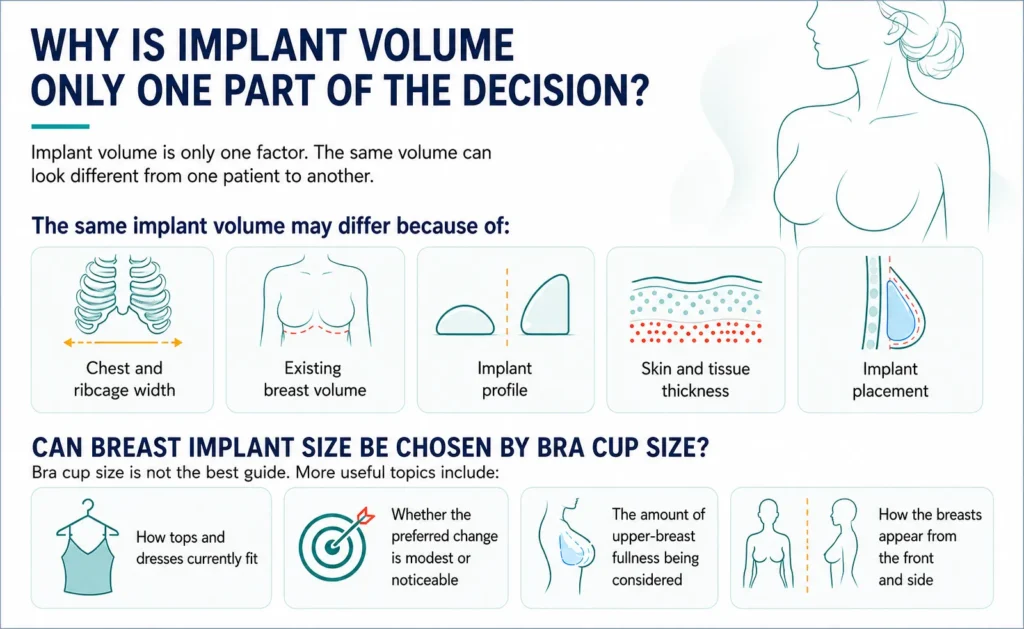
Why Is Implant Volume Only One Part of the Decision?
Implant volume provides limited information when considered without chest width, breast tissue and skin characteristics. A particular volume may appear relatively prominent on one frame and more modest on another.
The selection process generally begins with physical measurements rather than choosing a cc number from photographs or online discussions. Research into breast implant planning supports assessing breast width and implant dimensions together rather than treating volume as an isolated measurement.
The same implant volume may differ because of:
- Chest and ribcage width
- Existing breast volume
- Implant profile
- Skin and tissue thickness
- Implant placement
Can Breast Implant Size Be Chosen by Bra Cup Size?
Bra cup size cannot be used as an exact surgical measurement because cup labelling differs between brands, styles and band sizes. It may help describe a general preference, but it cannot guarantee a particular postoperative cup.
A person may wear different cup sizes across several bra manufacturers even before surgery. Dr Mark Kohout therefore uses clothing preferences and desired degree of volume change as discussion points rather than treating a cup letter as a fixed target.
More useful topics include:
- How tops and dresses currently fit
- Whether the preferred change is modest or noticeable
- The amount of upper-breast fullness being considered
- How the breasts appear from the front and side
Why Does Existing Breast Tissue Matter?
Existing breast tissue affects implant coverage, breast shape and how noticeable the implant edges may be. Patients with thinner tissues may have a greater likelihood of visible or palpable implant borders or rippling.
The amount and distribution of breast tissue are assessed across the upper, central and outer breast. Implant size and placement may need to be adjusted when tissue coverage is limited.
Tissue assessment considers:
- Existing breast volume
- Thickness over the upper breast
- Coverage near the centre of the chest
- Tissue quality after pregnancy or weight change
- Previous breast surgery
Can Implants Correct Breast Asymmetry?
Different implant dimensions may help reduce some differences in breast size or shape. Perfect symmetry cannot be guaranteed because the chest wall, breast tissues, nipple positions and skin commonly differ between sides.
Dr Mark Kohout may consider different implant sizes or profiles when one breast has less volume than the other. Other techniques may also be discussed when the asymmetry involves skin position, breast shape or the underlying chest wall.
Planning may address:
- Differences in breast volume
- Unequal breast-base widths
- Variations in nipple position
- Chest-wall asymmetry
- Different skin envelopes
How Do Implant Width and Profile Work Together?
Implant width describes how much of the chest the implant occupies, while profile describes how far it projects forwards. Volume is produced by the combination of these dimensions rather than by projection alone.
A high-profile implant generally has a narrower base and greater forward projection than a lower-profile implant of a similar volume. Manufacturer terminology varies, so the actual implant measurements are more useful than the profile label alone.
Common profile considerations include:
- Lower profile with a broader base
- Moderate profile with intermediate projection
- Higher profile with a narrower base
- Extra projection in selected implant ranges
What Is the Difference Between Round and Anatomical Implants?
Round implants have a symmetrical form, while anatomical implants are shaped with more volume in the lower portion. The visible result still depends on the patient’s tissues, implant position and surgical technique.
A three-dimensional intraoperative study found that implant form can change under the influence of gravity and surrounding tissues, illustrating why the label alone does not determine the final breast shape. Implant rotation is also a particular consideration with anatomical devices.
Selection may account for:
- Existing breast shape
- Preferred volume distribution
- Tissue coverage
- Implant rotation considerations
- Available implant dimensions
How Does Lifestyle Affect Breast Implant Size?
Occupation, exercise, sleep position and daily responsibilities can influence how an implant feels during ordinary activities. These factors may affect whether a patient prefers a more moderate or more noticeable volume change.
Dr Mark Kohout asks about work, sport, caring responsibilities and regular movement during consultation. The aim is to consider both the physical appearance being discussed and the practical experience of living with the selected implant.
Lifestyle topics may include:
- Running and high-impact exercise
- Swimming or gym training
- Physically demanding work
- Regular lifting
- Preferred sleeping position
Can Larger Implants Affect Exercise and Movement?
Larger implants may create more breast weight and movement during activities such as running, jumping or vigorous training. Appropriate support may help, but it cannot remove every physical effect of additional breast volume.
The experience varies according to implant placement, tissue support and the patient’s activity level. Exercise is also restricted during early recovery, regardless of the implant size selected.
Practical considerations include:
- Sports-bra support
- Upper-body training
- High-impact activity
- Work uniforms or protective equipment
How Is Implant Size Planned During Consultation?
Implant sizing combines medical assessment, breast measurements and discussion of the patient’s preferred degree of change. The aim is to identify a range of implants compatible with the person’s anatomy rather than begin with one fixed volume.
Dr Mark Kohout’s current breast implant information describes a consultation process that considers implant type, placement, anatomy and individual preferences. Research has also examined structured selection methods that involve patients in the sizing decision.
A breast consultation may include:
- Medical and surgical history
- Breast and chest measurements
- Assessment of skin and tissue coverage
- Discussion of implant dimensions
- Review of risks and alternatives
How Are Implant Sizers Used?
Implant sizers may be placed inside a bra or fitted top to demonstrate how different volumes affect clothing. They provide a visual guide but cannot reproduce the exact appearance or feel of an implant after surgery.
Sizers sit outside the body and do not account fully for tissue compression, implant placement or postoperative healing. They are therefore used alongside measurements and clinical assessment rather than as the sole sizing method.
Sizers may help compare:
- Relative differences between volumes
- Appearance beneath clothing
- Overall proportion
- Comfort with a modest or greater change
Does Implant Placement Affect How Size Appears?
Implants may be positioned behind the breast tissue, beneath the chest muscle or in a dual-plane pocket. Placement can affect upper-breast contour, tissue coverage, movement and how implant dimensions appear.
The appropriate pocket depends on anatomy, tissue thickness, implant type and the surgical plan. Dr Mark Kohout’s current breast implant information discusses placement as one component of individual implant selection.
Recognised placement options include:
- Subglandular placement behind breast tissue
- Subpectoral placement beneath the muscle
- Dual-plane placement
- Other selected tissue-plane approaches
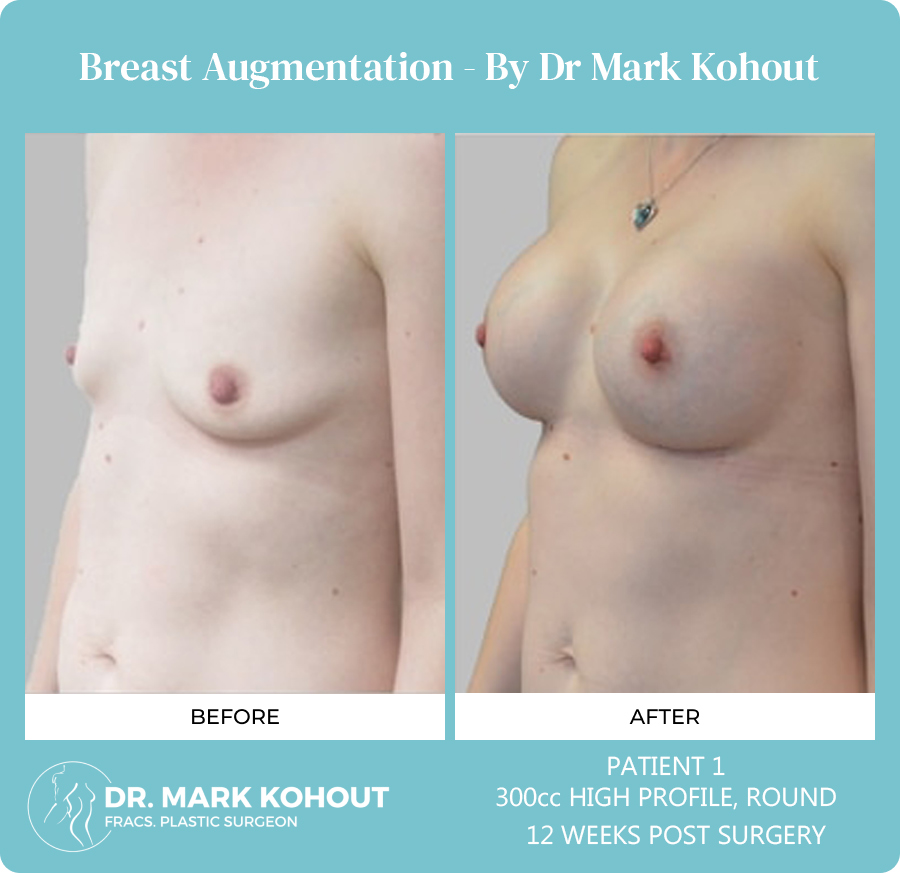
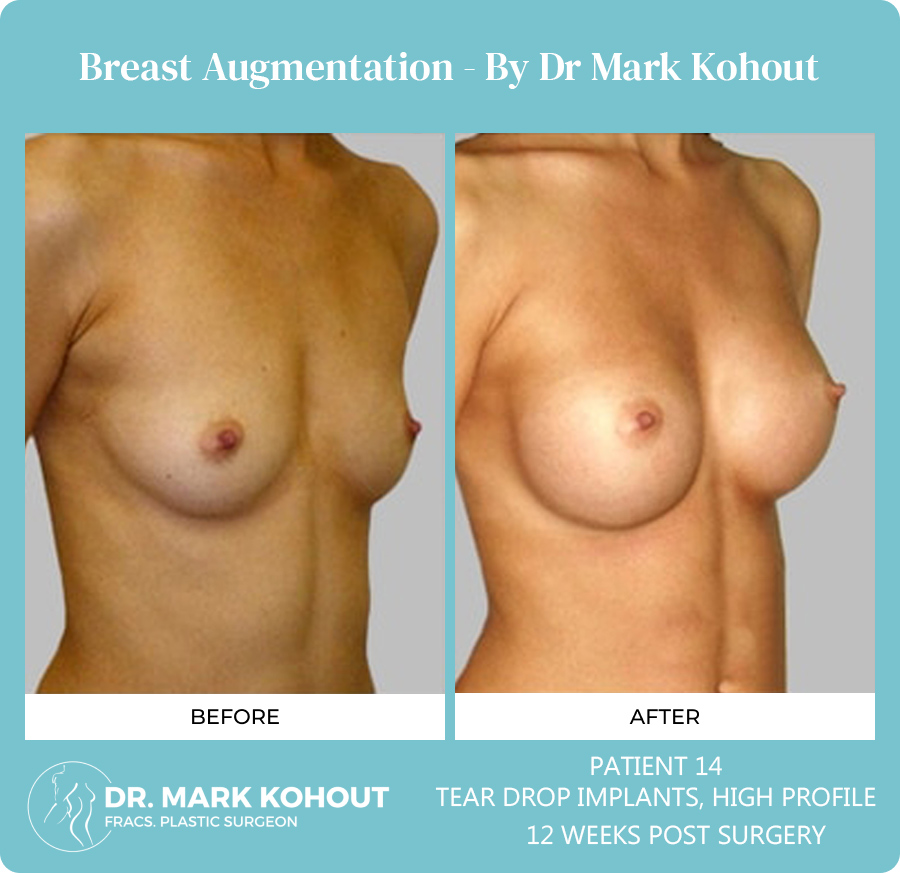
Breast Augmentation Before and After Images
What Risks Are Associated with Breast Implants?
Breast implant surgery carries risks related to anaesthesia, bleeding, infection, wounds, sensation and the implant itself. Some complications may require monitoring, medication or further surgery.
Dr Mark Kohout’s current breast implant information states that risks and limitations are discussed during consultation. Breast implants are medical devices and should not be presented as permanent or free from the possibility of revision.
Recognised risks include:
- Infection or bleeding
- Capsular contracture
- Implant rupture
- Changes in breast or nipple sensation
- Revision or implant-removal surgery
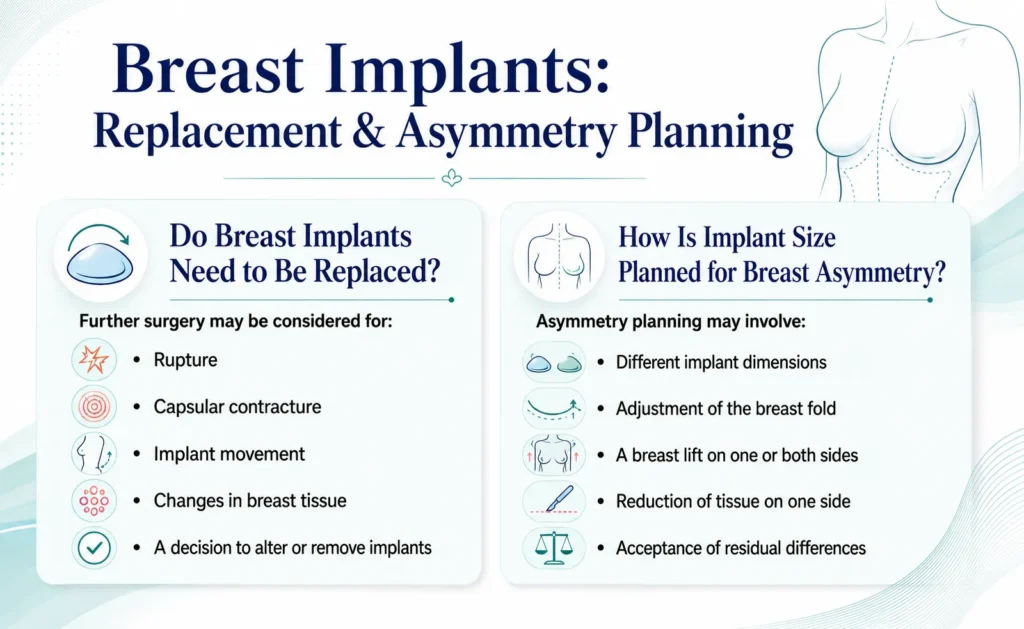
Do Breast Implants Need to Be Replaced?
Breast implants should not be described as lifetime devices, but they do not necessarily require replacement at one fixed interval. Revision may be considered if a complication develops, the implant changes or the patient’s preferences alter.
Ongoing care may include clinical review and imaging when recommended for the implant type and individual circumstances. New breast changes, pain, firmness or asymmetry should be assessed by an appropriately qualified practitioner.
Further surgery may be considered for:
- Rupture
- Capsular contracture
- Implant movement
- Changes in breast tissue
- A decision to alter or remove the implants
How Is Implant Size Planned for Breast Asymmetry?
Implant sizing for asymmetry may involve different implant volumes, widths or profiles on each side. The goal is to reduce visible differences rather than promise identical breasts.
An implant may address a volume difference but cannot correct every variation in the ribs, breast fold, nipple position or skin. Additional tissue adjustment may sometimes be discussed.
Asymmetry planning may involve:
- Different implant dimensions
- Adjustment of the breast fold
- A breast lift on one or both sides
- Reduction of tissue on one side
- Acceptance of residual differences
How Is Implant Size Chosen for Revision Surgery?
Breast revision sizing requires assessment of the existing implants, scar capsule, skin, breast tissue and current breast position. The procedure may be more complex than first-time implant surgery because the tissues have already been operated on.
Patients may seek revision because of a complication, a change in preferences or changes in the breasts over time. Dr Mark Kohout’s practice currently lists breast revision and breast implant replacement among its breast surgery services.
Revision planning may consider:
- Current implant dimensions
- Capsule condition
- Remaining tissue coverage
- Breast and nipple position
- Whether removal, replacement or lifting is being considered
How Is Implant Size Chosen for Breast Reconstruction?
Reconstructive implant sizing must account for remaining skin, scars, previous treatment and the condition of the chest tissues. The process may involve several stages and differs from elective primary breast implant surgery.
Previous mastectomy, radiotherapy or reconstruction can affect tissue quality and the available implant pocket. The opposite breast may also be considered when discussing volume and symmetry.
Reconstructive planning may include:
- Available skin and tissue
- Previous radiotherapy
- Chest-wall anatomy
- The opposite breast
- Possible staged surgery
Breast Implants FAQs
Can I choose my breast implant size purely from photos I like online?
Photos can be a useful starting point to explain what you like, but they do not show your chest width, tissue thickness or skin quality. Dr Mark Kohout uses them as conversation tools, then guides sizing based on your own measurements and anatomy.
Is there such a thing as a “normal” or “standard” breast implant size?
There is no single standard size, because bodies and goals vary widely. Dr Mark Kohout usually recommends a size range that suits your frame rather than aiming for one “normal” number.
Will a larger implant always give a more noticeable result?
Not necessarily, because chest width and existing breast tissue change how a given size appears. A moderate implant on a narrow chest can sometimes look more prominent than a larger implant on a very broad chest.
Can breast implant size affect how I feel when I exercise?
Some people notice more movement or weight with larger implants, especially during high impact sport. This is why lifestyle and activity levels are part of the sizing discussion with Dr Mark Kohout.
If my friend is happy with her implant size, can I safely choose the same?
Even close friends can have very different chest shapes, tissue support and medical histories. Dr Mark Kohout assesses each person individually, so your recommended size may be different even if you share similar goals.
Does choosing a smaller implant size mean I will not need revision in the future?
A smaller size may place less weight on tissues, but it does not remove the possibility of future change or revision. Ageing, weight variation and life events can affect breasts with or without implants.
Can breast implant size influence how easy it is to detect breast changes on imaging?
Implants can change how breast tissue appears on imaging, but radiology providers use specific techniques to improve visualisation. It is important to tell your imaging provider you have implants and what type they are.
Is it possible to go “too small” with implants and not notice a change?
Some patients feel a very small size change is less noticeable than they expected, especially if they start with more natural breast tissue. During sizing, Dr Mark Kohout usually shows a range so you can see what feels worthwhile yet still appropriate for your frame.
Do different implant sizes feel different when lying down or sleeping?
Larger implants can feel more noticeable in certain positions, especially for side sleepers. This is one of the reasons Dr Mark Kohout asks about sleep habits and comfort when discussing size.
If I lose weight after surgery, will my chosen implant size look different?
Weight loss can reduce natural breast tissue and change how the implant sits, sometimes making the implant more defined. During consultation, Dr Mark Kohout may discuss your current weight stability and how possible future changes might affect the appearance of your chosen size.
Medical References

- Optimizing Implant Width Selection in Breast Augmentation: Insights From Clinical Assessment and 3D Imaging-Based Measurements – Aesthetic Surgery Journal. https://academic.oup.com/asj/advance-article-abstract/doi/10.1093/asj/sjae040/7611640
- Kolasiński M, Kolenda P, Kołacz P, Kasielska-Trojan A. Effect of Patient Involvement in Implant Size Selection on Satisfaction With Breast Size: An Analysis Based on the Patient Decision-Making Process on Implant Size Selection Algorithm. Aesthetic Surgery Journal. 2025;45(9):899–905. https://academic.oup.com/asj/article/45/9/899/8133964
- Lotter L, Zucal I, Brébant V, et al. Intraoperative 3D Comparison of Round and Anatomical Breast Implants: Dispelling a Myth. Journal of Clinical Medicine. 2022;11(1):149. https://www.mdpi.com/2077-0383/11/1/149
How Should I Prepare for a Breast Implant Consultation?
Preparing notes about current concerns, clothing, activity and preferred degree of change can make the consultation more focused. Patients should also provide complete information about medical history, medicines, imaging and previous breast procedures.
Reference images may be brought as discussion tools, but they should not be treated as guaranteed targets. Patients are encouraged to ask questions and take time to consider the information rather than finalise an implant size immediately.
Useful information to bring includes:
- Current medicines and supplements
- Previous breast imaging
- Details of earlier breast surgery or biopsies
- Relevant medical and family history
- Questions about sizing and breast implant surgery recovery
Take our Plastic Surgery Quiz to find out if you’d be a good candidate and if you are ready for cosmetic surgery.
What Are the Next Steps for Those Considering Breast Implants?
People considering breast implants can arrange a consultation to discuss their anatomy, health, lifestyle and preferred degree of volume change. Individual assessment is required to determine whether implant surgery and a particular size range may be appropriate.
Dr Mark Kohout provides breast implant consultations in Sydney, with additional consultation availability listed for Orange. The appointment is an opportunity to review implant dimensions, placement, risks, recovery and alternatives without committing to surgery.
- Arrange an individual consultation
- Describe the change being considered
- Review the proposed implant range
- Ask about risks and long-term care
- Allow time to consider the information
Further Reading
- Read more about Breast Reduction Sydney
- Read more about Mastopexy – Breast Lift Sydney
- Read Dr Mark Kohouts Blog on Recovery After Breast Implants Exchange Surgery
- Read Dr Mark Kohouts Blog on How Will My Breasts Look After Implant Removal?
- Read Dr Mark Kohouts Blog on Dr Mark Kohout on Motiva Implants: Tailored Options and Considerations
Related Blog Posts
Recovery After Breast Implant Removal With…
Many women who once chose breast implants find that, over time, their preferences or health considerations change. Some decide that implants no longer suit their lifestyle, while others experience medical…
Recovery after Breast Implants Surgery
What to Anticipate in the Initial 6 Months after Breast Augmentation Whether you’re undergoing breast augmentation for cosmetic reasons or reconstructive purposes, understanding the recovery process is important for a smooth transition…
Breast Implant Myths and Misconceptions
Breast augmentation is one of the most popular cosmetic surgeries in Sydney. Doing your Research is crucial before making a significant surgical decision. This article covers five popular misconceptions about this…
Experienced Plastic Surgeon
Dr. Mark Kohout
A qualified plastic surgeon who operates with care and integrity, based in central Sydney with over 20 years of experience in the cosmetic field. His extensive training and experience assures patients they are in well trained surgical hands. Dr. Kohout is a dedicated, friendly professional who is committed to providing the high quality care, support and results, alongside his compassionate team.
Dr Mark Kohout (MED0001133000)
Specialist Plastic Surgeon
Specialist registration in Surgery – Plastic Surgery