
Dr Mark Kohout

How to Choose the Right Breast Implant Size in Sydney

doctor working
Home » Blog » How to Choose the Right Breast Implant Size in Sydney
How Breast Implant Size Is Chosen - Dr Mark Kohout

Table of Contents

Returning To Exercise After Breast Implant Removal Or Replacement (BIRR) by Dr Mark Kohout

Many people who visit Dr Mark Kohout’s practice in Sydney arrive with the same key question in mind: What breast implant size will suit my body?


Some are hoping for a modest increase in volume. Others are interested in a more noticeable change in how clothing fits. Many feel unsure about what “too big” or “not big enough” might mean for them personally. It is common for patients to bring screenshots, social media examples or notes from conversations with friends.


From the perspective of Dr Mark Kohout, a Plastic Surgeon practising in Sydney with many years of experience in breast surgery, there is no single breast implant size that suits everyone. The most suitable size is individual. It depends on a person’s anatomy, tissue characteristics, lifestyle and personal aims. It is also a medical decision that needs to be considered in the context of risk, long term breast health and realistic expectations.


This article reflects how breast implant sizing is discussed in Dr Kohout’s practice. It is general information for people thinking about breast augmentation or exploring their options. It does not replace personalised medical advice. All surgical procedures carry risks, and individual outcomes vary. A second opinion from an appropriately qualified health practitioner is recommended before making any decisions about surgery.


Looking for a complete overview of breast augmentation, including implant types, placement options and recovery? Read our Guide to Choosing Breast Implants and Customising Your Augmentation.

How Breast Implant Size Is Described in Clinic

Outside a medical setting, breast size is usually described using bra cup letters. In a surgical consultation, implants are described using more detailed measurements.


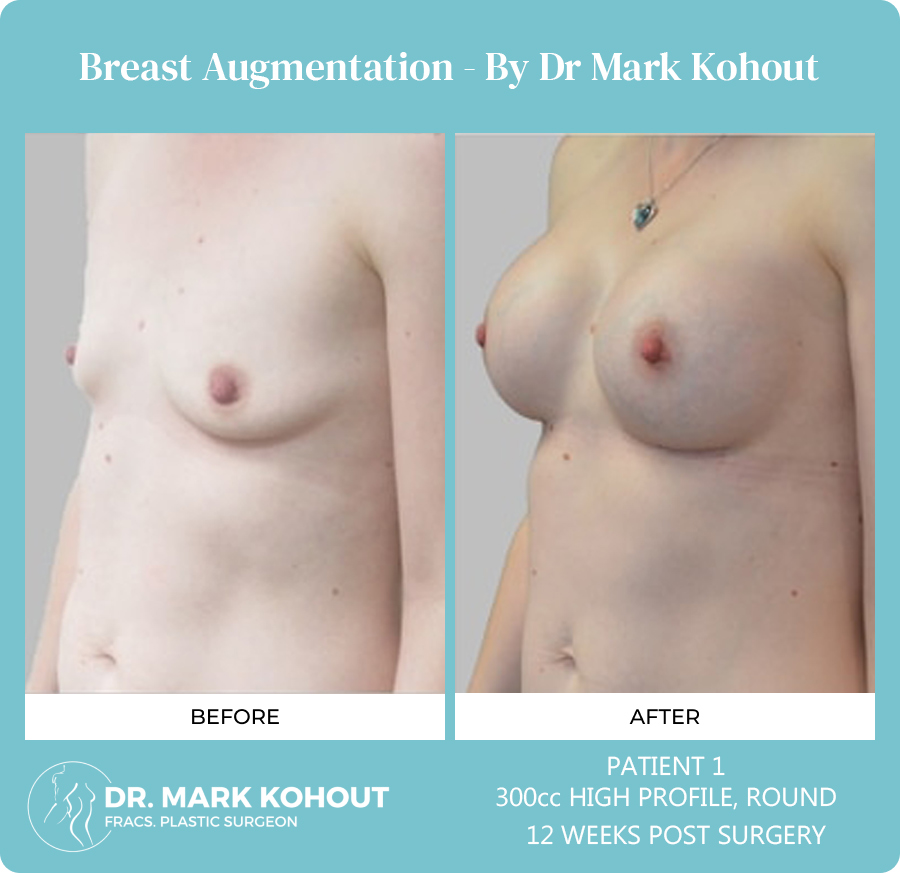
The first element is volume, expressed in cubic centimetres (cc). A label might read 250 cc, 300 cc or 375 cc. In general, a higher cc number means a larger implant. However, the cc number by itself does not determine how an implant will look on a particular person. Two people with the same volume implant can have very different results, because their bodies and tissues are different.


Each implant also has a base width. This is the measurement across the implant where it contacts the chest wall. Every person’s natural breast has a footprint on the chest, and this footprint is measured carefully in consultation. In most cases, Dr Mark Kohout aims for an implant whose base width is similar to the breast footprint so that it sits within the natural boundaries of the chest rather than spilling significantly beyond them.

A third important feature is profile, sometimes called projection. Within the same volume range, implants can have different profiles, such as:

  • Low profile
  • Moderate profile
  • Higher profile options in some ranges


A moderate profile implant at 300 cc is generally wider with less projection. A higher profile implant at the same 300 cc tends to be narrower and projects further forward. On the same person, these two implants can create noticeably different appearances even though the volume is identical.


When patients in Sydney sit down with Dr Mark Kohout, discussions about breast implant size usually include all three aspects:

  • Volume (cc)
  • Base width in relation to the breast footprint
  • Profile and projection


Considering all of these together provides a clearer and more individualised picture than relying on the cc number alone.

Download Dr Mark Kohout’s Breast Augmentation Guide

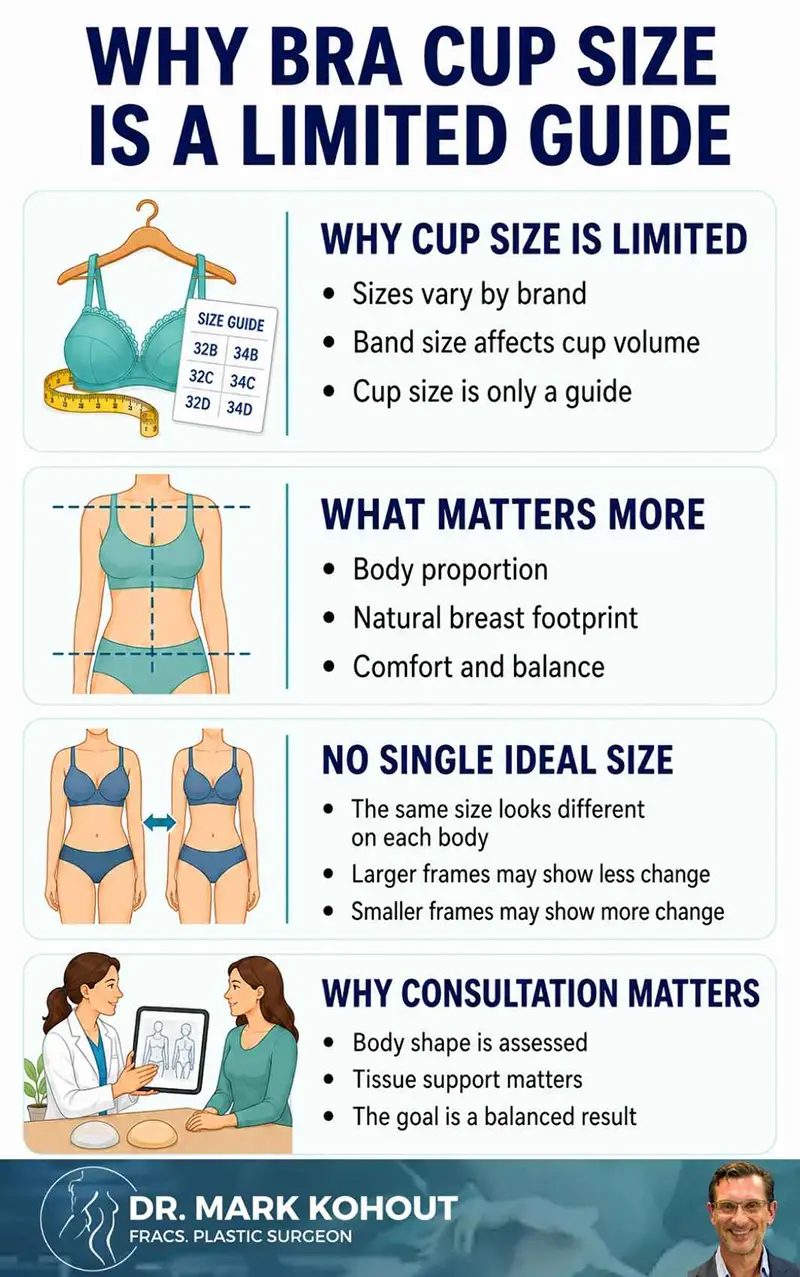
Why Bra Cup Size Is a Limited Guide

Many patients come to their appointment with a target cup size in mind. They may say they would like to be around a C or D cup, or to “go up a couple of cup sizes“. This is understandable, because cup sizes are familiar and part of everyday clothing.


However, bra cup sizing has several limitations:

  • Different brands use different sizing systems
  • Styles vary, and padding or construction can change the apparent size
  • Band size alters what the cup letter means
  • A 10D and a 14D are very different volumes, despite sharing the same cup letter


Because of these inconsistencies, it is not realistic or responsible to promise a specific bra size after surgery. In his Sydney clinic, Dr Mark Kohout treats cup size as a general reference only. It is helpful for understanding a patient’s aims in broad terms, but it is not used as a guaranteed outcome.

Instead, conversations focus on:

  • How the chest appears in proportion to the rest of the body
  • How the selected breast implant size fits within the natural breast footprint
  • Whether the proposed size appears compatible with daily activities and clothing preferences


Many patients find this shift in focus helpful. Rather than concentrating on a letter printed on a tag, they start thinking about proportion, practicality and how they would like their chest to look in the context of their overall frame.

Why There Is No Single "Ideal" Breast Implant Size

How Breast Implant Size Is Chosen - Infographics Mark Kohout

Sometimes people assume that surgeons have a standard or "ideal" breast implant size that suits most women. In modern practice, this is not the case. A size that works well for one person may not be appropriate for another.


A simple example helps illustrate this. Imagine two patients:

  • One is tall, with a broad chest and strong shoulders
  • The other is shorter, with a narrower ribcage and smaller frame

If both chose a 325 cc implant, the outcome would not look the same. On the taller person, 325 cc may appear moderate and in proportion to a larger frame. On the smaller person, 325 cc might look more prominent.


Dr Mark Kohout often explains this using the concept of proportion. The aim is not to choose the largest possible volume, but to select a breast implant size that sits comfortably within the patient's overall body shape. Standing in front of a mirror during the consultation is one of the most effective ways to make this concept visible. Patients can see how potential sizes relate to their shoulders, waist and hips, rather than only to the breasts in isolation.


Tissue quality is another reason there is no universal size. Skin, ligaments and breast tissue can only support a certain amount of additional weight and volume in a sustainable way. An implant that is significantly larger than the tissues can reasonably accommodate may be associated with a greater likelihood of stretching or changes in position over time.


For these reasons, there is no single "ideal" breast implant size. The most suitable size is the one that:

  • Fits within the measured breast footprint
  • Takes tissue thickness and skin quality into account
  • Sits relatively in proportion with the person's frame
  • Reflects realistic aims discussed carefully in consultation

Every patient's combination of these factors is different.
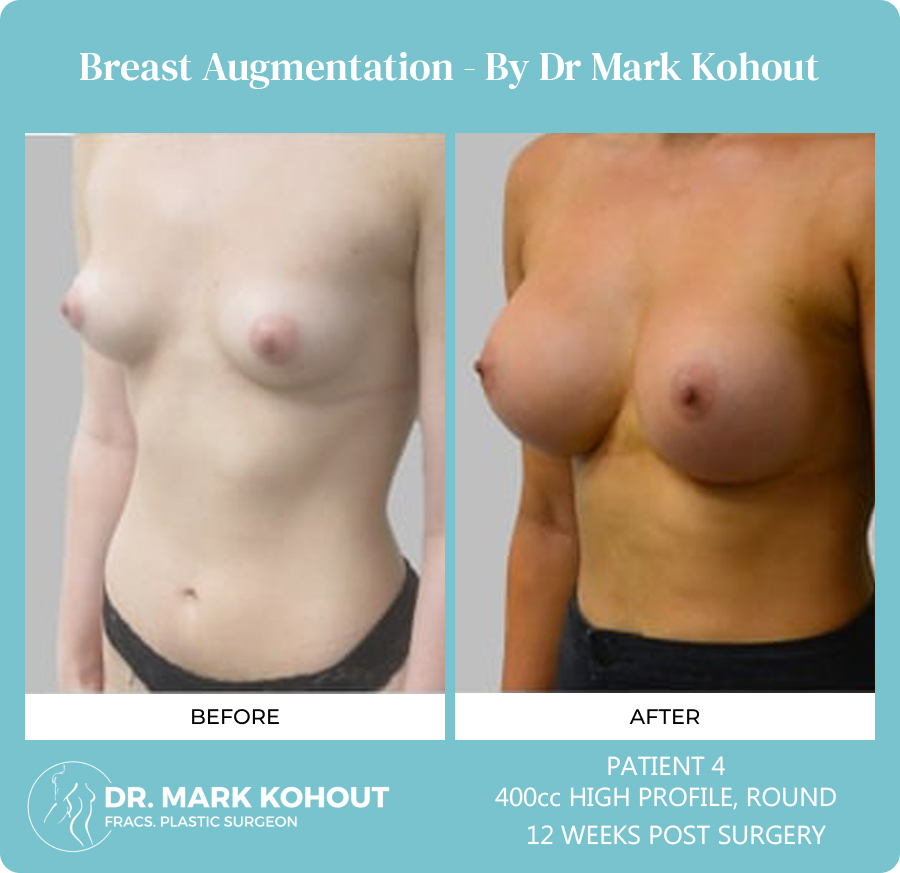
What Actually Influences the Choice of Size

In Dr Mark Kohout’s Sydney practice, breast implant size is chosen through a structured and collaborative process rather than by guesswork or fashion trends.


One key measurement is breast base width. This describes the width of the breast where it meets the chest. An implant that is much wider than this base width can extend too far to the outer chest or close to the centre. An implant that is much narrower may not adequately occupy the breast footprint. Matching implant width to breast base width supports a more balanced relationship between the implant and the chest.


Another important consideration is tissue thickness and skin quality. Thin tissues provide less natural coverage over the implant. In this situation, very large or high-projection implants may be more likely to show edges or rippling. When tissues are thicker, they may cover the implant more fully, although the range of suitable sizes still has upper limits. During consultation, Dr Mark Kohout assesses this through examination of the breast and chest wall in a respectful and methodical way.


Broader body proportions are also central. Height, shoulder width, torso length and hip width all influence how an implant size appears. A volume that looks modest on someone with a wide chest may look more noticeable on a smaller frame. For this reason, Dr Kohout often asks patients to view themselves in a mirror as different size options are discussed, so they can see potential changes in the context of the whole body.


Lifestyle and daily activities are discussed as well. Patients who routinely run, play sport, work in physically demanding roles or care for small children may wish to prioritise comfort and movement flexibility. Others with less physically demanding routines may feel comfortable considering a slightly fuller implant within clinically suitable limits.


Personal preferences are respected throughout. Some people are seeking a subtle change that is most obvious in fitted clothing. Others are interested in a more noticeable change in upper body contour. In consultation, Dr Mark Kohout may ask questions such as:


  • How obvious would you like the change to be day to day?
  • Are there particular types of clothing you imagine when you think about size?
  • Do you prefer a fuller upper chest or a softer slope?


Patients are welcome to bring realistic reference images. These are then discussed in relation to their anatomy and what is medically appropriate, rather than copied directly.


Future plans, such as possible pregnancy, breastfeeding and likely weight changes, are also important. These events can alter breast shape and volume over time, regardless of whether implants are present. Patients are reminded that surgery occurs at one point in time, while the body continues to evolve.

Tissue Based Planning and Evidence-Informed Sizing

In contemporary breast surgery, many surgeons, including Dr Mark Kohout, use an approach often referred to as tissue based planning. This approach aims to align breast implant choice with the physical characteristics of the breast and chest.


Tissue based planning usually involves:

  • Measuring breast base width and breast height
  • Assessing chest wall shape and curvature
  • Evaluating skin quality and tissue thickness
  • Considering current breast volume and position
  • Clarifying, in realistic terms, the degree of volume increase the patient would like


Using these details, the surgeon identifies a range of implants whose width and projection appear consistent with the measurements. The intention is to avoid implants that are clearly too wide or heavy for the available tissues.


Some studies report an association between this systematic approach and certain structural outcomes over time when compared with sizing based mainly on subjective judgement. Individual results still vary, and no method can promise a particular result for any one person. Tissue based planning is best viewed as a structured way of guiding decisions rather than a guarantee.

How Patients Often Think About Size, and How This Is Discussed

Over time, similar questions about breast implant size tend to arise in consultations. Addressing them openly can help patients feel more informed.


One common assumption is that a specific cc volume will always produce the same look. Patients may know someone with a certain implant size and expect a similar appearance if they choose that number. Dr Mark Kohout explains that this comparison is limited, because chest width, natural breast tissue, skin quality and overall body shape differ between individuals.


To help illustrate this, patients may be invited to try on sample sizer implants in a soft bra during the consultation. While this exercise does not replicate surgical results exactly, it demonstrates how the same cc volume can look different on different frames and helps patients observe each size in their own body outline.


Concerns about choosing a size that feels “too large” are also common. Rather than dismissing these concerns, Dr Kohout uses measurements and mirror views to explore what different size ranges might look like for that particular person. If a requested size appears to place significant demands on the tissues or sit outside the range considered appropriate for long term support, this is explained and alternative options are discussed.


Questions about intentionally starting with a smaller implant and increasing volume later also arise. While implant exchange procedures are technically possible, each operation involves its own anaesthetic, recovery and potential risks. For many patients, it is more appropriate to spend time arriving at a carefully considered size that feels suitable for the longer term, rather than planning multiple size changes without a clear medical reason.


Asymmetry is another frequent concern. Many people notice differences between their breasts even before surgery. In some cases, slightly different implant sizes or profiles may be used on each side to help reduce visible differences. At the same time, it is explained that complete symmetry is not realistic, as ribs, muscles and natural tissues also influence final appearance.

Safety and Medical Aspects Linked to Size

Breast augmentation is a significant operation. Breast implant size decisions sit within a broader medical context rather than being purely cosmetic.


All surgery carries general risks, such as bleeding, infection, wound healing issues and reactions to anaesthesia. There are also risks specific to breast implants, which may include:


Breast implant size can interact with some of these factors. Larger implants add more weight and may place greater strain on the skin and supporting structures of the chest. Over time, this may be associated with stretching or changes in implant position. Some patients may notice physical effects in certain activities or clothing styles when larger volumes are used.


Selecting a breast implant size that sits within a range informed by tissue based planning may help reduce some of these size related pressures, although it does not remove risk. In consultations in Sydney, Dr Mark Kohout outlines these matters in clear terms so that patients understand that sizing relates to both appearance and longer term breast health.

What a Sizing Consultation With Dr Mark Kohout Involves

Many people feel more at ease once they understand what actually happens in a breast implant consultation. The process is structured, respectful and designed to share information.


Appointments usually begin with a detailed medical history. This includes previous operations, current medications, allergies, smoking or vaping history, existing health conditions and any pregnancies or breastfeeding. This information helps to determine whether breast augmentation is appropriate and what particular points need consideration.


A physical examination of the breasts and chest follows, carried out with attention to privacy and dignity. During this examination, Dr Mark Kohout records measurements such as:

  • Breast base width
  • Breast height and natural projection
  • Nipple position and areolar characteristics
  • Skin quality and tissue thickness
  • Any difference between the two sides


These measurements form the basis for discussing appropriate breast implant sizes.


After the examination, size options are explored. Patients may have the opportunity to try different sizer implants in a soft bra while standing at the mirror. This gives a rough sense of how various volumes might look under clothing, while emphasising that the final surgical outcome will not be identical to the sizing exercise.


Throughout this process, Dr Mark Kohout explains how each option relates to the person’s anatomy, activities and aims. If a requested size appears inconsistent with tissue measurements or long term considerations, this is discussed openly. The intention is not to impose a single choice, but to guide patients towards size ranges that align with both their goals and clinical judgement.


Rather than fixing on a single number, it is common to agree on a range of suitable implant sizes. For example, a range such as 275 to 300 cc may be selected. During surgery, the final size within that range is chosen based on how the implants sit and how the tissues respond, while staying within the agreed plan.

How Breast Implant Size Decisions Play Out Over Time

Even when a breast implant size is chosen carefully, it is important to remember that breasts and implants change over time.


In the early period after surgery, swelling and temporary tissue tightness can make the breasts appear higher and firmer than expected. Some patients initially feel that they look larger than they had imagined. As recovery progresses, swelling typically reduces and tissues soften. Implants often settle into a more natural position, and the appearance may gradually move closer to what was discussed in consultation. This is the part of a progressive healing process rather than an instant end point.


Over the longer term, natural ageing, gravity, hormonal shifts, weight variation and any future pregnancies can all influence the appearance of the breasts. Implants themselves are medical devices that may eventually require replacement or removal. For this reason, breast implant size should always be considered in a long term context rather than as a once-only decision with a fixed outcome.


Dr Mark Kohout encourages patients to attend follow up appointments and to seek review if they notice any of the following:

  • Significant or sudden changes in breast size or shape
  • Persistent discomfort or pain
  • New rippling, hardness or swelling


These features do not always indicate a serious problem, but they do warrant assessment by an appropriately qualified practitioner.

Breast Implant Size FAQs

Can breast implant size affect how “natural” the chest looks when leaning forward or lying down? Yes, larger and higher profile implants can sometimes look more prominent in certain positions, especially if tissues are thinner. Dr Mark Kohout discusses how different sizes are likely to behave when standing, lying and leaning so patients have a realistic sense of everyday appearance.
Is it possible for the “same” implant size to look different over the years as fashion and clothing styles change? Yes, clothing trends and bra designs change over time, which can influence how noticeable a particular breast implant size appears. A size that feels modest now might stand out more or less in future depending on cuts, fabrics and how people dress.
Does breast implant size change how easy it is to exercise comfortably? Larger implants can be more noticeable during high-impact sport or running, particularly if supportive sports bras are not used. Dr Mark Kohout encourages patients to consider the types of activity they enjoy when deciding on a size range, so the choice aligns with their day-to-day routine.
Can someone with very uneven breasts choose noticeably different implant sizes on each side? In some cases, slightly different implant sizes or profiles may be used to help reduce asymmetry, but there are limits to how far this can go before it looks unbalanced. Dr Mark Kohout explains likely outcomes with diagrams and measurements so patients understand what can reasonably be addressed.
Does choosing a smaller implant size mean there is less chance of needing future surgery? A smaller or moderate size may place less weight on the tissues, which can help reduce some size-related strains over time, although it does not remove general implant risks. Whether or not future surgery is needed still depends on many factors, including healing, ageing, lifestyle and any implant-specific issues that arise.
If a patient is unsure between two sizes, does Dr Mark Kohout always recommend the larger one? No, size recommendations are based on measurements, tissue limits and the person’s own aims, rather than a default preference for larger implants. When patients are undecided, he often explains the pros and cons of each option and may suggest choosing the range that best fits their lifestyle and long-term priorities.
Can breast implant size influence how easy it is to detect changes such as lumps or unusual firmness? Any implant can make the breast feel different, but regular self-checks and appropriate imaging remain important regardless of size. Dr Mark Kohout discusses how to monitor the breasts after augmentation and may recommend specific imaging approaches through the patient’s GP or radiologist.
Will a particular breast implant size always make someone look fuller in every type of bra? Not necessarily, because bra construction, padding and underwire design all influence the final appearance. A size that looks quite full in one bra may appear more modest in a soft, unstructured style, which is why patients are encouraged to think about the types of bras and clothing they typically wear.
Is there such a thing as choosing an implant size that is “too small” for the chest? Implants that are much narrower than the breast footprint may not fully occupy the available space, which can look under-filled, particularly on a broader chest. During consultation, Dr Mark Kohout uses measurements and mirror views to show when a size may be smaller than the chest can comfortably accommodate.
Can someone change their mind about size after the consultation but before surgery? In many cases, adjustments within a clinically suitable range can be discussed before the operation, provided there is enough time to reassess and consent to the new plan. Dr Mark Kohout encourages patients to contact the clinic early if their thoughts about breast implant size shift, so there is time to review measurements, options and risks again.
Medical References
  • Medor MC, Bouhadana G, Churchill IF, et al. How Big Is Too Big? Exploring the Relationship Between Breast Implant Volume and Postoperative Complication Rates in Primary Breast Augmentations. Plastic and Reconstructive Surgery – Global Open. 2023;11(3):e4843. https://europepmc.org/article/PMC/PMC9995107
  • Kim J-H, Park J-W, Woo K-J. Prediction of the Ideal Implant Size Using 3-Dimensional Healthy Breast Volume in Unilateral Direct-to-Implant Breast Reconstruction. Medicina. 2020;56(10):498. https://www.mdpi.com/1648-9144/56/10/498
  • Akgun Demir I. Optimizing Implant Width Selection in Breast Augmentation: Insights From On-Patient Landmark Positioning in 3-Dimensional Breast Simulation. Aesthetic Surgery Journal. 2024;44(9):909–914. https://academic.oup.com/asj/article/44/9/909/7611640

Preparing for a Breast Implant Size Consultation in Sydney

A small amount of preparation can make a breast implant consultation more productive and less overwhelming. Patients often find it helpful to:

  • Write down what they currently like and dislike about their breasts
  • Note how they would like clothing to fit after surgery
  • Gather a small selection of realistic reference images
  • Think about work duties, exercise patterns and hobbies
  • Prepare questions about size, risks, recovery and long term follow up


Bringing this material to the appointment can assist Dr Mark Kohout in understanding each person’s aims and daily environment. It also supports a more detailed and individualised discussion about which breast implant sizes may be suitable.


In Sydney, patients can arrange a consultation with Dr Mark Kohout directly through his clinic or by referral from a GP. A GP can also help discuss whether it is the right time to consider surgery and may recommend seeking more than one specialist opinion.


Choosing the right implant size is only one part of planning breast augmentation. To learn more about implant types, placement options and other decisions, see our complete Guide to Choosing Breast Implants and Customising Your Augmentation.

Next Steps for People Thinking About Breast Implant Size

Choosing a breast implant size is a careful process that connects anatomical measurements, tissue characteristics, personal aims and medical judgement. There is no universal formula and no single size that suits everyone. Instead, there is a structured approach that involves assessment, discussion and clear explanation of risks and options.


For people in Sydney or surrounding areas who are considering breast augmentation and would like to understand which breast implant sizes might be appropriate for them, a consultation with Dr Mark Kohout, Plastic Surgeon in Sydney, provides an opportunity to explore these questions in depth. During this appointment, patients are encouraged to ask questions, consider a range of options and take the time they need before deciding whether to proceed.


All surgical procedures carry risks, and individual outcomes vary. Before proceeding with surgery, it is recommended to seek a second opinion from an appropriately qualified health practitioner. This can help patients make informed decisions about breast implant size and about breast surgery more broadly.

Further Reading​

Related Blog Posts

Healing and Recovery After Breast Reduction Surgery

Healing and Recovery After Breast Reduction…

Comprehensive Guide to Healing and Recovery After Breast Reduction Surgery Download Dr Mark Kohout’s Breast Reduction Surgery Guide Healing and Recovery After Breast Reduction: Timeline and Tips Breast reduction surgery,…
Breast Reduction Medicare Cover – Will Medicare cover Mammoplasty?

Breast Reduction Medicare Cover – Will…

Will Medicare Cover My Breast Reduction? Breast reduction, medically known as reduction mammoplasty, is a surgical procedure that removes excess breast tissue and skin to achieve a breast size more…

Reducing Back Pain with Breast Reduction Surgery: Can Breast Reduction Surgery Help with Back Pain?

Reducing Back Pain with Breast Reduction…

The Connection between Back Pain and Overly Large Breasts For some women, overly large breasts can be a source of discomfort and pain, particularly in the back region. The weight of…
Experienced Plastic Surgeon

Dr. Mark Kohout

A qualified plastic surgeon who operates with care and integrity, based in central Sydney with over 20 years of experience in the cosmetic field. His extensive training and experience assures patients they are in highly trained surgical hands. Dr. Kohout is a dedicated, friendly professional who is committed to providing the high quality care, support and results, alongside his compassionate team.

Dr Mark Kohout (MED0001133000)
Specialist Plastic Surgeon
Specialist registration in Surgery – Plastic Surgery

This website contains imagery which is only suitable for audiences 18+. All surgery contains risks, read more here.

X

Get Your Breast Augmentation Guide

Get Your Facial Aesthetic

Get Your Breast Implant Removal

Get Your Female Genital Surgery Guide

Get Your Excess Skin Guide

Get Your Gynaecomastia Guide

Get Your Liposuction Guide

Get Your Abdominoplasty Guide

Get Your Cost of Surgery Guide

Get Your Breast Implant Replace Guide

Get Your Breast Reduction Guide

Make an Enquiry