Many people with breast implants carry the same quiet questions for years:
- How can they tell if their implants are still alright
- What should they actually be checking at home
- When is it time to see a doctor instead of just watching and waiting
In his Sydney practice, Specialist Plastic Surgeon Dr Mark Kohout regularly meets patients who have had implants for some time and are unsure how to monitor them. Some have noticed a change and feel uneasy. Others sense that something is different, but struggle to explain exactly what they are feeling.
This article has been written as a practical guide to the breast implant check, using patient-friendly language and focusing on clear, factual information. It outlines what a breast implant check involves, how people can look and feel for changes at home, which signs may need attention, and how professional assessment with a GP or a Plastic Surgeon such as Dr Mark Kohout in Sydney fits into long term implant care.
The information here is general in nature. It does not replace a consultation, examination, diagnosis or personalised advice. All surgery carries risks. Breast implants are long term medical devices that may require ongoing monitoring and, in some cases, further surgery over time. Anyone with specific concerns about their implants should seek advice from a suitably qualified health professional.
Understanding What Has Been Placed
A breast implant check is easier to understand and perform when patients have at least a basic idea of what was placed in their body. Many people do not remember every detail of their surgery, especially if it was performed many years ago or overseas, and this is very common.
Most breast implants used in Australia fall into two broad categories:
- Silicone gel implants, which contain cohesive silicone gel inside a silicone shell
- Saline implants, which contain sterile salt water inside a similar shell
The surface of the implant may be smooth or textured. The shape may be round or more anatomical. Implants can be positioned in front of the chest muscle or partly behind it.
When patients attend a breast implant check with Dr Mark Kohout, Plastic Surgeon in Sydney, he often asks whether they have kept their implant card or original operation report. These documents usually list:
- Brand and model of the implant
- Size and shape
- Surface type
- Position in relation to the muscle
Keeping this information somewhere safe can assist with future imaging, clinic visits and any later decisions about implant management.
One important point applies to everyone. Breast implants are not regarded as lifetime devices. They may remain in place for many years, but the chance of issues such as rupture, capsular contracture or changes in shape tends to increase over time. This does not mean a problem will definitely occur at a particular year. It simply highlights why regular review and awareness form part of responsible long term care.
A breast implant check is not meant to create fear or encourage constant self-scrutiny. Instead, it is a structured way to stay familiar with what feels and looks usual for each person, so that meaningful changes stand out and can be discussed early with a doctor.
How a Breast Implant Check Differs From a Breast Cancer Check
It is easy to confuse the idea of a breast implant check with a breast cancer check, but they have different purposes and use different tools.
A breast implant check focuses on the implant and the nearby tissues. It considers questions such as:
- How does the implant sit on the chest
- Has the breast shape or firmness changed over time
- Is there new swelling, discomfort or a sense of fluid around the implant
A breast cancer check or screening appointment is aimed at detecting early signs of cancer in breast tissue. In New South Wales, this usually involves mammograms through services such as BreastScreen NSW, sometimes combined with ultrasound or other imaging where appropriate.
People with implants should still participate in breast cancer screening according to their age and risk profile. It is important to inform the imaging service that implants are present so that suitable techniques can be used. In his Sydney practice, Dr Mark Kohout often explains to patients that breast implant checks and breast cancer screening work alongside one another. One does not replace the other; both contribute to overall breast health.
How Often Should You Check Breast Implants
There is no single schedule that suits everyone, but certain patterns can help patients plan their care.
For many individuals, a monthly breast implant check at home is a practical starting point. Choosing a regular time, such as the first weekend of each month, can make it easier to build the habit. The aim is not to perform a detailed medical examination. Instead, a monthly rhythm allows people to notice changes over time without becoming preoccupied daily.
During a home check, patients are mainly asking:
- Do my breasts look and feel similar to last month
- Has anything changed or stayed different for several checks in a row
In addition to home checks, professional review is an important part of ongoing care. Early after surgery, follow up is usually arranged by the operating surgeon. As time passes, patients may rely more on their GP or see another Plastic Surgeon such as Dr Mark Kohout in Sydney. If implants are older, or if symptoms appear earlier, it is reasonable to speak with a doctor about a plan for regular clinical review.
Some signs suggest that a person should arrange medical assessment promptly rather than waiting for the next planned check. These include:
- Sudden or ongoing swelling of one breast
- A clear change in shape or size on one side only
- New lumps in the breast or under the arm
- Persistent redness, warmth or discomfort
- A sensation of fluid moving around the implant
- Feeling generally unwell along with breast changes
If any of these issues arise, patients are encouraged to see their GP or an appropriately qualified specialist rather than relying on repeated self examination.
Preparing For An At Home Breast Implant Check
An at home breast implant check does not require special equipment. A little preparation can make the experience more comfortable and more reliable.
Many people prefer to examine their breasts at a time when they are usually less tender. For those who menstruate, this may be a few days after a period finishes. The intention is to reduce the influence of normal hormonal changes, so that findings are easier to compare from month to month.
A private, calm space helps. A warm, well lit room with a mirror large enough to see the upper body from different angles is ideal. Some people prefer to perform their breast implant check as part of their shower or bathroom routine. Others choose a separate time of day when they are unlikely to be interrupted. There is no single correct approach, as long as the person can focus and move comfortably.
Keeping a simple record can be useful. Patients may choose to note:
- The date of each check
- Any differences they noticed compared with previous checks
- Questions they want to ask their GP or Plastic Surgeon
When people later attend the clinic of Dr Mark Kohout in Sydney, these notes can support a clearer understanding of how long a symptom has been present and whether it has changed.
The first few checks are mainly about learning what is typical for that person. Natural differences between the left and right breasts are common. Scars may sit in slightly different positions. Some areas may always feel a bit firmer or softer. Over time, this familiar pattern allows new or progressive changes to stand out more easily.
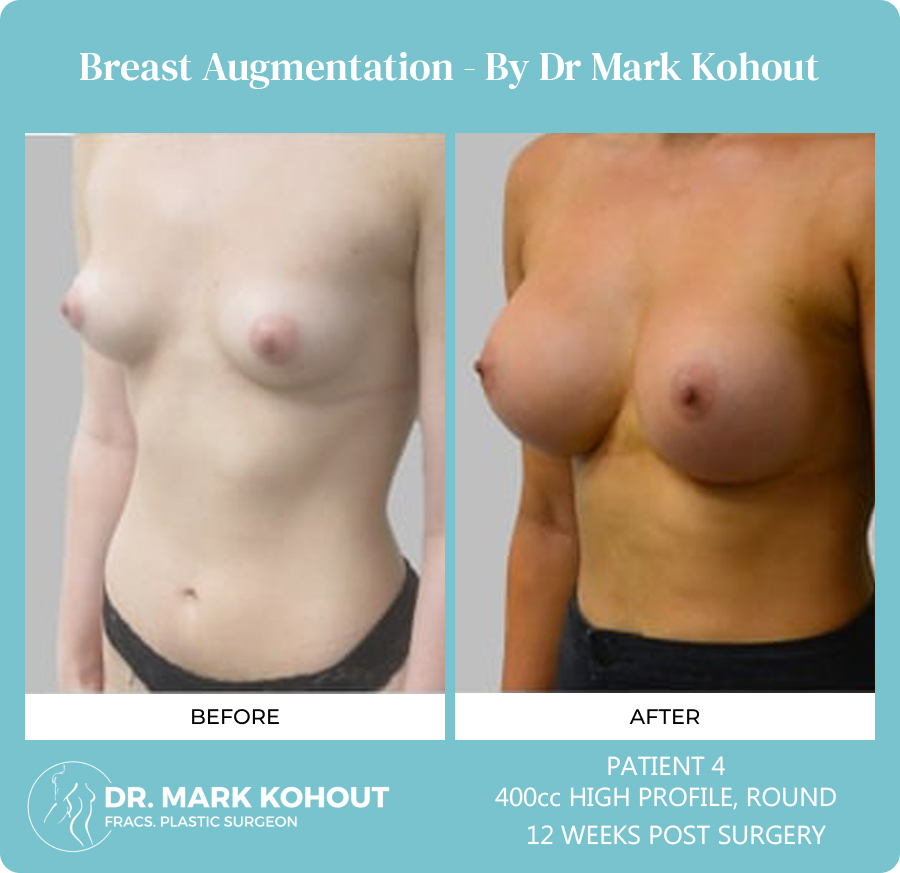
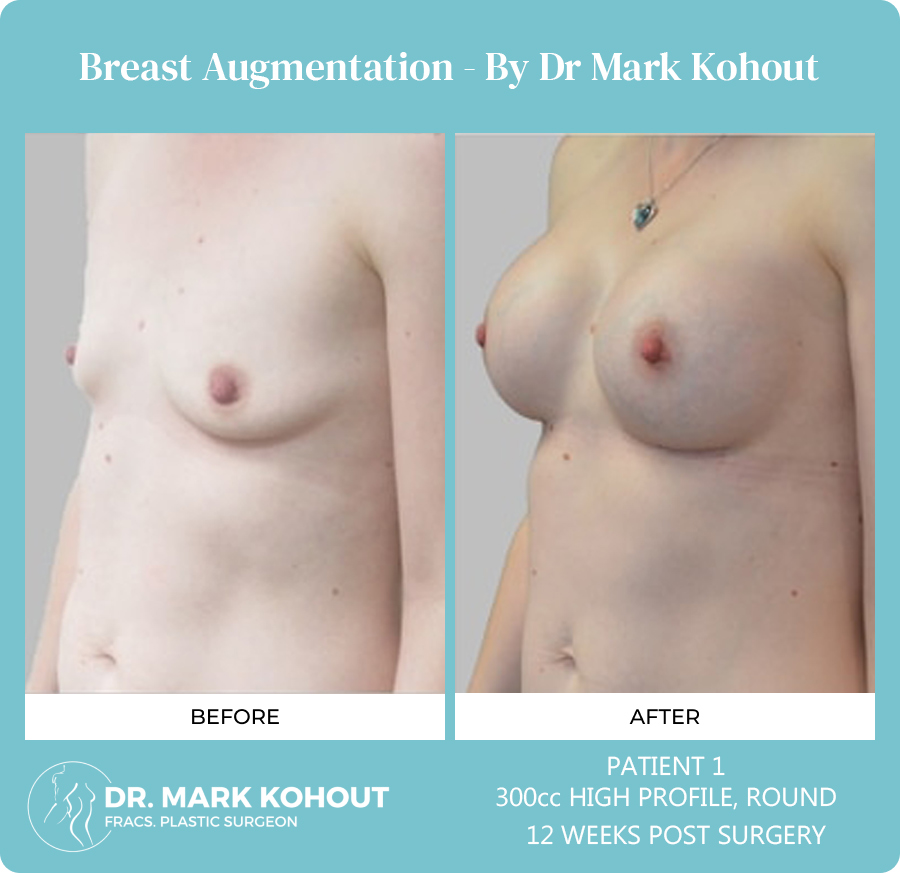
Breast Augmentation Before and After Images
The Visual Part Of A Breast Implant Check
A breast implant check often starts with looking. Visual changes in shape, position and contour can sometimes be easier to notice than subtle differences in texture alone.
Standing in front of a mirror with arms relaxed, patients can begin by observing both breasts together. They might consider:
- Do the breasts look broadly similar to how they did at the last check
- Has one side become noticeably higher, lower, fuller or smaller
- Do the lower breast folds sit at about the same level as before
The focus is not on judging appearance, but on noticing whether something appears different from the person’s usual pattern.
Turning slightly to view each breast from the side and at an angle can provide extra information. From these viewpoints, it is easier to see how the implants rest on the chest wall and how the breast slopes above and below the nipple. Raising both arms carefully above the head and then lowering them allows patients to see how the breasts move with the body.
People may notice, for example:
- A breast that now appears more rounded and tight in the upper area compared with older photographs
- An implant that seems higher or lower than it used to be
- A new indentation, fold or ripple in the skin surface
These changes do not automatically indicate a serious problem, but they are important to record and discuss if they persist.
The skin and scars also form part of the visual check. Patients can look for:
- Areas of persistent redness or rash
- Patches of thickened, shiny or stretched skin
- New irritation, breakdown or discharge around scars
Minor marks from clothing or temporary irritation often settle on their own. However, changes that persist, worsen or are associated with pain should be reviewed by a health professional.
Stepping back at the end of the visual check and comparing both sides gives an overall impression. A breast that looks clearly more swollen, asymmetric or altered compared with the other side may need clinical assessment rather than repeated self monitoring.
The Tactile Part: Feeling During A Breast Implant Check
After completing the visual part, patients can move on to the tactile aspect of the breast implant check, which involves gently feeling the breasts and nearby areas.
Many people find it easier to lie on their back with a small pillow under the head. Placing one arm behind the head on the side being examined helps spread the breast tissue more evenly. The other hand can then use the flat pads of the fingers to examine the breast in a regular pattern.
A common method is to start at the outer edge of the breast near the armpit and move in small circles, gradually covering the whole breast, including:
- The upper area above the nipple
- The central region
- The lower area towards the fold
While doing this, patients are paying attention to:
- New lumps or nodules
- Areas that feel noticeably firmer or thicker than the rest of the breast
- Localised tenderness that does not seem typical for their usual cycle
The same pattern is then repeated on the other side.
Next, attention can be directed to the likely edges of the implant. This usually includes the fold under the breast, the outer edge near the armpit and the inner edge near the centre of the chest. Over time, many people become quite familiar with how this contour feels. If an edge that was previously smooth now feels sharply folded, very tense, or appears to have moved, this is important information to share with a doctor.
The underarm areas are also part of a thorough breast implant check. With light pressure, using the pads of the fingers, patients can feel for any new lumps or areas of fullness in each axilla. Lymph nodes located here can respond to a range of conditions, including infections and other health issues. Any new, persistent lump in this area should be assessed by a GP or specialist.
After finishing the tactile check, it is useful to pause and consider the overall picture. Questions people might ask themselves include:
- Does one breast feel significantly firmer than the other
- Has a particular area felt unusual for more than one monthly check
- Is there a sensation of pressure, tightness or discomfort that seems to be increasing
If the answer is yes, arranging a clinical review is recommended rather than relying only on repeated self examination.

Changes That May Be Linked To Implant Related Problems
Breasts can change for many reasons, including weight variation, hormonal changes, pregnancy, breastfeeding and the natural effects of ageing. Some patterns, however, are more suggestive of implant related issues and should be discussed with a doctor.
One of these patterns is capsular contracture. The body naturally forms a capsule of scar tissue around an implant. In some people, this capsule becomes unusually thick or tight. Patients might notice:
- Increasing firmness of one or both breasts
- A more rounded or high sitting look compared with older images
- Discomfort or a feeling of pressure, especially when lying on the affected side
Capsular contracture can range from mild to more significant. Management options may vary from ongoing monitoring to surgery. A detailed assessment with a Plastic Surgeon such as Dr Mark Kohout in Sydney is important before any decisions are made.
Another concern is implant rupture. With saline implants, rupture often results in a more rapid loss of volume in the affected breast, because the saline is absorbed by the body. The breast may appear smaller or less full than the other side, with looser skin.
Rupture of a silicone implant can be more subtle. Sometimes there are no clear external signs and the change is identified through imaging. When symptoms are present, they may include:
- A small but persistent change in breast shape
- Localised areas of firmness
- Lumps close to the implant shell
Because silicone ruptures can be difficult to confirm on examination alone, imaging such as ultrasound or MRI is often suggested if rupture is suspected.
Late swelling or fluid around an implant is less common but important. A breast that gradually enlarges over weeks, feels heavy or has a distinct fluid wave when moved should be assessed promptly. In rare situations, fluid or lumps around certain types of textured implants have been associated with implant related lymphoma. Most patients will never develop this condition, but any persistent swelling or unexplained fluid build up around an implant should be taken seriously and investigated.
What To Expect From A Professional Breast Implant Check In Sydney
When patients attend a professional breast implant check with Dr Mark Kohout, Plastic Surgeon in Sydney, the consultation is structured yet individualised.
The appointment generally begins with a detailed history. Dr Kohout asks about:
- When and where the implants were placed
- Any available details about implant brand, size, type and position
- Symptoms such as pain, firmness, swelling, shape change or skin changes
- General health, prior operations, pregnancies and any breast related history
This background information helps guide examination and any investigations.
A physical examination follows. This has similarities to an at home breast implant check but is more thorough. Dr Mark Kohout observes the breasts from various angles, both at rest and with arm movement. He gently palpates the breast tissue, implant area and underarms, and examines scars and skin. If he identifies any areas of concern or uncertainty, he explains what these might represent and which tests may help clarify the situation.
Imaging frequently forms part of a professional assessment. Depending on the circumstances, this may include:
- Ultrasound, which can evaluate fluid collections and some implant changes
- MRI, which can give detailed information about silicone implants and possible ruptures
- Mammography, often arranged through screening services or radiology providers, as part of breast cancer surveillance
The type of imaging recommended will depend on symptoms, implant type, age of the implants and the clinical findings.
Once the necessary information has been gathered, Dr Mark Kohout discusses the results and possible options. These may include:
- Ongoing observation with scheduled reviews
- Further imaging at particular intervals
- Surgery to remove or replace implants, where appropriate and desired
Every plan is tailored to the individual. Patients are encouraged to ask questions and, if they wish, to obtain a second opinion from another suitably qualified practitioner, in line with good medical practice and AHPRA expectations.
Breast Implant Checks FAQs
Can a breast implant check at home actually pick up problems, or is it just for reassurance?
A home breast implant check can sometimes highlight changes such as swelling, firmness or a new lump, which may then prompt a professional review. It does not diagnose problems on its own, but it may help you recognise when something is different and worth discussing with your GP or Plastic Surgeon.What if I have no idea what type of implants I have or where my surgery was done?
This is very common, especially if surgery was done many years ago or overseas. A GP or Plastic Surgeon can often piece together useful information from examination, imaging and any old paperwork you can find, and your future care can still be planned even if every detail is not available.Can I ‘overdo’ breast implant checks and make myself more anxious or sore?
Frequent, intense checking can sometimes increase worry rather than reduce it, and may make the breasts feel tender. A regular, gentle monthly check is usually enough for most people, with extra review if you notice a clear change or develop symptoms.Is a breast implant check different for people who had reconstruction after breast cancer?
Yes, the surgical techniques and tissues involved can be different after reconstruction, so the examination may feel a little different too. The core idea is the same, though: knowing what is usual for you now and seeking medical advice if you see or feel changes that persist.Can my partner help with breast implant checks, or is that not recommended?
Some people find it helpful for a partner to alert them to obvious changes in appearance, such as new swelling or a marked difference between sides. The more formal parts of the check, such as systematic palpation, are still best guided by instructions from a health professional and supported by medical review when needed.If my implants feel and look normal, do I still need professional checks?
Even if everything appears stable, it can be useful to have periodic reviews, especially as implants get older. A GP or Plastic Surgeon can assess things that are not always obvious on a self-check and discuss whether any imaging or follow up schedule is appropriate for you.Do breast implant checks change how I should approach mammograms and screening?
Regular breast implant checks do not replace mammograms or other breast cancer screening. Instead, they sit alongside screening, and it is still important to tell the imaging service that you have implants so they can adjust their technique if needed.Can exercise, weight training or certain sleeping positions affect what I feel during a check?
Yes, recent heavy exercise or changes in muscle tone can temporarily influence how the chest and implants feel, especially if implants are partly under the muscle. If something feels different, it can help to repeat the check at a quieter time and then speak with your doctor if the change persists.What if I notice a change but feel embarrassed or worried that I am ‘overreacting’?
Doctors who regularly see patients with implants are used to hearing about a wide range of concerns, from minor queries to significant symptoms. It is reasonable to raise any persistent or worrying change, even if it turns out not to be serious, and a consultation can help you understand what is happening.Is there an age at which I should seriously consider removing or replacing long-standing implants?
There is no fixed age where implants must be removed, but the chance of implant related issues generally increases over time. A discussion with a Plastic Surgeon, such as Dr Mark Kohout in Sydney, can help review your implants, your health and your preferences so you can weigh up whether continued monitoring or surgery is appropriate for your situation.Medical References
- Chetlen A, Niell BL, Brown A, et al. ACR Appropriateness Criteria Breast Implant Evaluation: 2023 Update. Journal of the American College of Radiology. 2023;20(11 Suppl):S329–S350. https://doi.org/10.1016/j.jacr.2023.08.019
- Noreña-Rengifo BD, Sanín-Ramírez MP, Adrada BE, et al. MRI for Evaluation of Complications of Breast Augmentation. Radiographics. 2022;42(4):929–946. https://doi.org/10.1148/rg.210096
- Masoumi E, Seow C, Deva AP, et al. Prospective Study of Clinical Outcomes From a Breast Implant Assessment Service. Aesthetic Surgery Journal. 2023;43(3):308–314. https://doi.org/10.1093/asj/sjac266
Keeping Records And Planning Ahead
Maintaining a clear record of implant related information can support long term care and decision making. Patients may choose to keep:
- Implant cards or labels
- Operation reports or letters from previous surgeons
- Copies of imaging results
- Notes from significant consultations
Brief entries from regular breast implant checks at home can also be helpful, especially if a particular concern has developed gradually. When individuals attend the rooms of Dr Mark Kohout in Sydney or another clinic, these records provide useful context and reduce reliance on memory alone.
Looking to the future, it is worth remembering that breast implants placed at one stage of life may still be present many years later. Health priorities, family circumstances and personal preferences can all change. Some people may later consider implant removal or replacement, whether for medical reasons or by choice. Having a complete record and an established relationship with a Plastic Surgeon can support a calm, informed approach if and when these decisions arise.
Bringing The Key Ideas Together
A breast implant check is one part of ongoing breast and implant care. It is not about perfection, and it is not about patients diagnosing themselves. It is about awareness, observation and timely communication with health professionals.
At home, a monthly check can help people stay familiar with how their breasts typically look and feel. By looking carefully in the mirror, feeling gently in a consistent pattern and keeping brief notes, they may notice changes that are new or persisting. While many differences turn out to be harmless, symptoms such as progressive swelling, increasing firmness, new lumps, altered shape, fluid sensations or persistent discomfort should be discussed with a doctor rather than ignored.
Professional breast implant checks with a GP or a Plastic Surgeon, such as Dr Mark Kohout in Sydney, can provide further assessment and individualised guidance. Through history taking, examination and appropriate imaging, these reviews help patients understand what may be happening with their implants and what steps may be suitable for their situation.
Patients in Sydney and surrounding regions who are concerned about their breast implants, or who feel it has been a long time since their last review, may choose to contact the rooms of Dr Mark Kohout, Plastic Surgeon in Sydney, to discuss whether a consultation is appropriate for their circumstances. Bringing any implant cards, previous reports or imaging results to the appointment can support a more complete assessment.
Overall, concerns about breast implants are best addressed through clear information, steady monitoring and timely medical advice. A structured approach to breast implant checks, both at home and in clinic, can support ongoing monitoring and may help patients make informed decisions about their care over time.
Further Reading
- Read more about Breast Revision Sydney
- Read Dr. Mark Kohout’s Blog on Recovery After Breast Augmentation: Guidelines for Healing after Implants
Related Blog Posts
How Long Do Breast Implants Last?…
Breast implants are a significant consideration for many individuals exploring cosmetic or reconstructive breast surgery. For patients in Sydney and surrounding areas, understanding how long breast implants last is an…
FAQs About Breast Augmentation with Breast…
Breast augmentation with breast implants is a procedure many individuals consider for various reasons, including balancing asymmetry, restoring volume after pregnancy or weight loss, or achieving a sought aesthetic appearance.…
Recovery after Breast Implants Surgery
What to Anticipate in the Initial 6 Months after Breast Augmentation Whether you’re undergoing breast augmentation for cosmetic reasons or reconstructive purposes, understanding the recovery process is important for a smooth transition…
Experienced Plastic Surgeon
Dr. Mark Kohout
A qualified plastic surgeon who operates with care and integrity, based in central Sydney with over 20 years of experience in the cosmetic field. His extensive training and experience assures patients they are in highly trained surgical hands. Dr. Kohout is a dedicated, friendly professional who is committed to providing the high quality care, support and results, alongside his compassionate team.
Dr Mark Kohout (MED0001133000)
Specialist Plastic Surgeon
Specialist registration in Surgery – Plastic Surgery