

Buttock surgery may be considered when ageing, weight variation or changes in tissue support affect the position and shape of the gluteal area. A buttock lift can remove excess skin and reposition soft tissue, but it does not necessarily add the volume needed to address concerns about reduced projection or fullness.
Dr Mark Kohout is a Specialist Plastic Surgeon in Sydney with more than 25 years of clinical experience. During consultation, he assesses skin position, tissue volume, donor-fat availability and overall proportions to determine whether a lift alone, fat transfer or a combined approach may be considered.
What Does a Buttock Lift Actually Change?
A buttock lift primarily removes excess skin and repositions existing soft tissue. It may address tissue laxity or downward displacement, but it does not automatically add volume to the gluteal area.
The operation may be considered following substantial weight loss, ageing or changes in skin support. The location and length of the incisions depend on the amount of tissue involved and the type of adjustment being planned.
A buttock lift may address:
- Excess or lax skin
- Downward displacement of soft tissue
- Selected contour irregularities
- Changes following substantial weight loss
Why Might Skin Tightening Alone Produce a Flatter Appearance?
Skin removal and tissue repositioning may make the buttocks appear flatter when there is limited underlying fat or muscle volume. Tightening the outer tissues does not replace volume that has been lost or was naturally limited.
Some patients are mainly concerned about skin position, while others are also seeking greater projection or fullness. Identifying the primary concern before surgery helps clarify whether a lift alone is likely to align with the person’s goals.
Factors that may contribute include:
- Limited fatty tissue in the buttocks
- Reduced gluteal muscle volume
- Significant tissue loss after weight reduction
- A lift plan focused mainly on skin removal
- Differences between expected and achievable change
How Does Volume Influence Buttock Shape?
Volume contributes to projection, roundness and the relationship between the buttocks and surrounding areas. When volume is limited, repositioning the skin may not substantially alter the side profile.
Buttock shape is influenced by the pelvis, gluteal muscles, fatty tissue, skin and connective-tissue support. The distribution of volume across the upper, central and outer buttocks can also affect how the area appears from different angles.
Volume may affect:
- Projection when viewed from the side
- Fullness in the upper buttock
- The transition between the waist and hips
- Differences between the left and right sides
Who May Have Reduced Buttock Volume?
Reduced buttock volume may occur because of genetics, substantial weight loss, ageing or changes in muscle mass. Some people naturally store relatively little fat in the gluteal area even when their overall weight is stable.
The cause and location of volume loss vary between patients. A physical assessment is needed to distinguish reduced fatty tissue from skin laxity, muscle changes or differences in skeletal structure.
Common contributing factors include:
- Inherited fat-distribution patterns
- Significant or repeated weight changes
- Age-related changes in soft tissue
- Reduced gluteal muscle mass
- Previous surgery in the area
How Can Fat Transfer Add Volume During Buttock Surgery?
Fat transfer involves removing fatty tissue from suitable donor areas and placing it into selected parts of the buttocks. It may be combined with a lift when both skin position and reduced volume are being addressed.
Fat is commonly collected through liposuction from the abdomen, waist, hips or thighs before being processed for transfer. Some transferred fat may establish a blood supply and remain, while another portion may be reabsorbed during healing.
The procedure generally involves:
- Assessing suitable donor areas
- Collecting fat through liposuction
- Preparing the harvested tissue
- Placing fat into selected gluteal areas
- Monitoring volume changes during recovery
Why Might a Buttock Lift and Fat Transfer Be Combined?
A combined procedure may address excess skin and reduced volume during the same operation. The lift repositions tissue, while fat transfer adds volume in selected areas where the patient has suitable donor fat.
Combining procedures does not guarantee a particular shape or level of projection. The possible change depends on anatomy, skin quality, the amount of transferable fat and how the tissues heal.
A combined plan may:
- Address skin laxity and volume together
- Add volume to selected regions
- Reduce the need for separate operations
- Provide more options for individual surgical planning
Is a Combined Procedure Suitable for Everyone?
A buttock lift with fat transfer is not suitable for every patient. Suitability depends on general health, donor-fat availability, tissue quality, medical history and the extent of surgery being considered.
People with very limited body fat may not have enough donor tissue for a meaningful transfer. Smoking, unstable weight and health conditions that affect circulation or healing may also influence whether surgery is recommended.
Assessment commonly considers:
- The amount and location of donor fat
- Skin and connective-tissue quality
- Current health and medication use
- Smoking or nicotine exposure
- Ability to follow recovery instructions
What Happens If There Is Not Enough Fat for Transfer?
Patients with limited donor fat may need to consider a lift alone, implant-based surgery or no operation. The appropriate option depends on whether the main concern involves skin position, volume or both.
Deliberately gaining weight does not automatically make fat transfer suitable because fat distribution is unpredictable and later weight loss may alter the result. Gluteal implants may be discussed in selected patients, although they have different risks and recovery requirements.
Possible alternatives include:
- A buttock lift without added volume
- Gluteal implant surgery
- Staged surgical planning
- Further review after weight stabilisation
- No surgery when the limitations outweigh the possible change
What Are the Limits of Buttock Fat Transfer?
Fat transfer cannot guarantee a precise amount of retained volume or exact symmetry. Some transferred fat is expected to be reabsorbed, and the remaining tissue may change with later weight variation.
The amount that can be transferred is limited by donor-fat availability and the capacity of the recipient tissues. More than one operation may sometimes be discussed, but additional surgery also introduces further risks and recovery.
Important limitations include:
- Variable fat retention
- Possible asymmetry
- Limited donor-fat availability
- Changes associated with weight fluctuation
- The possibility of further surgery
What Risks Are Associated with Gluteal Fat Transfer?
Gluteal fat transfer carries general surgical risks and procedure-specific risks, including fat embolism. Published research emphasises careful patient selection, detailed anatomical knowledge and techniques intended to avoid injection into the gluteal muscles.
Other possible complications include infection, bleeding, fat necrosis, fluid collection, contour irregularity and delayed healing. Ultrasound guidance allows the surgeon to visualise the cannula and injection plane, although it does not remove every surgical risk.
Potential complications include:
- Fat embolism
- Infection or bleeding
- Fat necrosis or firm areas
- Uneven fat retention
- Contour differences or asymmetry
How Is Fat Placed During the Procedure?
Fat is placed in small amounts across selected areas rather than deposited as one large collection. The planned locations depend on the patient’s anatomy, tissue capacity and the areas where additional volume is being considered.
The fat must be handled carefully throughout collection, preparation and placement. Current research on gluteal fat grafting gives particular attention to keeping transferred fat within the subcutaneous tissue and avoiding intramuscular injection.
Planning may account for:
- Upper-buttock volume
- Central projection
- Outer contour transitions
- Existing asymmetry
- The capacity of the recipient tissues
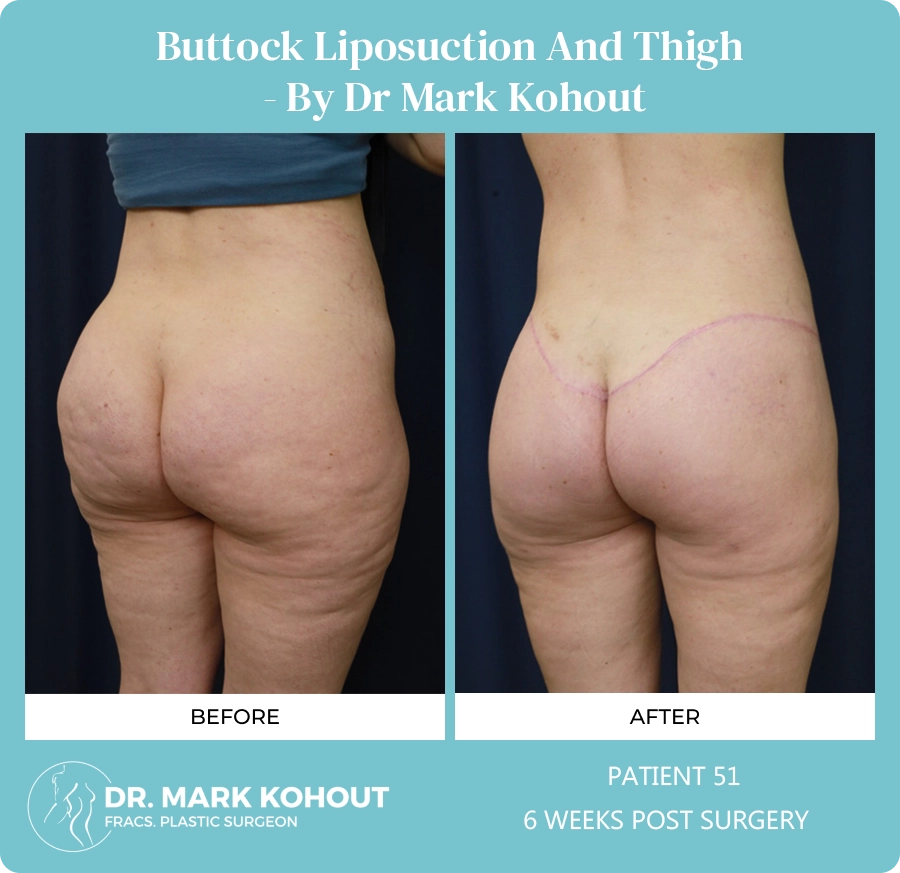
Buttock Liposuction Before and After Images
What Happens During a Consultation with Dr Mark Kohout?
A consultation includes assessment of skin laxity, existing volume, donor-fat availability and overall body proportions. It also provides time to discuss whether a lift, fat transfer or combined operation may be suitable.
Dr Mark Kohout reviews medical history, medications, previous surgery, weight changes, nicotine use and regular physical activities. He also explains the likely scars, limitations, procedure-specific risks and expected recovery requirements.
The consultation may include:
- Physical examination of the buttocks and donor areas
- Review of health and surgical history
- Discussion of the specific change being considered
- Comparison of available surgical options
- Explanation of risks and postoperative care
What Should I Expect After a Buttock Lift with Fat Transfer?
Recovery may involve swelling, bruising, discomfort and temporary changes to sitting or sleeping positions. Activity restrictions depend on the extent of the lift, the donor areas and the amount of fat transferred.
Patients receive individual instructions about wound care, garments, medication, movement and follow-up appointments. Healing rates vary, so recovery timeframes should be treated as general estimates rather than fixed promises.
Recovery planning may involve:
- Assistance at home during early healing
- Modified sitting positions
- Care of the lift and liposuction incisions
- Temporary limits on driving and exercise
- Scheduled reviews with the clinical team
Buttock Lift with Fat Transfer FAQs
Can I use fat from previous liposuction stored at another clinic?
Fat used in fat transfer must be freshly harvested and processed during the same procedure. Stored or previously removed fat is not suitable for safe or predictable use.Will the fat feel different once transferred to the buttock area?
In most cases, once healed, the transferred fat feels similar to surrounding tissue. Some individuals may notice a soft or slightly firm texture initially, which tends to settle over time.What happens to the fat that doesn’t ‘take’?
Some fat may not survive the transfer process and is naturally reabsorbed by the body. This is considered during planning, and a percentage is often added to account for this expected change.Can the transferred fat grow if I gain weight?
Yes, the transferred fat can behave like other fat cells in your body, so it may increase in size if there is significant weight gain after surgery.Is there a risk the fat can move to a different area over time?
Proper technique and careful placement help minimise movement. Once the fat has integrated, it generally stays in place, although changes in body composition can affect overall shape.How long should I avoid sitting directly on my buttocks after the procedure?
Sitting restrictions vary according to the lift, the amount and location of fat transferred, and individual healing. Patients should follow the specific pressure-avoidance and sitting instructions provided by their surgeon.Can this procedure be repeated in future if I want more volume?
Yes, some individuals choose to undergo a second stage of fat transfer if they wish to support additional volume later on, depending on fat availability and surgical considerations.Will I notice asymmetry if more fat ‘takes’ on one side?
Slight differences between sides are normal. Dr Kohout takes steps to support even distribution, but the healing process can vary slightly from one side to the other.Can I combine this procedure with body contouring in other areas?
It is possible to address multiple areas in one procedure, depending on safety, operative time, and your overall health. This is discussed during consultation.Is the change noticeable in clothing right away?
Initial swelling can make the area appear more prominent in the short term. As healing progresses, the final shape becomes more settled and may change how clothing fits.Medical References
- Safety Considerations of Fat Grafting in Buttock Augmentation. Rebecca C. O’Neill, Summer E. Hanson, Edward Reece & Sebastian Winocour. Aesthetic Surgery Journal (2021). https://academic.oup.com/asj/article/41/Supplement_1/S25/6277486
- Augmented Safety Profile of Ultrasound-Guided Gluteal Fat Transfer: Retrospective Study With 1815 Patients. Natalia Vidal-Laureano et al. Aesthetic Surgery Journal (2024). https://doi.org/10.1093/asj/sjad377
What Should I Consider Before Choosing Combined Surgery?
The decision should account for the possible physical change, scars, recovery demands and procedure-specific risks. Combining operations may address more than one concern, but it also increases the extent of surgery.
Patients should have realistic expectations about fat retention and understand that skin position and volume can continue to change. Taking time to review the proposed plan or seek another qualified opinion can support informed consent.
Questions to consider include:
- Am I mainly concerned about skin, volume or both?
- Do I have enough donor fat?
- Am I prepared for the recovery restrictions?
- Do I understand the major risks?
- Have I considered the possibility of further surgery?
What Are the Next Steps for Those Considering Buttock Surgery?
People considering a buttock lift, fat transfer or a combined procedure can arrange a consultation to discuss their anatomy and available options. Individual assessment is required to determine whether surgery may be appropriate and which approach may address the identified concerns.
Dr Mark Kohout provides consultations in Sydney for patients considering buttock surgery. The appointment provides an opportunity to review the likely scars, risks, limitations and recovery requirements before making a decision.
- Arrange an individual consultation
- Explain whether the concern involves skin, volume or both
- Review donor-fat availability
- Ask about risks, scars and recovery
- Allow time to consider the proposed buttock reshaping plan
Explore factors commonly discussed when considering buttock surgery. This quiz does not determine medical suitability.
Further Reading
- Read Dr Mark Kohout’s Procedure Page on Body Lift Surgery
- Read Dr Mark Kohout’s Blog about Exploring Options for Changing Buttock Shape Without Fat Transfer
- Read Dr Mark Kohout’s Blog about Why Your Buttocks Look Flat Despite Exercise
- Read Dr Mark Kohout’s Blog about Preparing for Buttock Reshaping Surgery: A Practical Pre-Op Checklist
Related Blog Posts
What Is Empty Buttock Syndrome? Causes,…
Volume changes in the buttocks are sometimes described as “Empty Buttock Syndrome,” a non-medical term used to explain a noticeable reduction in shape or projection following certain procedures or significant…
Gluteal Augmentation With Implants in Sydney:…
Interest in fuller, more projected buttock shapes has grown steadily, encouraged in part by social media and online imagery. Many people in Sydney arrive at a consultation with screenshots, mixed…
FAQs About Bodylift Surgery
Dr Mark Kohout, Plastic Surgeon in Sydney, brings over 25 years of experience in aesthetic and reconstructive surgery. His practice is known for its patient-focused approach and thorough consultation process.…
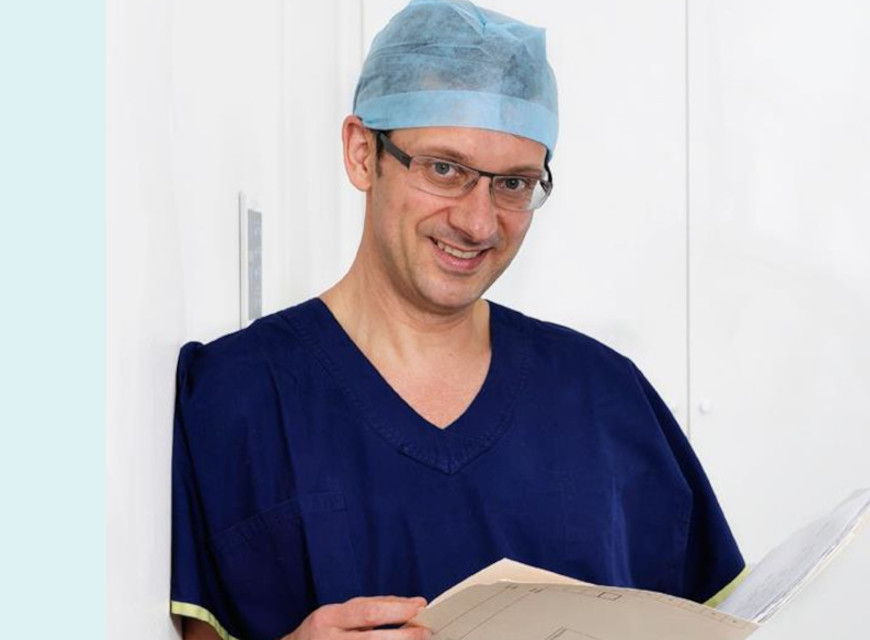
Experienced Plastic Surgeon
Dr. Mark Kohout
A qualified plastic surgeon who operates with care and integrity, based in central Sydney with over 20 years of experience in the cosmetic field. His extensive training and experience assures patients they are in highly trained surgical hands. Dr. Kohout is a dedicated, friendly professional who is committed to providing the high quality care, support and results, alongside his compassionate team.
Dr Mark Kohout (MED0001133000)
Specialist Plastic Surgeon
Specialist registration in Surgery – Plastic Surgery